This piece was originally published by Policy magazine on January 18, 2026.
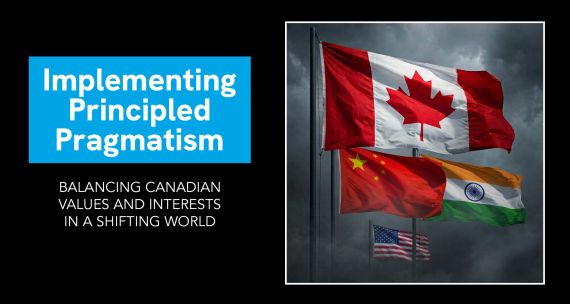
Prime Minister Mark Carney’s visit to China will stand as one of the most consequential moments in Canada’s foreign policy. It not only reframed Canada’s relationship with China but also signalled a fundamentally new approach to how Ottawa intends to navigate a more fragmented, contested and uncertain world.
On the bilateral front, the trip produced three tangible outcomes: a new strategic partnership framework, a roadmap for economic and trade cooperation, and provisional progress on two of the most politically sensitive trade files in the relationship—electric vehicles and canola.
Taken on their own, these outcomes would already make the trip significant. But to understand what Mr. Carney was trying to achieve in Beijing—and why the outcomes and symbolism of the visit matter so much—we need to situate it within his broader effort to fundamentally rewire Canadian foreign policy and Canada’s place in the world.
This was not simply about stabilizing relations with China. It was about signalling, and beginning to implement, a more independent Canadian foreign policy in response to fundamental shifts in the global economic and security order—and a growing recognition that Canada can no longer rely on old assumptions about alliances, global rules, predictability, or insulation from geopolitical shock, including in its relationship with the United States.
A world that has ‘ruptured’
In his press briefing in Beijing, Carney emphasized that Canada must “see the world as it is, not as we wish it to be.” He reiterated the observation made in his speech to the Council on Foreign Relations last September that the world is undergoing a rupture rather than a gradual transition, which is true in terms of the stunning geopolitical impact of Trump’s second term, but also belies a systemic evolution that has unfolded over the past two decades. Multilateral institutions are now weaker, technological and energy transformations are accelerating, and economic relations are increasingly shaped by power rather than rules.
This framing matters. Carney was not merely defending engagement with China; he was articulating the intellectual foundation for a broader rewiring of Canadian foreign policy. The implication is that Canada can no longer rely on inherited assumptions about its benign interdependence with the United States. Instead, Canada must re-tool its economic posture for a world in which “friend-shoring” is partial, supply chains are weaponized, and economic coercion is increasingly normalized. In such a world, market access is no longer a passive benefit of globalization, but a strategic instrument that must be diversified, protected, and actively managed.
For a country as trade-dependent as Canada, this shift is consequential. The United States remains Canada’s most important relationship, but it has become more transactional, more unreliable, and more willing to weaponize market access—even toward allies. China, meanwhile, has a clear track record of deploying economic coercion against Canada and others, using trade dependence to extract political compliance. Carney’s China trip is best understood as part of a broader effort to adapt Canada’s economic and foreign-policy posture to these realities, rather than continue operating as if the old order still applies.
The strategic partnership—and its limits
The most striking outcome of the visit was the announcement of a new strategic partnership between Canada and China. The term is politically charged and carries significant historical baggage. Canada last designated its relationship with China a strategic partnership in 2005, under very different global, economic, and political conditions. It is therefore unsurprising that the announcement has generated confusion—some interpreting it as a return to the pre-2018 model of engagement centred on expanding economic ties, others questioning how China could move, in a matter of months, from being described by the prime minister as a major security challenge to being labelled a strategic partner.
This new strategic partnership is best understood as Prime Minister Carney’s concept of “variable geometry” of engagement. Under this logic, strategic partnerships in the current era do not necessarily signal alignment, shared values, or comprehensive cooperation. Instead, they can function as pragmatic, interest-based frameworks for selective engagement—defined by clear limits and guardrails. They reflect a world in which countries engage differently with different partners, across different sectors, with clear limits—and where cooperation in one domain does not imply trust, convergence, or alignment in others.
Seen through this lens, the partnership with China is not a return to the expansive engagement of the early 2000s. It is an attempt to define a structured framework for cooperation in clearly identified areas, while maintaining distance elsewhere. Carney framed the partnership explicitly around working together “where we are aligned,” namely five pillars: clean energy and climate competitiveness; expanded trade, particularly in agriculture and energy; multilateral cooperation; public safety and security; and people-to-people ties. These pillars are revealing precisely because of what they include—and what they exclude. There is no reference to sensitive sectors such as artificial intelligence, advanced technologies, defence, or intelligence cooperation.
Equally important, the visit revived long-dormant mechanisms of engagement—ministerial dialogues, working groups, and sectoral cooperation—designed to manage interaction and reduce friction, not to signal trust or strategic convergence. From Ottawa’s perspective, this is about rebuilding channels to cooperate where mutually beneficial, and to contain disputes—not about redefining China as a trusted partner.
The risks: dependence and misinterpretation
This approach, however, only works if there is sustained strategic clarity—at home and with Beijing. Canada has historically used the language of strategic partnership sparingly, and typically with countries with which it shares values and broad alignment. Applying it to China therefore represents a significant departure from past practice and will require disciplined, consistent communication.
One central risk is misinterpretation: that pragmatic, interest-based engagement is mistaken for a broader re-engagement with China, or for a softening of Canada’s assessment of the national and economic security challenges China poses. At the same time, there is a real risk that Beijing does not share Ottawa’s understanding of the partnership’s limits. If Canada views the framework as clearly defined around specific pillars while China interprets it as a pathway toward deeper economic integration or political accommodation, frictions will re-emerge quickly.
Strategic dependence remains a particular vulnerability. Canola is the clearest example. While restoring market access offers short-term relief, expanding reliance on the Chinese market without a serious diversification strategy would increase long-term risk. Reducing exposure will require both market diversification and movement up the value chain, rather than deeper dependence on the Chinese market.
Domestic politics further constrain Ottawa’s room to manoeuvre. Engagement without visible guardrails—on investment in sensitive sectors, cooperation in dual-use technologies, and protection against foreign interference, transnational repression and cyberthreats—will erode public trust. Trade-offs between sectors and regions, particularly between EV manufacturing and agriculture, will sharpen political resistance if Canadians are not persuaded that the benefits of engagement with China are real and clearly outweigh the risks.
Washington and the end of waiting
It is increasingly clear that the Canada–U.S. relationship will not revert to what it once was—defined by shared values, predictability, and broad alignment of interests. Canada can no longer afford to wait for clarity or reassurance (including on the future of CUSMA) that may never come. The choice Carney appears to be making is to prioritize Canadian interests and long-term resilience in the evolving world order, even if doing so introduces more friction or risks retaliation from President Trump.
Carney’s visit to China did not resolve the structural challenges Canada faces. But it did signal a willingness to confront them directly—and to begin rewiring Canada’s foreign policy for a world defined less by an alliance with the U.S. and more by power, leverage, and choice.
In doing so, Carney has positioned Canada among the first of Washington’s closest allies to move openly in this direction. While others continue to delay or hope for a return to a more familiar order, Canada is testing whether a pragmatic, interest-driven approach can provide a workable foundation for an independent Canadian foreign policy.