There was more optimism, fewer tariffs, and a different government when Canada launched its Indo-Pacific Strategy (IPS) on November 27, 2022, pledging C$2.3 billion over five years to power "a generational Canadian response" to "the rising influence of the Indo-Pacific region."
Four years in, the IPS has mostly delivered, helping to cast Canada as a more serious, committed partner in the region, with trade, defence and security, and diplomacy emerging as priorities. Since November 2022, Canada has signed a trade agreement with Indonesia, finished negotiations with the Philippines, substantially concluded talks with the Association of Southeast Asian Nations (ASEAN), and is on the cusp of wrapping a deal with India.
Defence relations with Japan, the Philippines, and South Korea, in particular, have blossomed, and, thanks to the IPS, three Royal Canadian Navy vessels are dispatched to the Indo-Pacific every year.
Export Development Canada has opened new offices in Bangkok, Ho Chi Minh City, Jakarta, Manila, Seoul, and Tokyo, while, just this week, Ottawa expanded the presence of both FinDev Canada and Export Development Canada in Singapore. Seventy additional diplomats have been posted across the region, including an inaugural Indo-Pacific Trade Representative, a Senior Military Representative to the Indo-Pacific, and a Special Envoy for the Indo-Pacific.
But foreign policy aspirations sometimes clash with domestic realities. Recent budget cuts for Global Affairs Canada, for example, may hamper Ottawa's ability to further implement its vision.
A world away
The release in 2016 of Japan's "Free and Open Indo-Pacific" concept heralded a number of other Indo-Pacific strategies in the years to follow, with countries as far away as Ireland, Lithuania, and Czechia clamouring to publish plans of their own, spurred by the region's economic opportunities and a recognition of the so-called ‘China challenge.’
Although Canada's IPS is just four years old, in 'strategy years' — much like dog years — it feels older. In 2022, Justin Trudeau was prime minister; Joe Biden was president. The month before the strategy's release, Ottawa formally removed all travel-related COVID-19 measures. And three days after the release of the IPS, OpenAI unveiled ChatGPT.
The geopolitical environment has changed dramatically, too. In 2022, Canada labelled China "an increasingly disruptive global power" and joined a diplomatic boycott of China's Winter Olympics. This year, Canada minted a wide-ranging Strategic Partnership with the same country. Canada–India ties, meanwhile, have gone from good to bad to ugly (to good again).
To respond to these twists and turns, last month, the Standing Committee on Foreign Affairs and International Development recommended that the government publish an updated IPS in 2027.
The shapeshifting nature of regional diplomacy may be part of the reason for Ottawa's 'new' approach to foreign policy formulation: in December, Canadian Prime Minister Mark Carney is expected to introduce a foreign policy review, pointing towards a generalized approach to international affairs and possibly doing away with regional strategies.
Canada's last foreign policy document — released in 2005 and entitled "A Role of Pride and Influence in the World" — reflected the tenor of the times, aiming to make a "real difference in halting and preventing conflict and improving human welfare around the world." Carney's forthcoming review will likely put more emphasis on diversifying trade and investment and building a dense web of issue-specific coalitions, while "seeing the world as it is," rather than as it once was (or should be).
By the numbers
Trade has played a key part in Canada's Indo-Pacific engagement. Since 2022, Team Canada Trade Missions have touched down in Australia, Cambodia, India, Indonesia, Japan, Malaysia, the Philippines, Singapore, South Korea, Thailand, and Vietnam. Last week, Carney teased a trade mission to China in 2027.
Ottawa's drive is reflected in the data. Comparing September 2021–August 2022 with September 2025–August 2026, Canada's merchandise trade has grown considerably with Singapore (73.6%), Indonesia (36.1%), South Korea (29.3%), and India (27.1%). Canada has made smaller, but still significant, gains with Japan (10.9%) and China (7.1%).
Trade with Taiwan, meanwhile, has contracted 15.6 per cent. Over the same timeframe, Canada–U.S. trade has ticked up just 2.3 per cent.
Investment has underperformed. APF Canada's Investment Monitor data shows that, in 2025, two-way foreign direct investment (FDI) flows between Canada and the Indo-Pacific fell to their lowest level in the past two decades, declining to just C$17.8 billion — a 68.7 per cent drop compared to C$56.9 billion in 2021.
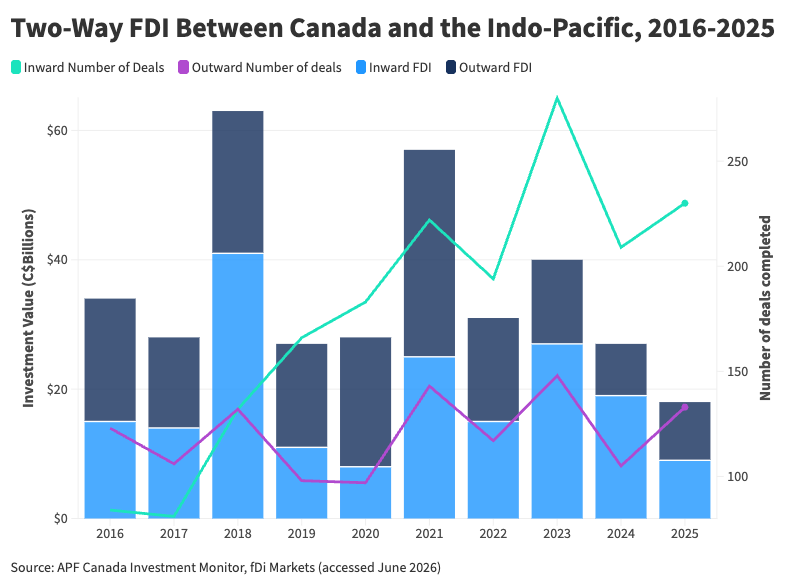
The decline in two-way FDI reflects broader global investment trends, according to our Investment Monitor team. Increased policy uncertainty has been one of the driving factors behind this overall slowdown, with some estimates suggesting that it contributed to a 5.3 per cent decline in foreign investment into Canada.