A fresh survey on Canada–China relations, promising new trade data, and a high-level economic dialogue this week helped define the evolving, occasionally complicated relationship between Ottawa and Beijing, as the two countries implement a wide-ranging Strategic Partnership while handling differences.
An exclusive new survey of 1,609 Canadians by Angus Reid Institute, commissioned by APF Canada, suggests a slight warming towards China, with 38 per cent of respondents holding a favourable view of the country, inching up from the historic low recorded in 2021.
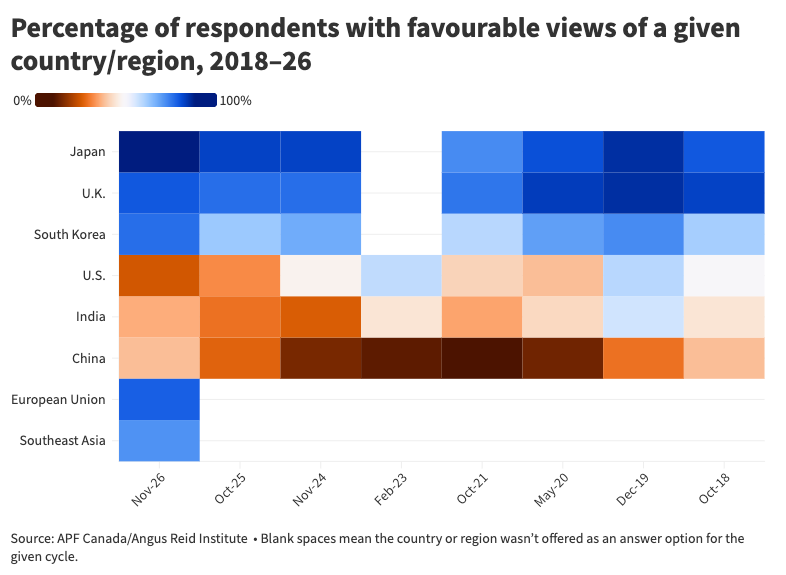
Concerns over foreign interference, however, persist. In the same poll, 71 per cent of respondents said they believe Beijing's foreign interference in Canada has either increased or stayed the same over the past five years.
A recent report by Safeguard Defenders, a Spanish non-governmental human rights organization, claimed that Beijing operates 1,247 illegal police stations across the world — 18 of them in Canada. Public Safety Minister Gary Anandasangaree said Ottawa would investigate the allegations.
Canada's foreign interference commission found in 2025 that China was "the most active perpetrator of foreign interference targeting Canada’s democratic institutions."
The Canada–U.S. trade dispute seems to have added urgency to Canada's ties with China: 59 per cent of respondents agreed that Canada "needs to focus more on its economic relationship" with China, up from 36 per cent in 2023 and 50 per cent in 2025.
Making hay while the sun shines
Exporters are already acting on this desire for deeper economic ties. In September, Canadian goods exports to China hit C$4.36 billion — the highest-ever monthly total.
That figure is larger than Canada's September goods exports to Belgium, France, Germany, Italy, the Netherlands, Norway, Spain, and Switzerland combined.
This banner month builds on a broader trend. From January–September 2026, Canada's merchandise exports to China totalled C$32.92 billion, increasing a whopping 40.2 per cent compared to the same period in 2025. Energy products accounted for 36.4 per cent of exports, up from 27.5 per cent last year.
The data highlights the impact of a deal negotiated in January (recently extended until the end of 2028) suspending Chinese tariffs on Canadian canola meal, peas, lobster, and crabs: from January–September 2026, Canadian exports of farm, fishing, and intermediate food products increased by 30.6 per cent to C$5.40 billion.
This boon may lend credence to Ottawa's aim of increasing exports to China by 50 per cent over the next four years.
It was a different picture on the receiving end: Canadian imports of Chinese goods ticked up just one per cent, landing at C$68.83 billion. Bilateral trade in services remained essentially static in the first half of 2026, totalling C$6.95 billion — a 0.8 per cent increase year-over-year.
At the table, off the menu
Senior officials on both sides are looking to unwind any lingering irritants. Canadian finance minister François-Philippe Champagne and international trade minister Maninder Sidhu met Chinese Vice-Premier He Lifeng in Vancouver, B.C., on Sunday and Monday for the Canada-China Economic and Financial Strategic Dialogue, the first such dialogue in eight years. Talks covered financial services, energy security, the green economy, and food security.
He Lifeng, for his part, said discussions touched on "extending the current tariff exemption measures" (presumably Canadian canola meal, peas, lobsters, and crabs) and "expanding the scope of tariff-exempt products" (presumably Canadian pork and canola oil, both of which are still subject to Chinese tariffs).
He added that the ministers discussed "quotas for electric vehicles" — a topic missing from the Canadian readout.
An editorial in a Chinese state media outlet welcomed the dialogue but warned Canada generally against discussing "differences over regional security in the Asia-Pacific and so-called 'human rights issues,'" presumably meaning Taiwan, Beijing's treatment of Uyghurs, and Hong Kong.
Days before the editorial, Canada — along with nine partners — released a statement criticizing the sentencing in Hong Kong of activist Joshua Wong, underscoring simmering Canada–China tensions over civil liberties.