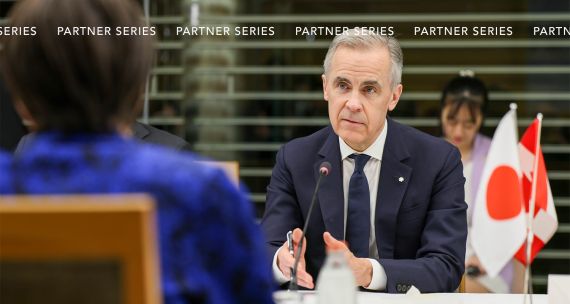
Prime Minister Mark Carney’s recent Davos speech articulates a fundamentally different way of understanding the global economy, with important implications for how Canada should approach trade diversification. In his account, the era in which economic integration could be assumed to be mutually beneficial, politically neutral, and peace-promoting is ending. Economic interdependence, once treated primarily as a source of efficiency and shared prosperity, has become conditional, politicized, and increasingly used as an instrument of power. This shift calls not for incremental policy adjustment, but for a rethinking of trade diversification itself.
Canada’s traditional trade diversification strategy was shaped by the assumptions of rules-based globalization. It emphasized expanding exports beyond the United States, signing trade agreements with countries outside of North America, and allowing firms to organize production according to comparative advantage. Trade diversification was largely treated as a technocratic exercise, grounded in the belief that deeper and more diversified interdependence would automatically enhance stability and prosperity.
Carney argues that this foundation no longer holds. Major economic powers, including but not limited to the U.S. and China, are now willing to weaponize interdependence, deploying tariffs, standards, sanctions, and regulatory controls as tools of coercion and discipline. In this environment, global value chains—especially in strategic sectors—are no longer neutral, efficiency‑maximizing business systems but contested spaces shaped by state intervention in pursuit of economic security, resilience, and geopolitical objectives. For middle powers like Canada, the assumption that deeper trade integration automatically delivers security runs the risk of generating new forms of vulnerability.
This Policy Brief argues that, under these new geoeconomic conditions, trade diversification can no longer be reduced to extra‑U.S. export growth or trade‑agreement counting. Nor can diversification away from the U.S. be treated as inherently beneficial in all cases. While reducing excessive dependence on our southern neighbour can enhance resilience, diversification that ignores geopolitical structure, sectoral sensitivities, and value‑chain positioning may simply replace one form of vulnerability with another.
The central questions are therefore not how concentrated Canada’s exports are to different regions, but how Canada is positioned within global value chains, where critical dependencies lie, and which forms of interdependence are politically and strategically tolerable. As Prime Minister Carney emphasizes, trade diversification is not only an economic objective; it underpins strategic autonomy and the ability of middle powers to act without fear of retaliation.
Trade diversification must therefore be reframed as a strategic national undertaking for Ottawa — a tool of statecraft — not a technocratic exercise. This involves positioning Canada within trusted value chains, explicitly distinguishing between strategic and non-strategic sectors, and moving from a logic of simple export expansion toward one of managed interdependence. The goal is not disengagement from globalization but shaping the terms under which Canada’s integration into the global economy occurs.
Building on this reframing, the brief proposes three shifts in Canada’s trade diversification strategy: moving from non‑U.S. export expansion to strategic positioning within global value chains; adopting a sector-selective approach that recognizes distinct political and security logics across and within industries; and replacing autonomy‑seeking with managed interdependence among trusted partners. To operationalize these shifts, it advances a five‑P framework: Pursue trade integration in non-strategic sectors; Protect against chokepoints and Promote domestic strongpoints in strategic value chains; Partner with allies; and Pinpoint emerging risks. Together, these steps reposition trade diversification as a risk management tool to develop resilience, economic security, and strategic agency.
The limits of the current trade diversification paradigm
Canada’s existing approach to trade diversification reflects the assumptions of an earlier phase of globalization. Historically, Canada’s trade diversification policy pursued three objectives: reducing dependence on the U.S. market by expanding extra‑continental exports; improving access to non‑U.S. markets through trade agreements; and encouraging firms to diversify suppliers and customers where resilience appeared insufficient. This approach rested on a market-centred logic that treated international business as largely politically neutral and assumed that firms retained primary autonomy over how cross-border production was organized.
These assumptions have weakened considerably. Export controls, investment screening, due‑diligence obligations, tariffs and “foreign entity of concern” rules are now used to directly shape where firms can source, with whom they can partner, which technologies they can deploy, and which markets they can serve. Under such conditions, trade diversification strategies that ignore geopolitical structure risk reproducing or even amplifying vulnerability rather than mitigating it.
This disconnect is especially visible in strategic sectors such as advanced manufacturing and clean technologies. Firms in these industries may be encouraged to diversify toward Asia only to encounter technology‑transfer restrictions, barriers to accessing critical inputs, or political limits imposed by the U.S., China or other large economies that render otherwise efficient partners untenable. In such contexts, trade diversification pursued solely through export facilitation can increase exposure to regulatory risk, policy reversal, or coercive pressure.
Shift One: From export expansion to strategic value‑chain positioning
Policy implication: Trade diversification should be evaluated by Canada’s position within global value chains, not simply by export volumes or market breadth.
Rather than treating non-U.S. export growth as an end in itself, diversification policy should focus on how Canada is embedded across value chains as both a supplier and a buyer, particularly in strategic industries. Strategic positioning requires identifying value‑chain segments where Canada’s resource endowments, regulatory credibility, and political alignment confer durable advantage, while actively managing dependencies on critical imported inputs, technologies, and buyers.
A clear illustration is critical minerals. Trade diversification should not be understood simply as exporting raw lithium, nickel, or rare earths to more destinations. It must also address Canada’s dependence on foreign processing, refining, and downstream technologies. Strategic diversification, therefore, involves strengthening midstream processing and refining, developing difficult‑to‑substitute activities such as traceability and standards-compliant production, and securing reliable access to especially allied inputs and know-how to ensure that it is less likely to face interdependence weaponization. In this framing, diversification becomes as much about managing inbound interdependence as outbound trade.
Shift Two: From broad‑based to sector‑selective diversification
Policy implication: Trade diversification should be designed differently in strategic versus non‑strategic sectors—and often differently across segments within the same sector.
The global economy is increasingly bifurcated between non-strategic sectors, which continue to operate largely under market logic, and strategic sectors, where reliance on foreign suppliers is considered too consequential to be left to markets alone. In these latter sectors, economic activity is increasingly shaped by state intervention, security considerations, and industrial policy. Strategic industries include dual-use technologies, semiconductors, electric-vehicle batteries, critical minerals, pharmaceuticals, and cloud computing. Importantly, this distinction often applies within sectors: while some value-chain segments remain commercially workable, others raise national or economic security concerns.
Strategic sectors are those in which interdependence itself creates vulnerability. Control over chokepoints, supply continuity, or key firms can be weaponized, producing risks to societal welfare and national security that markets alone cannot efficiently manage. In response, governments deliberately depart from efficiency-driven logic, accepting higher costs, redundancy, and more selective partnering as necessary trade-offs to reduce coercive leverage and secure resilience and trust.
Defence industries and energy‑transition technologies illustrate this logic clearly. Clean energy and EV‑related value chains, minerals processing, advanced battery chemistries, grid technologies, and digitally-enabled control systems are more likely to be strategic as leading economic powers can leverage access to these value chain stages for their own geopolitical advantage. By contrast, downstream deployment, installation, and some services may allow for broader international engagement under appropriate safeguards.
Shift Three: From autonomy‑seeking to managed interdependence
Policy implication: The objective of trade diversification should not be autarkic independence, but strategic autonomy through managed interdependence.
For a middle power such as Canada, full economic autonomy is neither realistic nor desirable. The more attainable goal is to shape interdependence in strategic sectors and value chain stages in ways that reduce vulnerability to foreign coercion, preserve policy flexibility, and strengthen bargaining power, particularly through co-ordination with trusted partners.
Implications for policy design in Ottawa: Operationalizing the ‘Five Ps’
Operationalizing these shifts requires a coherent framework for governing interdependence—one that also clarifies how Canada should engage major Asian economies, including China, in light of Prime Minister Carney’s recent visit to Asia’s largest economy.
Pursue (where markets still govern)
Canada should continue pursuing trade expansion and integration in non‑strategic sectors, including with large countries like China. In these sectors, economic security concerns are very small, even if foreign governments may at times take protectionist trade policy actions. In this regard, our country’s focus should especially be on growing trade with the Indo‑Pacific region, where economic growth remains superior and the commercial logic stays dominant.
Protect (where states intervene)
In strategic sectors, diversification must explicitly identify and address chokepoints that can be leveraged for coercion. This includes reducing both import and export exposure to single‑country processing hubs or strategic value chain stages that can be leveraged for coercion, especially when dealing with countries known to have weaponized interdependence.
Promote (domestic strongpoints)
Diversification should reinforce Canadian capabilities in strategic value‑chain segments where reliability, standards compliance, and political alignment confer advantage, anchoring Canada as an indispensable partner in strategic sectors. Identifying these domestic strategic strongpoints, such as in critical minerals, should occur at the value chain stage level and not at the industry level.
Partner (to co‑manage interdependence)
Managed interdependence requires co-ordination with trusted partners. In strategic sectors, diversification toward Asia should emphasize depth of alignment with our international partners over breadth of market reach.
Pinpoint (emerging risks)
Finally, Ottawa must invest in state capacity to continuously map dependencies, assess substitutability, and anticipate geopolitical or technological shifts that can generate new economic security risks in the future.
How does China fit in this trade diversification strategy?
China fits into Canada’s diversification strategy neither as a partner to disengage from entirely nor as one to integrate with indiscriminately. Within a managed‑interdependence framework, engagement with China is most viable in non‑strategic or carefully delimited segments of strategic value chains—particularly where co-operation supports global decarbonization without worsening asymmetric dependence. Strategically sensitive nodes that could be weaponized by China, by contrast, should be anchored in trusted and allied value chains, even at the cost of reduced short‑term efficiency.
• Edited by Vina Nadjibulla, Vice-President Research& Strategy, AFP Canada