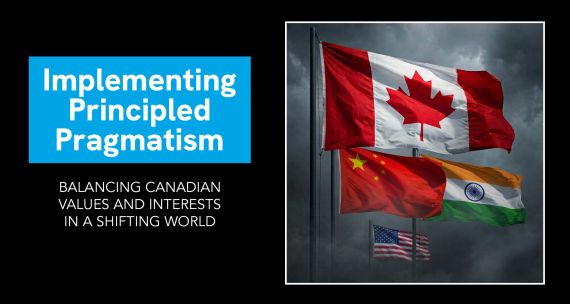
This strategic dialogue was convened on November 24, 2025, in New Delhi, India, by the Asia Pacific Foundation of Canada, in partnership with the Ananta Aspen Centre and the High Commission of Canada in India.
This Track 1.5 strategic dialogue took place at a pivotal moment in Canada–India relations. In the preceding months, the two countries had held several high-level meetings — including two meetings between Indian Prime Minister Narendra Modi and Canadian Prime Minister Mark Carney within six months — and announced a series of initiatives aimed at stabilizing and rebuilding the bilateral relationship. Together, these developments have created new momentum around trade, investment, technology, and economic security co-operation.
Key Takeaways from the Strategic Dialogue:
- Move from frameworks to projects. Canada–India co-operation on critical minerals will succeed only if it shifts from broad statements of intent to a small number of well-resourced, commercially viable pilot projects. Participants cautioned against over-reliance on new frameworks without clear delivery mechanisms.
- Co-operation on critical minerals should be framed as an economic security priority for both countries, linking clean energy, advanced manufacturing, and defence-adjacent technologies to long-term supply-chain resilience.
- Leverage complementarity and avoid duplication. Canada and India should avoid replicating China’s state-driven model. Instead, they should build a “market-plus” partnership combining Canadian upstream production and technology with Indian midstream processing, refining, and manufacturing capacity.
- Use state tools to crowd in private capital. Long timelines, price volatility, and technology risk require targeted interventions such as offtake-backed finance, sovereign equity participation, investment guarantees, and regulatory fast-tracking.
- Pick priority minerals and deliver early wins. Lithium, nickel, copper, and selected rare earths emerged as logical starting points based on demand outlook, existing capabilities, and policy tailwinds such as India’s tariff reforms.
- Institutionalize partnerships. The proposed Critical Minerals Annual Dialogue at PDAC 2026 should be paired with a standing working group focused on project identification, regulatory alignment, and financing solutions.
- Deepen subnational engagement. Provinces in Canada and states in India control key aspects of permitting, infrastructure, and industrial policy. Targeted province–state linkages can unlock practical co-operation faster than federal-only approaches.
- Invest in joint R&D and skills. Connecting Canadian universities and labs with Indian institutions such as Councils of Scientific & Industrial Research (CSIR) and Indian Rare Earths Limited (IREL) can accelerate innovation in extraction, processing, recycling, and ESG performance, while workforce development and training can strengthen long-term capacity.
- Strengthen investor confidence through an early conclusion of a Comprehensive Economic Partnership Agreement (CEPA). Investor protection and predictability — including dispute resolution and clearer rules — were seen as critical for unlocking institutional capital, including pension funds, and enabling sustained private-sector collaboration.