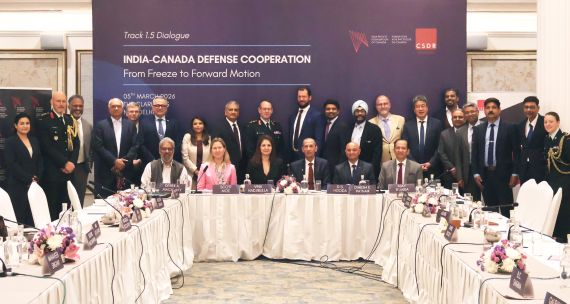
The Asia Pacific Foundation of Canada hosted a closed-door Strategic Roundtable, held under the Chatham House Rule, on February 5, 2026, on the margins of the Singapore Airshow in Singapore. The Future of Defence (Industrial) Co-operation: Singapore and Canada roundtable explored how Singapore and Canada can deepen defence industrial collaboration across dual-use technologies, innovation platforms, and more resilient supply chains.
The Asia Pacific Foundation of Canada convened a roundtable at the 2026 Singapore Airshow to examine opportunities for defence-industrial co-operation between Canada and Singapore. Participants at the event on February 5, 2026, included senior military officials, government representatives, industry associations, and private sector leaders.
The discussion highlighted three findings: bilateral co-operation remains limited relative to multilateral engagement; both countries face similar operational and industrial challenges; and progress will depend on focused, execution-oriented initiatives. This report summarizes key insights and recommendations.
Strategic Context
Canada’s defence and foreign policy is increasingly oriented toward flexible, issue-based partnerships with trusted partners. Recent policy signals, including Canada’s Defence Industrial Strategy, emphasize supply chain resilience, sovereign capability, and international collaboration in high-technology sectors.
Canada and Singapore’s bilateral relationship has deep roots. Both countries marked 60 years of diplomatic relations in 2025, building on Commonwealth ties and long-standing defence links, including a 1969 training agreement, a 1997 Memorandum of Understanding allowing Singapore’s air force to deploy aircraft, equipment and personnel to Canadian air bases for training, a 2022 Memorandum of Understanding on defence co-operation, and renewed cybersecurity collaboration in 2023.
Ongoing negotiations toward a General Security of Information Agreement (GSOIA) indicate a shift toward deeper industrial and information-sharing co-operation. See the Appendix for further details on existing agreements and their status.
Canada and Singapore are also responding to a common set of pressures: geopolitical uncertainty, supply chain vulnerability, and accelerating technological change. Canada is expanding defence investment and strengthening industrial capacity through a “build, partner, buy” approach. Singapore continues to modernize its armed forces while maintaining a strong emphasis on export-oriented defence industries.
These dynamics create a shared interest in practical, capability-driven co-operation. Despite these developments, bilateral defence-industrial collaboration remains limited.
The Imperative
Canada and Singapore have a new opportunity to develop defence-industrial partnerships that can deliver capabilities at scale.
Both countries are increasing defence spending, with Canada committing to five per cent of GDP in defence and security by 2035, and Singapore sustaining approximately three per cent of a fast-growing GDP on defence spending. Yet co-operation remains underdeveloped relative to existing commercial ties, a number of shared defence platforms, and complementary capabilities.
Middle powers need to diversify partnerships to reduce dependency and sustain industrial capacity. Domestic procurement alone is insufficient to support long-term industrial viability in either country.
Opportunity
Existing commercial activity—across aerospace, artificial intelligence, and defence technologies—demonstrates a foundation for expansion. Cohere, a Canadian AI firm, recently selected Singapore as its regional base; ST Engineering operates a number of Canadian subsidiaries including Kinetics Drive Solutions; Singaporean counter-drone firm TRD has provided capabilities to Canadian troops deployed in Latvia and ships deployed at sea; Bombardier operates a global maintenance, repair, and overhaul (MRO) facility in the region; and CAE has worked with the Republic of Singapore Air Force (RSAF) for more than 15 years.
The bilateral relationship offers clear, complementary advantages. Singapore provides access to Southeast Asian markets and serves as a regional benchmark for standards and capability development. For Singapore, Canada represents access to North American supply chains, and a growing domestic defence market with recent incremental investments exceeding C$80 billion.
The opportunity is practical and near-term but requires prioritization.
Current State of Co-operation
While Canada and Singapore engage regularly through multilateral forums and exercises such as the ASEAN Defence Ministers' Meeting Plus (ADMM-Plus) and the Rim of the Pacific Exercise (RIMPAC), direct defence-industrial collaboration is underdeveloped.
Commercial linkages exist but are not systematically leveraged. Firms from both countries operate in each other’s markets, yet these relationships have not translated into structured defence industrial (as opposed to civilian aerospace) partnerships. Two notable exceptions are the ST Engineering/Kinetics Drive Solutions acquisition and the recent Roshel agreement to manufacture ST Engineering’s ExtremV amphibious vehicle in Canada.
The relationship is therefore characterized by alignment without substantial integration.
Rationale for Co-operation
Three factors underpin the case for deeper collaboration.
1. Market access: Singapore provides Canadian firms access to Southeast Asia, while Canada offers Singapore entry into North American supply chains and a growing domestic defence market.
2. Industrial scale: Export competitiveness is essential for both countries. Collaboration enables firms to achieve scale, pursue joint opportunities, and strengthen global positioning.
3. Strategic resilience: Diversified partnerships enhance supply chain resilience and reduce reliance on single partners, particularly in a fragmented geopolitical environment.
Priority Areas for Collaboration
The roundtable emphasized focusing on a limited number of areas with clear operational relevance.
1. Upgrade the Formal agreement structure.
Conclude a Security of Information Agreement
Finalizing the GSOIA is essential to enable classified information sharing and industrial collaboration. Completion and announcement should be prioritized for 2026.
Flesh out the Defence Co-operation Agreement
The 2022 Singapore-Canada Defence Cooperation Agreement is not pubic. Make the text public and clarify the priorities and implementation timelines.
Export Controls
Canada and Singapore should align export controls to the associated commercial risks. Where it’s confirmed that defence goods and technology will not be re-exported (they will be used only by Canada or Singapore), consider removing all export controls.
2. Establish Institutional Linkages
Formal co-operation between the Aerospace Industries Association of Canada (AIAC) and the Association of Aerospace Industries Singapore (AAIS), supported by government participation, would provide continuity and reduce co-ordination costs. This institutional linkage provides stability, reduces transaction costs when leadership changes, and translates member needs into co-operation agendas, sustaining continuity. This MOU should include government representation from the Department of National Defence and Singapore's Ministry of Defence (MINDEF) and be completed before CANSEC 2026.
3. Focus on areas of shared strength and need
Aerospace and Maintenance, Repair, and Overhaul (MRO) Capabilities
Aerospace co-operation represents a natural starting point. Singapore's aviation ecosystem serves as a regional MRO hub, while Canada brings deep capabilities across platforms, components, and sustainment. Existing facilities in Singapore (CAE, Pratt & Whitney Canada, Bombardier) provide an operational base for expanded sustainment arrangements, mission system support, and related areas.
ST Engineering's aerospace division, with its regional MRO network and special mission aircraft modification capabilities, offers partnership opportunities for fleet sustainment and capability integration. ST Engineering's solutions also provide Canada an opportunity to diversify defence procurement relationships, particularly relevant given that approximately 70 per cent of Canadian defence capital expenditure currently flows to the United States.
The roundtable expressed interest in exploring longer-term co-operation on P-8 Poseidon maritime patrol aircraft operations and emerging areas such as electric vertical take-off and landing (eVTOL) aircraft and advanced air mobility.
All-Domain Awareness
All-domain awareness–the fusion of multiple sensor types, including space-based satellites, optical systems, radar, and sonar, to create a unified picture of activity from the seabed to space–is foundational to sovereignty and deterrence. Integrated systems connecting subsea, surface, air, and space sensing enable nations to maintain control over sovereign territory, protect critical infrastructure, and secure vital trade flows.
Collaboration opportunities exist particularly in the areas of satellites, earth observation, and data processing and transmission.
Cap Vista’s rapid procurement and accelerator mechanisms could offer significant opportunities to operationalize co-operation in these areas.
Artificial Intelligence and Cybersecurity
AI and cybersecurity represent enabling foundations that cut across domains. Defence-focused AI requires strong governance and secure deployment, especially for applications involving sensitive data requiring national control. Sovereign AI models and infrastructure with local data control emerged as a priority, alongside secure deployment platforms and incident response processes.
Canadian technology firms BlackBerry and Cohere were cited as examples of Canadian capability relevant to controlled government and defence environments. Both nations require government-grade security for communications and R&D to protect innovation in both peacetime competition and crisis.
Beyond technical capabilities, government and military officials emphasized the need to develop shared standards and norms around the use of AI in warfare. As nations field autonomous systems, establishing common ethical frameworks, operational rules of engagement, and accountability mechanisms for AI-enabled military capabilities will be essential for interoperability, allied alignment, and managing international expectations in multinational operations.
Critical Infrastructure Protection
Infrastructure protection specialists identified safeguarding essential systems, including communications networks, energy grids, and transportation hubs, as an area of common concern and vulnerability. The discussion focused on subsea cables, which carry over 95 per cent of international data traffic and face growing hybrid threat risks. Singapore's cable capacity expansion and protection initiatives offer collaboration opportunities in monitoring, detection, and redundancy. Specialists mentioned that technologies and systems like Transcelestial are highly relevant as high-throughput systems that offer resilience and redundancy.
Unmanned Systems and Counter-Drone Technology
Unmanned systems represent a rapidly evolving domain with innovation cycles measured in months, not years. Both Canada and Singapore face growing drone threats to critical infrastructure, military installations, and public events requiring integrated detection and neutralization capabilities.
Several Singapore firms (Icertos and TRD) have developed counter-drone capabilities informed by real-world deployments. The convergence of threat environments and the pace of technological change create strong incentives for collaboration.
Quantum Technologies
Research and technology specialists emphasized near-term quantum applications improving sensing and navigation resilience. Quantum sensors, such as those developed by Singaporean firm Atomionics, could accelerate critical mineral discovery, which is strategically relevant given Canada's mineral endowment and intensifying global competition. GPS-degraded and GPS-denied navigation and navigation when satellite systems are jammed or unavailable also emerged as operationally meaningful for contested environments and an area ripe for bilateral collaboration.
Simulation and Training
Simulation and training represent a high readiness co-operation area grounded in existing relationships and shared operational requirements. CAE's 15-year partnership with Singapore demonstrates proven collaboration, while both nations plan to, or operate, common platforms including the A330 Multi-Role Tanker Transport, P-8A Poseidon maritime patrol aircraft, F-35, and others, creating natural opportunities for joint training development, synthetic environment integration, and mission rehearsal systems.
Joint development of mission-specific training packages, cross-national instructor exchanges, and shared synthetic environments for complex scenarios such as multi-domain operations or contested logistics will deliver near-term value while building the technical interoperability and institutional relationships necessary for deeper defence-industrial collaboration.
Cap Vista’s rapid procurement and accelerator mechanisms could offer significant opportunities to operationalize co-operation in these areas.
Critical Success Factors
Successful co-operation will depend on enabling conditions rather than strategic intent alone.
- Information sharing frameworks: Progress depends on resolving constraints related to classified information and export controls.
- Institutional mechanisms: Formal structures are needed to sustain collaboration over time.
- Procurement processes: Faster, more flexible acquisition models will be critical.
- Industry engagement: Partnerships must be driven by firms, supported by government frameworks.
- Clear demand signals: Industry requires predictable and sustained government commitment.
- Support for SMEs: Smaller firms require targeted support to participate in international markets.
- Human capital exchange: Training and secondments can build trust and interoperability at low cost.
Without focused execution in these areas, this partnership will remain aspirational. The strategic alignment exists, and commercial foundations exist. Success now depends on speed and commitment.
Recommendation and Timeline
Short Term (6–12 months)
- Conclude security and information-sharing agreements
- Identify and resource 1–2 priority co-operation areas
- Formalize AIAC–AAIS institutional partnership
- Expand industry engagement through CANSEC and related forums
Medium Term (12–36 months)
- Launch joint rapid-prototyping initiatives
- Expand co-operation into additional priority domains
- Establish a recurring bilateral industry forum
- Develop trusted supplier networks
Strategic Measures
- Align export control and technology transfer frameworks
- Strengthen co-ordination between defence and economic policy
- Develop shared governance approaches for emerging technologies
Conclusion
Defence-industrial co-operation between Canada and Singapore represents a strategic imperative, and a practical response, for two middle powers navigating shared vulnerability in an increasingly contested global environment. It is supported by strong strategic alignment, complementary capabilities, and increasing defence investment.
The current moment is defined by execution readiness: enabling agreements are underway, industry stakeholders are engaged, and procurement cycles are creating demand. The remaining challenge is implementation. Progress will depend on prioritization, institutionalization, and sustained political and industry commitment.
• Edited by Vina Nadjibulla, Vice-President Research & Strategy, and Jahafar Abdullah
Marketing and Communications Manager, Singapore Office.
Appendix: Canada-Singapore Defence Industrial Architecture and Agreements
Assessment of bilateral defence agreements across nine categories, organized in three tiers. Status as of early 2026.
| Category | Description | Status | Commentary |
| Tier 1: Political and Legal Foundation | |||
| 1. Strategic Framework & Governance | Umbrella defence co-operation arrangements, ministerial dialogues, joint steering committees, annual co-operation plans | Partial | 2022 Defence Cooperation Arrangement signed at Shangri-La Dialogue. Ministers meet annually at Shangri-La. However, no standing joint committee or annual co-operation plan is publicly documented. Limited publicly available information on scope of agreement. |
| 2. Legal Status & Access | Visiting forces agreements, basing and reciprocal access arrangements | Partial | 1969 training agreement provides legal framework for SAF personnel attending training in Canada. Not a reciprocal visiting forces or access arrangement. No bilateral basing or facilities access agreement. Canadian naval vessels conduct periodic port visits to Singapore as part of Indo-Pacific deployments and operate together during multinational exercises hosted in the region. |
| 3. Information & Intelligence Sharing | General security of information agreements, intelligence sharing, signals intelligence | In negotiation | GSOIA negotiations launched in 2023. No signing publicly confirmed as of early 2026. Canada has signed five GSOIAs since December 2024 (Ukraine, Poland, Latvia, Spain, Portugal) but Singapore is not yet among them. No known bilateral intelligence sharing arrangement. |
| Tier 2: Functional Co-operation | |||
| 4. Operational & Logistics Co-operation | Logistics support agreements, exercise frameworks, military cyber co-operation | Not in place, ad hoc | No formal logistics support agreement. Both navies participate in RIMPAC and occasional bilateral exercises, but no standing exercise framework. A logistics support agreement would have value for Operation PROJECTION and other deployments. |
| 5. Science, Technology & Industrial Co-operation | Defence R&D agreements, industrial co-operation, co-development and co-production | Not in place | No defence S&T agreement between DRDC and DSO/DSTA. No industrial co-operation framework. Strong complementarity exists (Canada in AI, underwater acoustics, Arctic; Singapore in urban warfare, sensors, unmanned systems). Singapore is not part of The Technical Cooperation Program (TTCP). Singapore’s structures currently enable Canadian firms to access some opportunities (Cap Vista), however, there is less reciprocity with Canadian innovation programming. |
| 6. Domain-Specific & Specialist Agency Co-operation | Hydrographic co-operation, maritime domain awareness, space situational awareness, humanitarian assistance and disaster relief | Not in place | No hydrographic, maritime domain awareness, or Humanitarian and Disaster Relief co-operation agreements. Civilian cybersecurity MOU (2018, renewed 2023) between CSA and Global Affairs Canada is the closest adjacent instrument but arguably sits outside the defence relationship. |
| Tier 3: Enabling Environment | |||
| 7. Regulatory & Market Access | Export control co-ordination, certification mutual recognition, procurement access, end-use monitoring | Not in place | No bilateral defence export control co-ordination or procurement market access agreement. Canada is a Wassenaar Arrangement member; Singapore is not. Singapore’s export controls broadly track Wassenaar standards, but this asymmetry could complicate defence trade. No mutual recognition of defence product certifications. |
| 8. Multilateral Standards & Interoperability | Technical standardisation, interoperability protocols, multilateral export control regime membership | Partial | Canada is bound by NATO standardization agreements; Singapore is not a NATO member or partner. Both participate in some common multilateral exercises (RIMPAC). Singapore’s US-origin equipment (F-15, F-16, AH-64) provides de facto interoperability with NATO-standard systems, but no formal standardization arrangement exists bilaterally. |
| 9. Institutional & People-to-People | Military education exchanges, cadet programs, industry association linkages, defence business councils | Partial | Singapore is a member of Canada’s Military Training and Cooperation Programme. No formal institutional partnership between Royal Military College and SAFTI Military Institute. No defence industry association MOU or bilateral defence business council. Commonwealth ties provide informal linkages but no formal instruments. |
*Note, this table is not designed to be an exhaustive listing of defence agreements (i.e. mutual defence, alliances etc.), rather it is designed to capture the core infrastructure necessary for productive defence industrial engagement and co-operation outside specific procurement opportunities.
• Edited by Vina Nadjibulla, Vice-President Research & Strategy, and Jahafar Abdullah, Marketing & Communications Manager, Singapore Office, APF Canada