Financiers responsible for C$100 trillion in assets gathered in Toronto this week for two days of dealmaking as Canada looks to supercharge investment over the next five years.
The summit’s prospectus detailed 167 projects, with several pitches tied to Asia. Among the costliest propositions was Ksi Lisims LNG (US$28.5 billion), a proposed floating LNG export terminal in northern British Columbia that would ship LNG to Asia.
On Monday, Santos, an Australian oil and gas company, struck a non-binding agreement to buy 1 million tonnes of LNG annually from Ksi Lisims for up to 20 years, beginning in 2031. The project’s three other announced offtakers — Shell, TotalEnergies, and SEFE — are European, but South Korea’s Samsung Heavy Industries will build the floating units.
The proposed 1,250-kilometre West Coast Oil Pipeline, which would transport Alberta crude to southern British Columbia for Asian buyers, was also listed in the prospectus, as were the US$2.97-billion Kami Iron Ore Mine in Newfoundland and Labrador (backed by partnerships with Japan-based Nippon Steel and Sojitz) and the Casino Project, an undeveloped copper-gold deposit and “major critical minerals opportunity” in the Yukon, for which Mitsubishi Materials is a strategic partner.
Farm Credit Canada also announced C$150 million for Velocity Agri-Capital Partners to “help strengthen Canada’s food system.” The company is seeking a further C$350 million from other investors. Arlene Dickinson, General Partner at Velocity Agri-Capital, said in a statement that “the fund will help [...] Canadian companies ready to export to Southeast Asia and attract foreign investment from Southeast Asian companies looking to domicile and build jobs here.”
Canada–Asia investment falls to two-decade low
New data from APF Canada shows that, despite Ottawa’s increased attention to Asia since its 2022 Indo-Pacific Strategy, Canada’s ambition in the region has yet to reach its full potential. Our annual Investment Monitor report, released Friday, found that total FDI flows between Canada and the Indo-Pacific region declined in 2025 for the second consecutive year, reaching their lowest level in two decades.
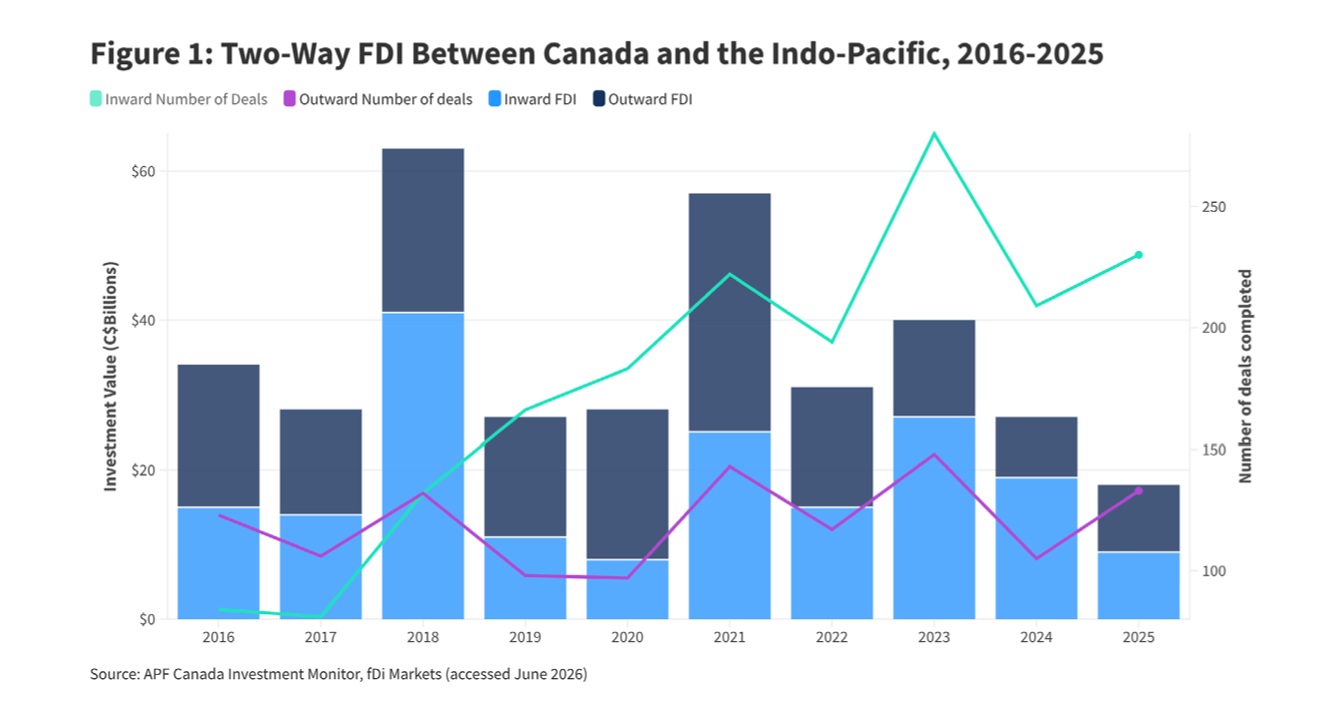
This decline stemmed from a 52 per cent drop in Indo-Pacific FDI in Canada, which fell from C$19.3 billion in 2024 to C$9.2 billion last year.
Canada’s investment in the region, in contrast, increased seven per cent, from just under C$8 billion in 2024 to C$8.6 billion in 2025, the first increase in Canadian FDI to the region in four years.
Canadian Prime Minister Mark Carney, in remarks on Sunday, noted that Ottawa is “shifting how we approach investment into Canada” and is revamping Invest in Canada, Canada’s FDI attraction and promotion agency.
Carney told The Globe and Mail that “there is a massive opportunity for Canada both in Europe and Asia. It’s safe to say we haven’t realized our potential in those markets.”
APF Canada President & CEO Jeff Nankivell told Asia Watch that “initiatives such as the Major Projects Office, Canada’s Global Innovation Clusters, and the Canada Critical Minerals Accelerator strengthen Canada’s investment proposition by demonstrating the government's commitment to advancing projects in strategic sectors.”
He added that free trade agreements, such as the Canada–Indonesia CEPA, and strategic agreements send positive signals to businesses at home and abroad. “But whether businesses will leverage these agreements and turn them into investments will depend on sustained focus and disciplined execution by Canadian governments on the relevant policy and regulatory changes,” Nankivell said.
Interest from the Indo-Pacific
Investors from Australia, Hong Kong, Japan, Malaysia, and Singapore attended the summit, including Dilhan Pillay, the CEO of Temasek, a state-owned investment firm that manages a C$568-billion portfolio. Carney met with Pillay on Monday.
Representatives from the China International Capital Corporation, an investment bank, and China Investment Corporation, a sovereign wealth fund with an estimated US$1.6 trillion in assets, were also present.
Canada–China two-way FDI declined from C$3.9 billion in 2024 to around C$1.5 billion in 2025; our Investment Monitor team attributed this decline to “a longer-term trend of weakening Chinese investment in Canada, driven in part by Canada’s more stringent investment screening regime for critical minerals and strategic sectors.” Notably, no Chinese companies were listed in the Investment Summit’s prospectus.