U.S. President Donald Trump resorted to threats and name-calling in his on-again, off-again trade war with Canada this week, adding urgency to Ottawa’s Indo-Pacific trade negotiations and delighting Beijing, for one, with more evidence of what it described as the “failure of U.S. policy.”
On Saturday, Canadian Prime Minister Mark Carney said that, after months of trade talks, the U.S. sought last-minute provisions, including “efforts to restrict [Canada’s] ability to have other trade deals,” leading Ottawa to reject the deal, walk away, and retaliate.
Washington has tried to insert these types of provisions into previous deals, including one with Malaysia in October 2025. The relevant article in that deal stated that if Malaysia signed a bilateral deal with a country that “jeopardizes essential U.S. interests,” the U.S. could terminate the agreement and reimpose tariffs on Malaysia. (In March 2026, following the U.S. Supreme Court’s striking down of IEEPA tariffs, Malaysia declared the deal “null and void.”)
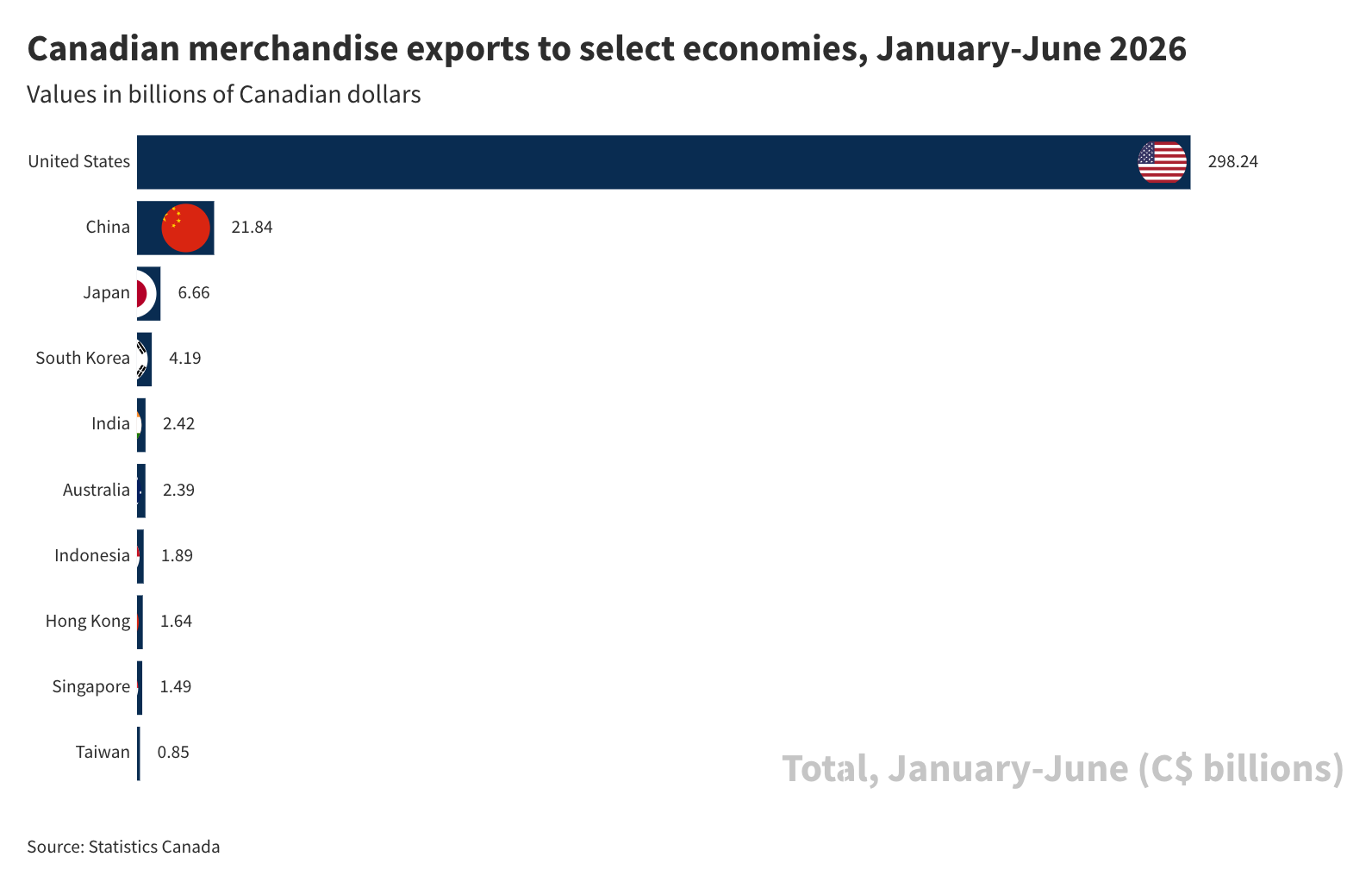
A 50 per cent U.S. tariff now applies to C$28 billion worth of a variety of Canadian goods, including milk, beer, wine, hockey skates, T-shirts, dog leashes, cement, and Christmas decorations.
APF Canada’s Asia Regional Director Barrett Bingley told Asia Watch that Canada–U.S. tensions “reinforce the importance of Canadian firms diversifying to the Indo-Pacific and increase the relevance of the CPTPP’s evolution and the implementation of the Canada–Indonesia CEPA. It also adds urgency to finalizing trade agreements with ASEAN, the Philippines, and Thailand.”
Bingley added that “the trade fight further cements the difference between Canada and the U.S. in the minds of Asian investors and policymakers, making Asian investments into Canada's energy and critical minerals projects that much more attractive.”
Trump’s salvos at Canada come just days after he abruptly reduced long-running military drills with South Korea and threatened to bomb Oman, an American ally mediating the U.S.–Iran conflict.
The art of the deals
Ottawa is looking to wrap up trade negotiations with ASEAN and India by the end of 2026. As of July, Canada and ASEAN had completed 19 of 26 chapters, but prickly topics remain, including rules of origin, government procurement, and sustainable development.
India appears closer to the finish line. Indian Prime Minister Narendra Modi is expected to visit Canada before the end of the year, and both sides want to finalize a deal before Modi’s arrival. A Canada–Taiwan trade co-operation framework agreement also awaits Ottawa’s signature.
Our South Asia Program Manager, Aditi Malhotra, told Asia Watch that Canada–U.S. trade tensions will push Canada toward “faster and more comprehensive economic agreements — ties with fast-growing markets outside North America are now a necessity rather than a hedge.”
Within South Asia, she says, India will remain the priority, but “Bangladesh may draw quieter interest as a manufacturing and textiles play.”
“Ottawa and its South Asian counterparts share the frustration with Washington's unpredictability,” Malhotra notes. “Next to a mercurial American administration, Ottawa is seen as a country that honours its commitments, and that matters even though Canada is neither the largest economy nor the biggest buyer.”
A nerve-wracking New Year’s Eve
U.S. Trade Representative Jamieson Greer said Canada’s actions amounted to “the kind of things that China would do.” (Chinese state media, in turn, applauded Canada for its “Chinese-styled counterattack.”)
Canada and China are the only two countries to impose tariffs on U.S. goods since Trump began his second term.
Following Carney’s visit to China in January 2026, Beijing agreed to suspend its anti-discrimination tariffs on Canadian canola meal, lobsters, crabs, and peas from March 1, 2026, until December 31, 2026.
Trump has complicated that timeline, announcing on Monday threats to increase tariffs on Canadian cars, trucks, automotive parts, and steel to 50 per cent on January 1, 2027 — just one day after China’s tariff pause is set to expire.
Carney is expected to travel to Shenzhen, China, for the APEC Economic Leaders’ Meeting in November and meet Chinese President Xi Jinping. The two leaders will likely attempt to extend the bilateral ‘trade truce,’ with Xi angling for expanded electric-vehicle access and Carney pushing for the removal of Chinese tariffs, among other goals.