New Delhi finds itself in a tricky position this weekend, hosting leaders from China, Russia, and Iran while trying not to jeopardize ties with the U.S., its largest market for goods and services and a key security partner.
The BRICS+ summit convenes in New Delhi on Saturday and Sunday for talks on trade, food security, and monetary co-operation. India will be wary of too much talk about ‘de-dollarization,’ a Russian priority that appeared in last year’s declaration as a call for “acceptable mechanisms of financing in local currencies.” U.S. President Donald Trump previously threatened 100 per cent tariffs over the bloc’s supposed efforts to replace “the mighty U.S. dollar.”
As C. Raja Mohan, our inaugural Indo-Pacific Visiting Scholar, wrote recently in Foreign Affairs, “India is trying to reduce its exposure to American volatility, but it still recognizes that Washington is its most important partner.” The theme for this year’s summit — “Building for Resilience, Innovation, Cooperation and Sustainability,” which doubles as a ‘backronym’ for BRICS — is as broad and inoffensive as possible, evidence of India’s moderating influence within the bloc.
Another BRIC in the wall
Brazil, Russia, India, and China formalized ‘BRIC’ in 2006, adding South Africa in 2010 to make ‘BRICS.’ In 2024, Egypt, Ethiopia, Iran, and the UAE became full members; Indonesia joined the bloc in 2025. Saudi Arabia was admitted but hasn’t formally accepted the invitation.
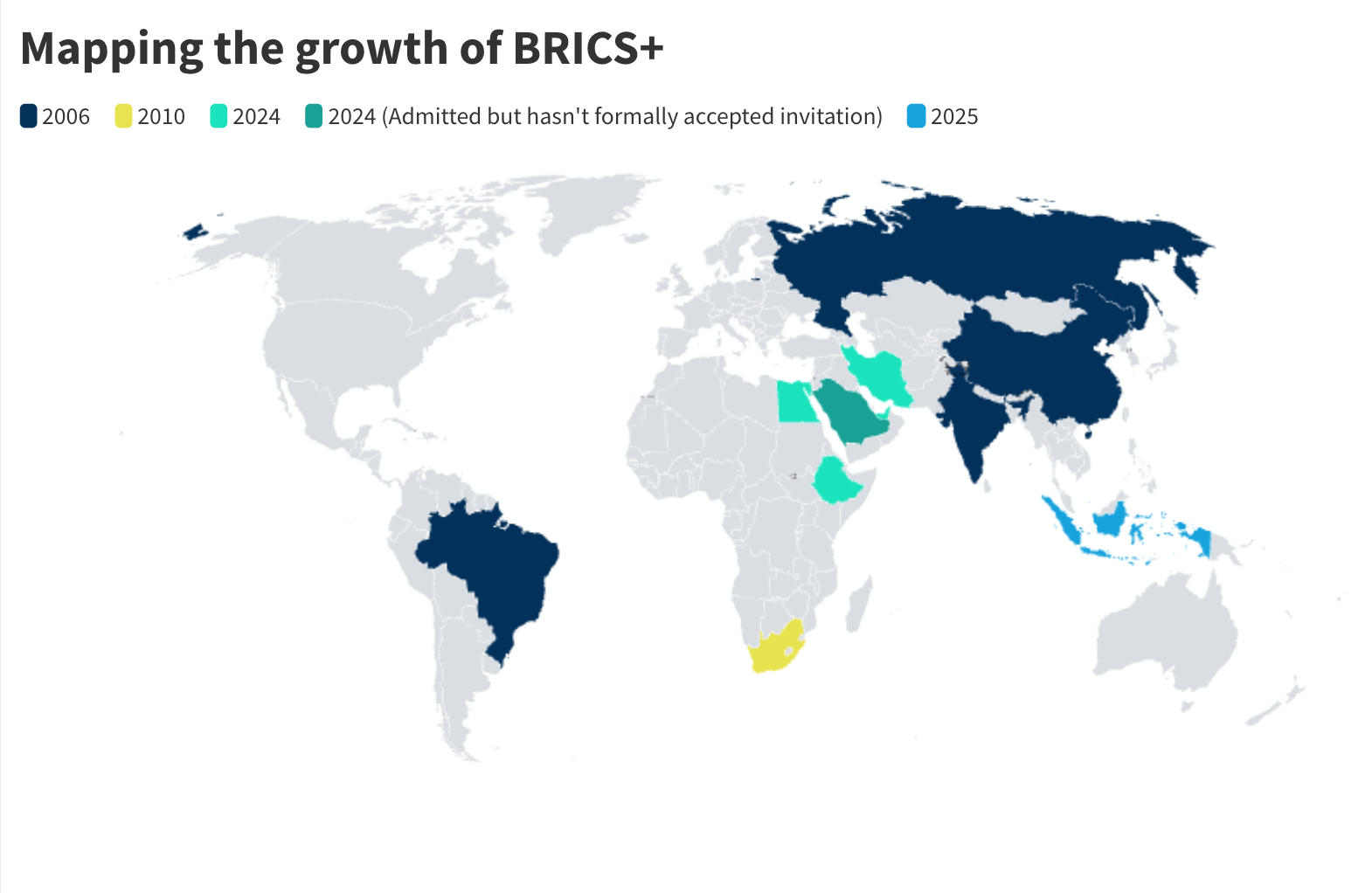
Trade between these 10 BRICS+ countries increased thirteenfold since 2003, but still only accounts for about five per cent of world trade. Merchandise exports from BRICS+ countries to the world increased from US$906 billion in 2003 to US$5.9 trillion in 2024.
Border talks
The summit likely won’t yield any concrete commitments. But a meeting between Indian Prime Minister Narendra Modi and Chinese President Xi Jinping could help boost the credibility of BRICS+ and further thaw China–India relations, which nosedived following border clashes in 2020.
Xi’s presence is a good sign; he skipped last year’s summit in Brazil and hasn’t travelled to India since 2019. The foundation for his visit was laid over the past two years: at the BRICS+ summit in 2024, Xi and Modi met and “welcomed... the resolution of issues that arose in 2020 in the India–China border areas.” In 2025, Modi travelled to China for the Shanghai Cooperation Organization summit, his first visit to the country in seven years. The same year, the two sides agreed to resume direct flights between the Chinese mainland and India.
Border talks remain a sticking point: on August 24–25, Indian National Security Adviser Ajit Doval travelled to Beijing to meet Chinese Foreign Minister Wang Yi to discuss “the boundary question.”