Over the past nine days, truckers, shopkeepers, sailors, chefs, and even the president himself sprang into action across Taiwan, contributing to an island-wide exercise to repel a potential Chinese invasion.
For the first time, this year's "Han Kuang" drills featured expanded civil exercises, underlining the increasing importance of whole-of-society preparedness, rather than just military organization.
The drills — held annually since 1984 — wrap up on Friday, and have simulated internet disruptions, chemical weapons attacks, amphibious landings, underground medical operations, and civilian evacuations. Even cooks played their part, preparing huge portions of beef and chicken for Taiwanese troops while wielding spatulas as big as canoe paddles.
On Monday in Taichung, a city of three million people, a simulated communications "throttling" blacked out much of the internet for half an hour. This test — cutting mobile data to roughly one per cent of its normal capacity — played out in 13 other cities and counties across Taiwan over the last nine days.
The highest-stakes drill played out on August 5, when Taiwanese President William Lai, wrapped in body armour, was shuttled in an armoured vehicle from his office to the underground Hengshan Military Command Center in Taipei.
The view from China
Chinese President Xi Jinping has made no secret of his desire to absorb Taiwan (by force, if necessary). In a New Year’s address earlier this year, he said that “the reunification of our motherland is unstoppable.”
China is undergoing a generational military buildup, pouring an estimated US$318 billion into its army, navy, air, cyber, and even space capabilities in 2024.
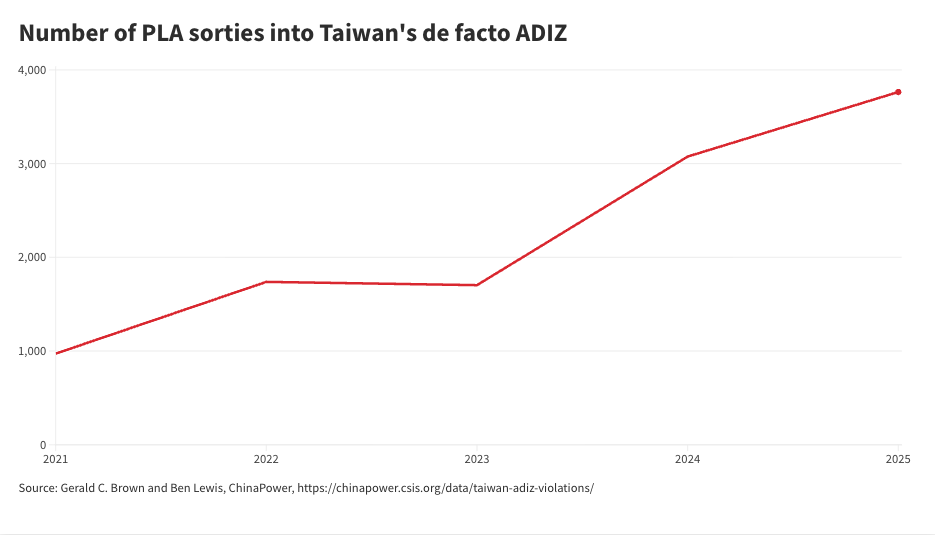
Beijing is getting bolder, too: in 2025, close to 3,800 People's Liberation Army (PLA) aircraft sorties were detected in Taiwan’s de facto Air Defence Identification Zone (ADIZ), a 22.4 per cent increase compared to 2024.
China has even built working replicas of important landmarks across Taiwan, including the Presidential Office Building where Lai "fled" from this week.
Canada, Taiwan counter 'grey-zone' tactics
Former Canadian deputy prime minister Chrystia Freeland, now an economic adviser to Ukrainian President Volodymyr Zelensky, spoke at the Ketagalan Forum in Taiwan last week, arguing that elements of a new Chinese 'ethnic unity law' — specifically those targeting organizations or people outside of mainland China — mirror Russian President Vladimir Putin's rationale for invading Ukraine in 2022.
Canada does not have formal security or defence ties with Taiwan, but in 2025, the two economies signed an MOU on dark-vessel detection technology, allowing Taipei to counter ships around the island engaging in "illegal, unreported, and unregulated maritime activities."
Ottawa also dispatched a cyber attaché to the Canadian Trade Office in Taipei in 2024, presumably to learn from the island's experience in combating Chinese disinformation and hacking.