The expansion of an LNG facility and the designation of a proposed oil pipeline as a "project of national interest" are priming the pump for even deeper Canada–Asia energy ties, representing two landmark announcements in Ottawa's continuing quest to diversify beyond the U.S.
LNG Canada — a joint venture between Shell Canada, Malaysia's PETRONAS, PetroChina, Japan's Mitsubishi Corporation, and South Korea's KOGAS — announced on September 28 that it reached a final investment decision (FID) on 'phase two' of its LNG export facility in Kitimat, B.C., committing to double the project's export capacity from 14 million to 28 million tonnes annually.
Asian partners collectively own 60 per cent of the LNG Canada joint venture.
The office of Canadian Prime Minister Mark Carney noted that the decision "unlocks a transformative" C$33-billion private-sector investment, which will make LNG Canada the second-largest facility of its kind globally and "strengthen Canada’s trade ties across the Indo-Pacific."
Just two days later, Carney announced that Ottawa is officially listing the new West Coast Oil Pipeline, or "Pacific Link," as a project of national interest, reducing Canada's "dependence" on the U.S. by allowing Canada to export an additional one million barrels a day to "growing markets in Asia." The pipeline — tentatively scheduled for completion by 2032–33 — would carry Alberta oil to southern B.C.
The Westridge Marine Terminal in Burnaby, B.C., the end destination for the Trans Mountain Pipeline, shipped an estimated 15.3 million barrels of crude in July, with roughly three-quarters of that total destined for the Asia Pacific.
Canada a 'bystander' no more: Bingley
Asia Regional Director Barrett Bingley told Asia Watch that "energy has taken its place alongside agricultural commodities as a leading element of both the trade and investment relationship between Canada and Asia," noting the LNG Canada decision is a "tangible expression of this, and a confirmation that Canada's stable energy supply for Asia is locked in for generations."
The Pacific Link oil pipeline would have a similar impact. "This is an aspect of Canada–Asia ties that simply never existed before," he says. "It's hard to overstate how much this changes Asian countries' views of Canada in their calculations of building resilience and optionality."
"Canada is a player in Asia now, rather than a polite bystander," Bingley notes. "The recent momentum around energy is also likely to draw substantially more Asian investment into Canada."
Oil, LNG grease wheels of Canada–China ties
China has benefited from Ottawa's desire to "unlock Canada’s full potential as a global energy superpower," becoming far and away the biggest buyer of Canadian energy in Asia.
Energy products accounted for C$10.33 billion, or 35.6 per cent, of all Canadian merchandise exports to China in the first eight months of 2026, according to data released on Tuesday by Statistics Canada.
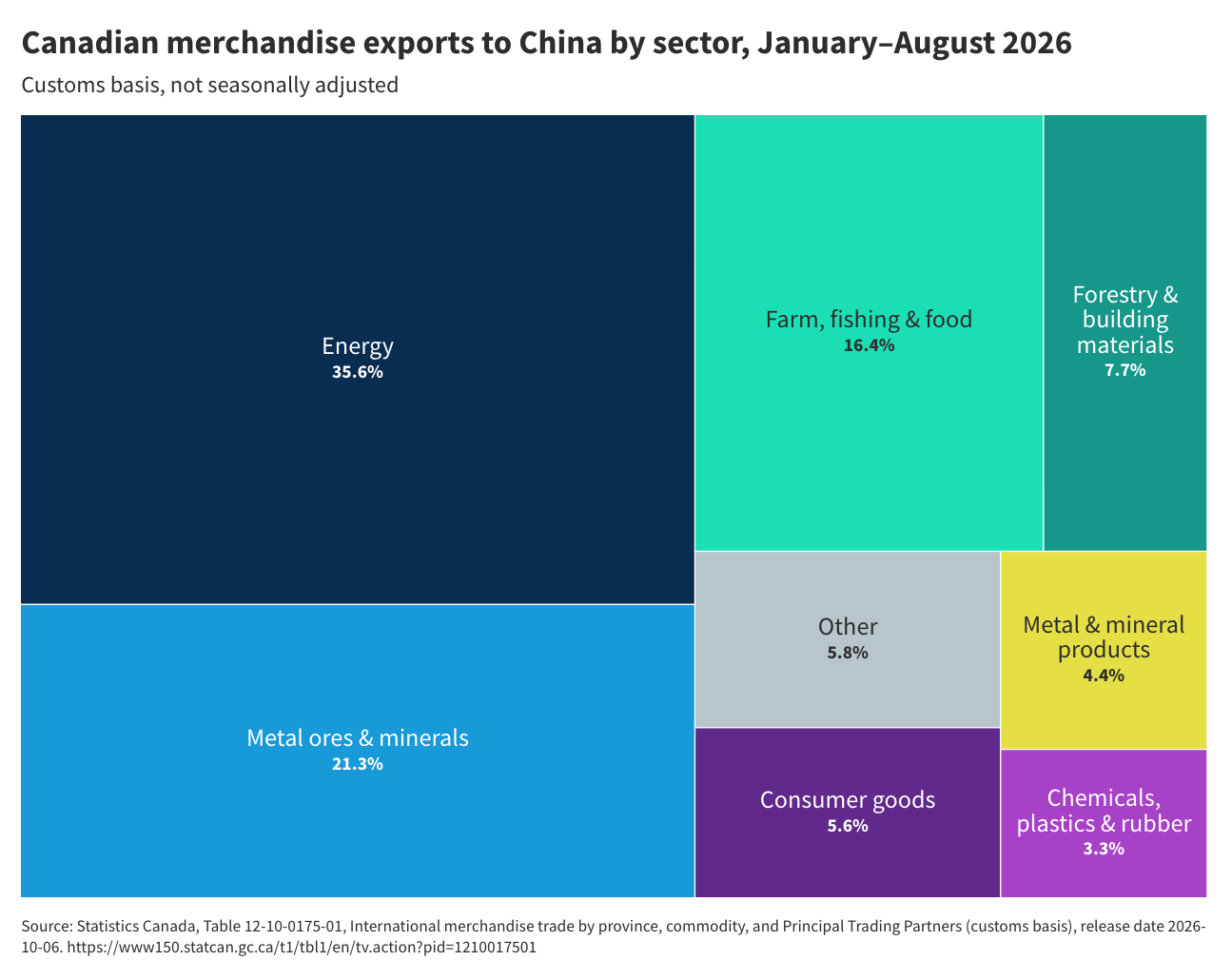
The value of those energy exports represents an 80 per cent increase year-over-year, although some of that uptick reflects increased oil prices since the closure of the Strait of Hormuz in late February.
After Carney met Chinese President Xi Jinping in January 2026, the two leaders released details of a new "strategic partnership." The first area listed for co-operation was "energy." Carney's team has followed up on this commitment: last month, Corey Hogan, Parliamentary Secretary to the Minister of Energy and Natural Resources, attended the APEC Energy Ministers’ Meeting, the first time Canada's been represented politically at the forum in more than 10 years.