China’s ‘Two Sessions,’ dual meetings of top Chinese Communist Party (CCP) members, brought thousands of delegates to Beijing to greenlight plans for the year ahead and the government’s 15th Five-Year Plan, spanning 2026–30.
The weeklong sessions of the National People’s Congress (NPC), China’s “rubberstamp” legislature of 2,900, and the Chinese People’s Political Consultative Conference, an advisory body of 2,170 representatives, concluded today.
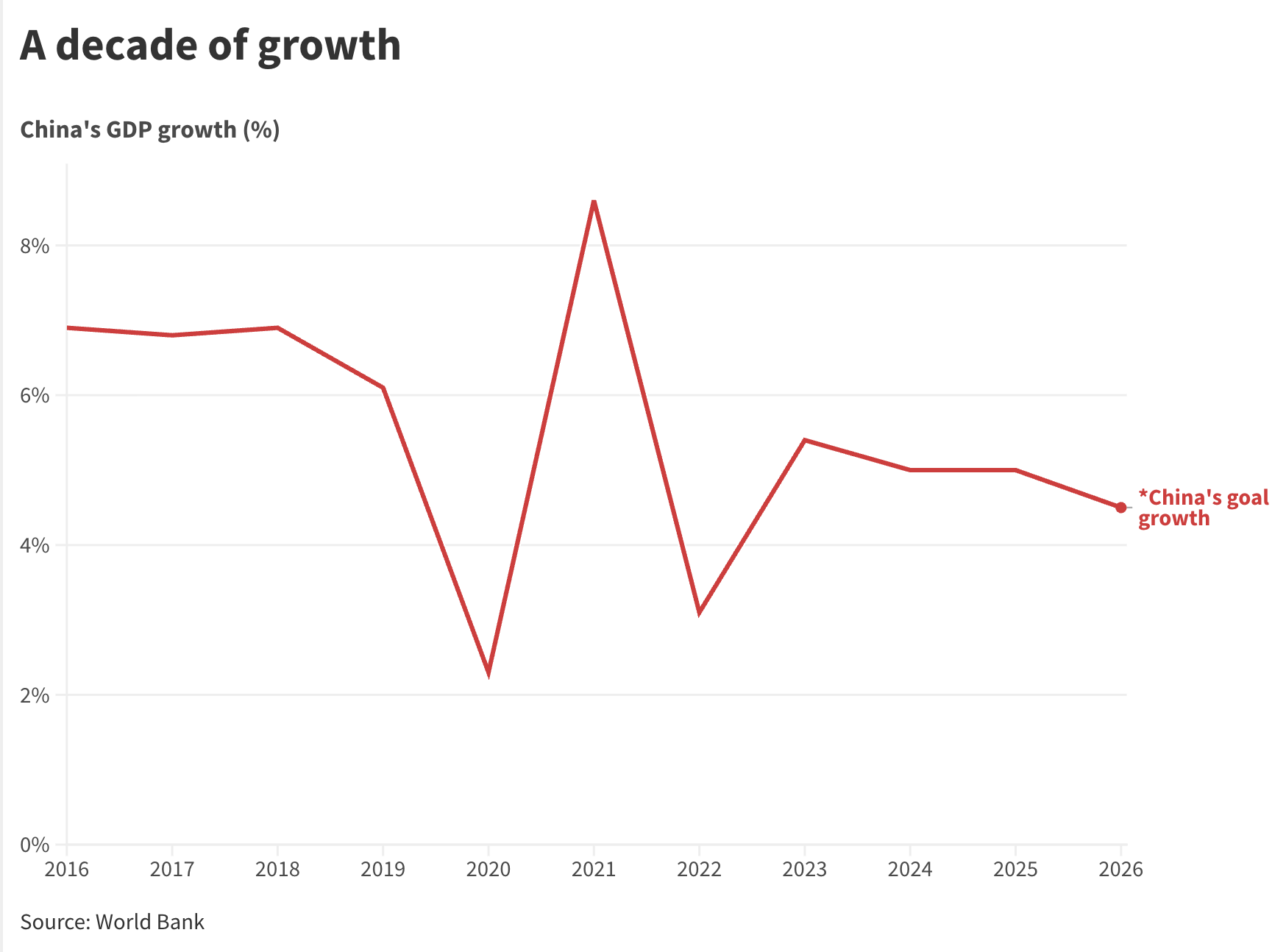
Last week, Chinese Premier Li Qiang delivered the government’s work report to the NPC, unveiling a GDP growth goal of “4.5–5 per cent” and a deficit-to-GDP ratio of “around 4 per cent,” tying last year’s record-high. Beijing will also target a two per cent inflation rate and an urban unemployment rate of no more than 5.5 per cent.
The GDP target — the lowest growth goal since 1991 — acknowledges sluggish consumer spending, tariffs, and global turmoil. For Beijing, it also cements a shift in focus, from high-growth numbers to “high-quality,” or sustainable, growth.
Household consumption accounts for 40 per cent of China’s GDP. In contrast, consumer spending accounts for roughly 55-60 per cent of Canada’s GDP, while in the U.S., the number is closer to 70 per cent.
Li said that “taking the expansion of domestic demand as our priority, we should make co-ordinated efforts to boost consumption, expand investment, [and] tap into every potential for growth in domestic demand.” CCP officials also emphasized continued support for strategic sectors such as advanced manufacturing, semiconductors, and artificial intelligence.
Wang Yi’s power hour
On the margins of the Two Sessions, Chinese Foreign Minister Wang Yi answered vetted questions from journalists for 90 minutes, providing a snapshot of Beijing’s foreign-policy priorities for the year ahead, including stabilizing relations with the U.S., presenting China as a stable, reliable defender of multilateralism and the Global South, and deepening co-ordination with Russia.
Journalists (and their questions) are called on by order of importance; unsurprisingly, Wang’s first answer — in response to a softball question from China Central Television — praised Chinese President Xi Jinping. Surprisingly, however, his second response focused on the China–Russia relationship, which he hailed as standing “rock-solid against all odds."
Wang discussed China’s hosting of APEC in 2026, stating that Beijing will focus on “[translating] the goal of building an Asia Pacific community into action.” His comments reflect Beijing’s ambition to shape a more integrated regional architecture — with China at its core — that emphasizes trade integration, connectivity, and digital and green development.
Wang suggested that 2026 could be a “landmark year” for China–U.S. relations but did not explicitly mention a potential upcoming meeting between Xi and U.S. President Donald Trump (expected to take place in Beijing in three weeks). Wang was also relatively positive about China–India relations.
Carney embraces Tokyo
As the spat between China and Japan lumbers into its fifth month, Wang seemed to soften his language on Tokyo: “The future of China–Japan relations hinges on Japan’s choice,” he said, avoiding threats and instead referencing Japan’s past “aggression” and “militarism.”
This fragile regional context intersects with Canadian Prime Minister Mark Carney’s recent trip to Japan, where Ottawa and Tokyo announced a new Comprehensive Strategic Partnership to deepen ties in defence, economic security, critical minerals, and advanced technologies. The announcement reflects Canada’s continued efforts to deepen ties with key Indo-Pacific partners while managing a complex relationship with China