The leaders of China, India, and Russia met in Bishkek, Kyrgyzstan, on Monday and Tuesday for the annual summit of the Shanghai Cooperation Organization (SCO), a security-focused group of largely Central Asian states.
SCO members include Belarus, China, India, Iran, Kazakhstan, Kyrgyzstan, Pakistan, Russia, Tajikistan, and Uzbekistan. This week, leaders discussed the U.S.–Iran conflict, the Russia–Ukraine war, and other regional issues.
Indian Prime Minister Narendra Modi met Russian President Vladimir Putin on Monday, telling Putin — after a hug — that the war in Ukraine must stop. Globally, India is one of the biggest purchasers of Russian oil (averaging 2.8 million barrels daily in July), a point of contention between New Delhi and Washington.
Putin and Chinese President Xi Jinping met briefly; Xi said that he was willing to work with Moscow to reform global governance and advance an “orderly multipolar world.”
The G20 finance ministers’ meeting played out in the U.S. state of North Carolina at the same time as the summit, offering a “split-screen" of two contrasting world orders.
India is the only country to be a member of the SCO, G20, BRICS+, and the Quad.
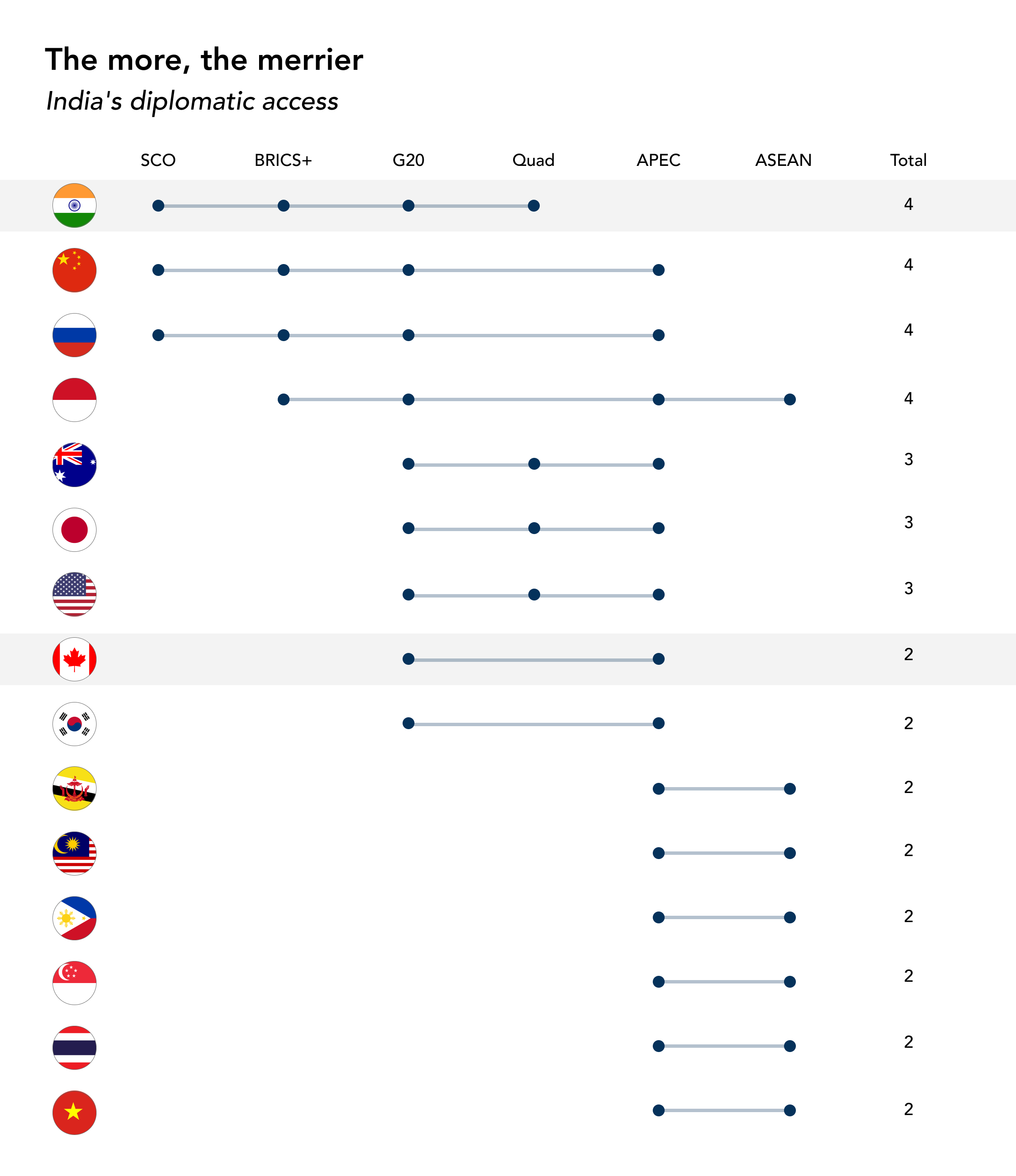
No place like home
This is only Xi’s second trip abroad in 2026. (He previously travelled to North Korea in June.) In 2014, Xi made 20 foreign visits; last year, only six.
The 73-year-old is increasingly inviting world leaders to China, rather than travelling, and has deputized some summits and meetings to Chinese Premier Li Qiang and other top officials. Now, any foreign trip for Xi carries a degree of significance, highlighting China’s diplomatic priorities. After Kyrgyzstan, Xi is set to travel to Egypt.
The SCO is marking its 25th anniversary this year. The group was initially limited to six countries and focused heavily on counterterrorism before expanding its focus to “strengthening mutual trust,” “new challenges and threats,” and “promoting economic growth.”
The organization remains a loose coalition of states, featuring rivals India and Pakistan alongside Iran, Russia, China, and others. But the presence of Putin, Modi, and especially Xi shows that — despite its blurry vision for ensuring “peace, security, and stability in the region” — the SCO still commands a crowd.
The summit offers a potential lesson for Canadian Prime Minister Mark Carney, whose attempts to form a middle-power coalition have generated buzz but, so far, no official grouping. The SCO’s aims may be vague (and some of its members divided), but its formal structure allows the group to meet, discuss, and — when it suits them — champion practical initiatives, such as the Regional Anti-Terrorist Structure, joint military drills, and last year’s SCO Development Bank.