In the News
APF Canada's media responses to the latest issues and events in Asia presented in chronological order
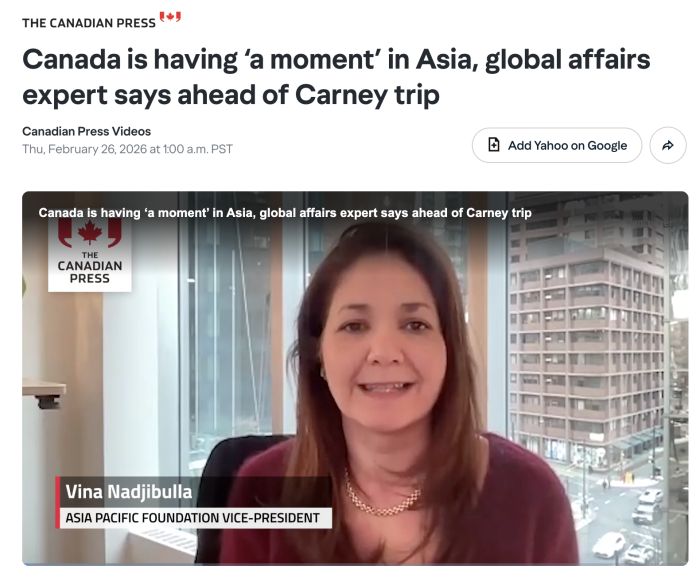
Canadian Press
Canada is having ‘a moment’ in Asia, global affairs expert says ahead of Carney trip
Canadian Press, February 26, 2026
Featuring: Vina Nadjibulla, Vice-President Research & Strategy, APF Canada
Excerpt: Nadjibulla says the time is ripe for Prime Minister Mark Carney to expand ties in Asia, following heavy praise in the region for his World Economic Forum speech. Carney said middle powers need to band together to withstand coercion from countries like the United States, thereby undermining the world order.
"In Asia, Canada is having a moment. Prime Minister Carney's speech really was quite an important development in how Asia sees Canada... this is an actual palpable difference in the level of curiosity, in the desire to partner with Canada, and that is also true about India."
Carney's speech received "wall to wall coverage for days in India and where is a desire to see what that could mean practically for [the nation] as part of [Carney's upcoming] visit" to New Delhi.

Toronto City News
Carney follows up speech in Davos with trip to India, Australia, Japan
Toronto City News , February 26, 2026
Featuring: Vina Nadjibulla, Vice-President Research & Strategy, APF Canada
Excerpt: PM Mark Carney this morning for a 10-day visit to India, Australia, and Japan, a trip that will give Carney a chance to put into action his calls to action in Davos as he visits three “powerhouses of the region,” Asia Pacific Foundation of Canada Vice-President, Research & Strategy, Vina Nadjibulla said in an interview.
“The Indo-Pacific is where the centre of gravity for geopolitics and economic growth … is increasingly converging.”
“In Asia, Canada is having a moment. Prime Minister Carney’s speech really was quite an important development in how Asia sees Canada."
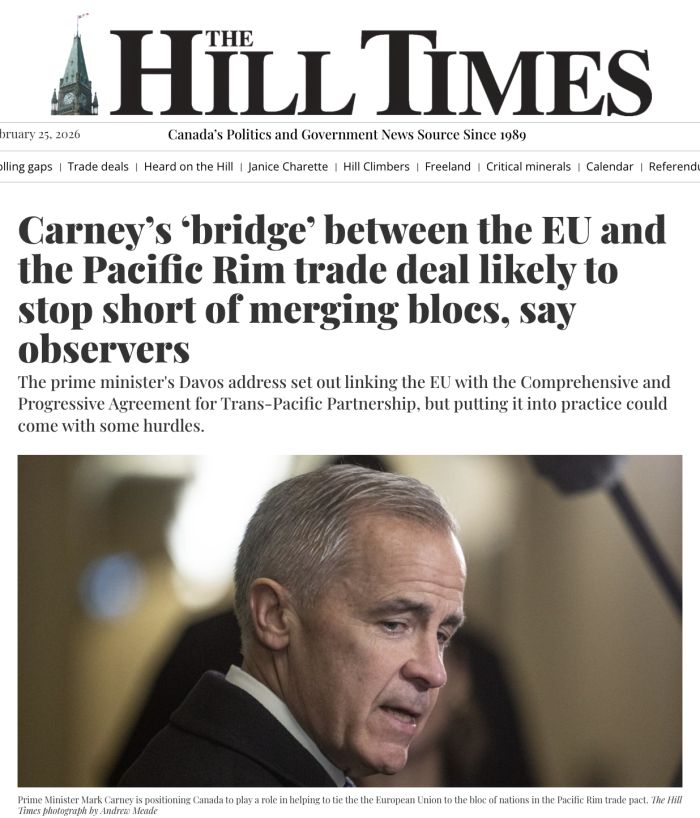
The Hill Times
Carney’s ‘bridge’ between the EU and the Pacific Rim trade deal likely to stop short of merging blocs, say observers
The Hill Times, February 25, 2026
Featuring: Vina Nadjibulla, Vice-President Research & Strategy, APF Canada
Excerpt: The Asia Pacific Foundation of Canada’s Vina Nadjibulla, Vice-President, Research & Strategy, said that discussions about linking the CPTPP and the EU have been ongoing for more than two years, gaining momentum last November, which included a dialogue between the blocs on trade and investment.
“The idea is that in the current environment of fragmentation of rules-based trade, and assault on the global trading order by President Trump’s tariffs, as well as China’s protectionism, that middle powers and other trading blocs need to work more closely together to create an alternative."
“...This is not just Prime Minister Carney’s initiative, but obviously [he] has taken an interest in it, and has elevated and given it political weight and momentum by raising it himself."

Vancouver Sun
Opinion: How to leverage B.C.'s generational opportunity to expand trade and spur economic growth
Vancouver Sun, February 24, 2026
Featuring: APF Canada's Canada-in-Asia Conference 2026
Excerpt: Tamara Vrooman, President and CEO of the Vancouver International Airport (YVR), details her experience at CIAC2026 in a new op-ed published by the Vancouver Sun.
Article conten
"This month, I travelled to Hong Kong and Singapore as part of an Asia Pacific Foundation [of Canada] conference focused on further growing Canada’s trade and connectivity with the region. I met with dozens of business leaders, investors, cargo operators, and airport representatives, as well as connecting with Canadian diplomats and trade representatives on the ground.
"The takeaway from these meetings was unequivocal: Canada has a generational opportunity to further our connectivity and trade with markets across the Pacific...But equally clear was that a window of opportunity is just that. Although these markets recognize what Canada has to offer, we are not their only option. If we cannot deliver promptly, other countries will, and our window will close."

The Strait Times
After China, India is next on Canada’s foreign policy reset agenda
The Globe and Mail, February 24, 2026
Featuring: Vina Nadjibulla, Vice-President Research & Strategy, APF Canada
Excerpt: “The decision to enhance security cooperation is a significant development,” said Vina Nadjibulla, Vice-President, Research & Strategy at the Asia-Pacific Foundation of Canada.
“I wouldn’t say the Khalistan issue has been pushed to the backdrop; rather, it is being addressed through the appropriate security and law-enforcement channels so it does not dominate the entire relationship."
“The visit to India, Australia and Japan is an opportunity to take his Davos message of middle power diplomacy to the Indo-Pacific. Carney’s visit to India this week will consolidate, elevate and expand the relationship.”

The Times of India
'Very Significant': Expert Highlights Mark Carney's India Agenda Ahead Of Key Meet With Modi
The Times of India, February 23, 2026
Featuring: Vina Nadjibulla, Vice-President Research & Strategy, APF Canada
Excerpt: Nadjibulla says PM Carney's visit to India next month will be a "very significant trip" that will aim a "consolidat[ing] the reset that the two prime ministers initiated last year on the margins of the G7... we will see most likely some MoU's and things around the defence sector" as a new area for Canada-India engagement.
Nadjibulla said she was also expecting to see announcements around AI and technology security given the recent AI Impact Summit hosted recently in India. "most importantly this [trip] is about rebuilding trust... putting the relationship on a new footing... [and] sharing Canada's new foreign policy approach to partnerships and India is going to be a big part of that."
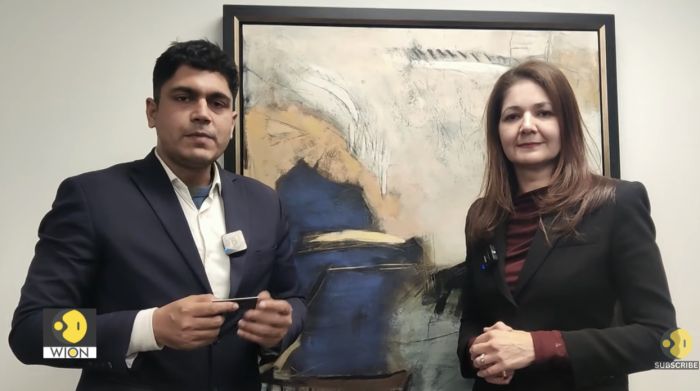
WION News
Exclusive: Canada-India Partnership Set to Boost Trade and Diplomatic Ties During PM Carney Visit
WION News, February 24, 2026
Featuring: Vina Nadjibulla, Vice-President Research & Strategy, APF Canada
Excerpt: Nadjibulla says an important aspect of PM Carney's upcoming trip to India is Ottawa's ability to "rebuild strategic trust" with the Indian government and "public trust" between the two nations.
"Public opinion is not catching up with the political reset and the political vision the two governments have... that's why it is so important that [Canada's] prime minister visit and speak in India with officials and also publicly. I do believe that there is an enormous opportunity here in the relationship, and we have to be steadfast in addressing the challenges."
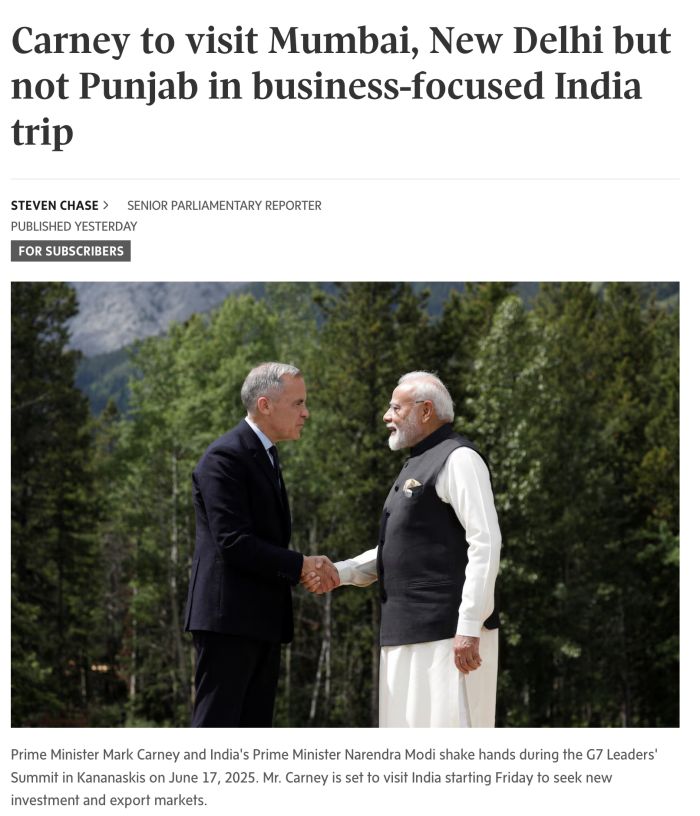
The Globe and Mail
Carney to visit Mumbai, New Delhi but not Punjab in business-focused India trip
The Globe and Mail, February 23, 2026
Featuring: Vina Nadjibulla, Vice-President Research & Strategy, APF Canada
Excerpt: The Prime Minister’s visit, announced Monday, begins Friday when his plane reaches India. His office said in a statement that he is heading to Mumbai, where he will meet with business leaders, and New Delhi, for a meeting with Prime Minister Narendra Modi.
Vina Nadjibulla, Vice-President Research & Strategy at the Asia Pacific Foundation of Canada, said she takes Mr. Carney’s itinerary as a sign that his foreign policy is “more focused on national interest and not limited to certain diaspora priorities.”
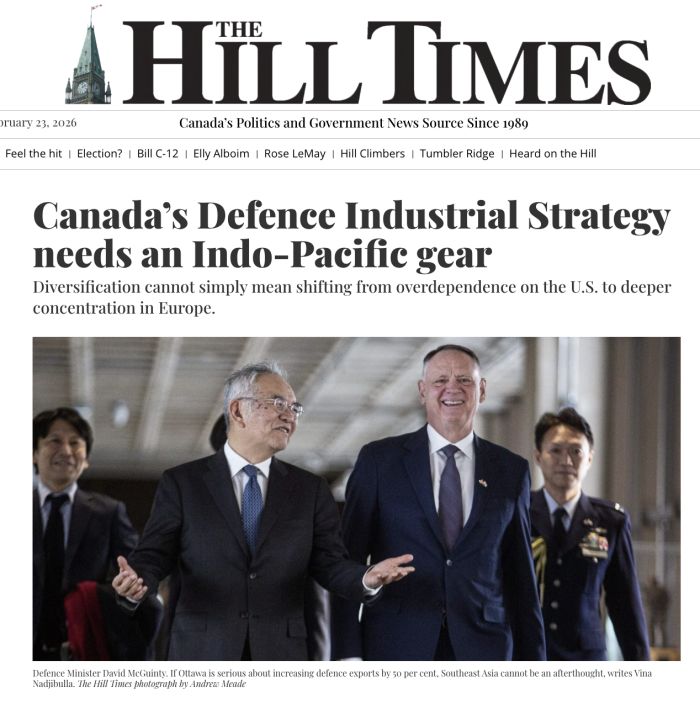
The Hill Times
Canada’s Defence Industrial Strategy needs an Indo-Pacific gear
The Hill Times, February 23, 2026
Guest Contributor: Vina Nadjibulla, Vice-President Research & Strategy, APF Canada
Excerpt: "Canada’s new Defence Industrial Strategy is more than a procurement update. In an era of great-power rivalry, economic coercion, and the weaponization of trade and global supply chains, the strategy correctly recognizes that national defence and economic security can no longer be treated as separate files.
"The strategy rightly commits Canada to new defence-industrial partnerships with the European Union and the United Kingdom. It also signals intent to collaborate more closely with Australia, Japan, New Zealand, and South Korea. That is a welcome start. Yet, the Indo-Pacific is larger and more economically dynamic than these four advanced economies."
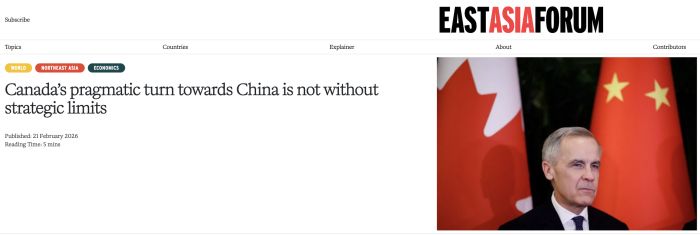
East Asia Forum
Canada’s pragmatic turn towards China is not without strategic limits
East Asia Forum, February 21, 2026
Guest Contributor: Vina Nadjibulla, Vice-President Research & Strategy, APF Canada
Excerpt: "Canadian Prime Minister Mark Carney’s January 2026 visit to China was significant not only in recalibrating the bilateral relationship but also in signalling a broader shift in Canadian foreign policy. The shift became clearer at the World Economic Forum in Davos, where Carney articulated Canada’s desire to build greater strategic autonomy, diversify partnerships and pursue a more pragmatic, interests-based and independent foreign policy.
This recalibration is necessary in an evolving world order defined less by rules and predictability and more by leverage and choice. But since the United States remains Canada’s most important economic and security partner, Ottawa faces a persistent dilemma in diversifying its economic relationships without jeopardising preferential access to the US market. With Washington increasingly willing to use tariffs and trade pressure as tools of coercion, Canada’s dilemma has become more acute."
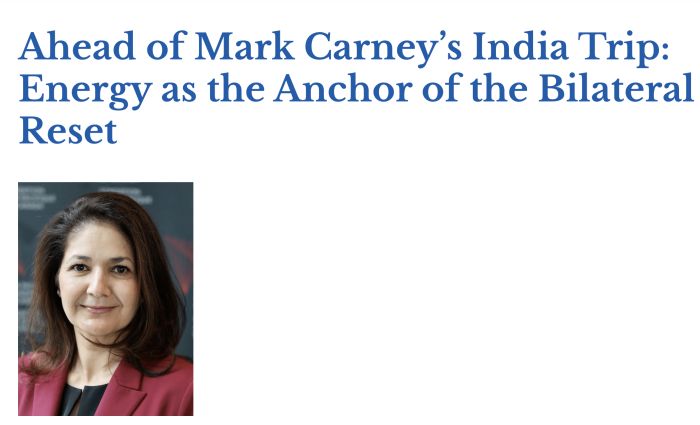
Policy Magazine
Ahead of Mark Carney’s India Trip: Energy as the Anchor of the Bilateral Reset
Policy Magazine, February 18, 2026
Guest Contributor: Vina Nadjibulla, Vice-President Research & Strategy, APF Canada
Excerpt: "Canada is not positioned to displace Gulf suppliers or suddenly dominate India’s import mix. But it can credibly become part of India’s diversified supply portfolio — particularly for crude oil and uranium in the near term, and LNG and critical minerals over the medium term.
In an environment where supply security and political reliability are increasingly priced into energy decisions, Canada’s reputation as a stable, rules-based producer carries weight."
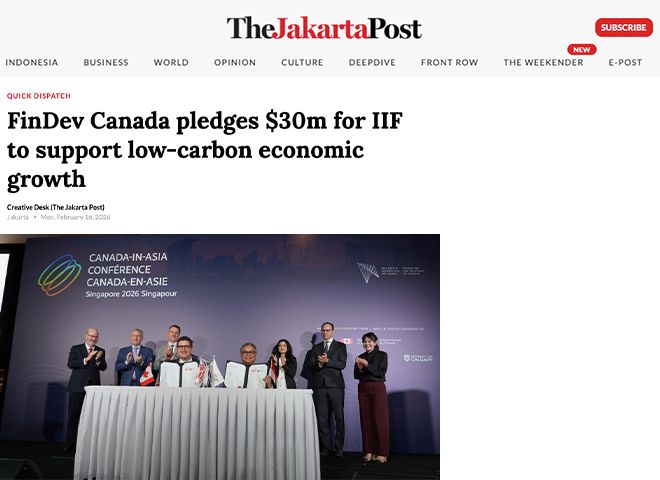
Courtesy of PT Indonesia Infrastructure Finance via The Jakarta Post
FinDev Canada pledges $30m for IIF to support low-carbon economic growth
The Jakarta Post, February 16, 2026
Featuring: APF Canada's Canada-in-Asia Conference 2026
Excerpt: Canada’s bilateral development finance institution, FinDev Canada, has committed to a US$30 million loan for Indonesia Infrastructure Finance (IIF), strengthening low-carbon economic growth in Indonesia through the financing of sustainable infrastructure projects.
Announced during the annual Canada-in-Asia Conference (CIAC) organized by the Asia Pacific Foundation of Canada from Feb. 10 to 11 in Singapore, the loan marks FinDev Canada’s first-ever investment in Indonesia.
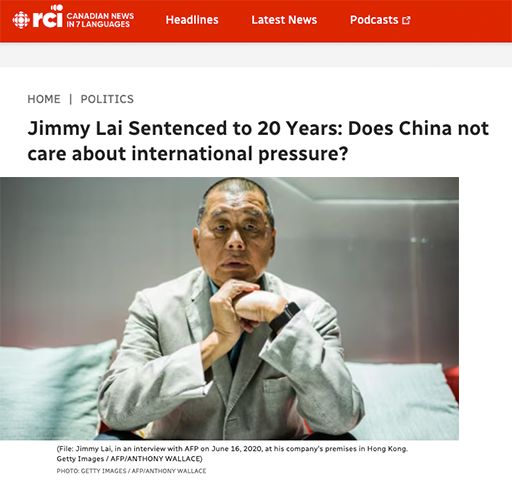
RCI via Getty Images / AFP/ANTHONY WALLACE
Jimmy Lai Sentenced to 20 Years: Does China not care about international pressure?
Radio Canada International, February 13, 2026
Featuring: Vina Nadjibulla, Vice-President Research & Strategy, APF Canada
Excerpt: On Monday (February 9), a Hong Kong court sentenced Jimmy Lai, founder of Apple Daily, to 20 years in prison for conspiracy to collude with foreign forces and endangering national security, which is the longest sentence since the implementation of the Hong Kong National Security Law.
Vina Nadjibulla, Vice-President, Research & Strategy at the Asia Pacific Foundation of Canada, . . . [expressed] deep disappointment with the verdict.
"Jimmy Lai’s sentence underscores the extent to which Hong Kong’s judicial system has been fully subsumed into Beijing’s broader political and security framework," said Nadjibulla.
She believes that under the current circumstances, sustained public pressure on China is unlikely, on its own, to produce results. Beijing has shown that it is willing to absorb reputational costs, particularly when it frames these cases as matters of national security. However, this does not mean the outside world has no leverage. Calls for Mr. Lai’s release on humanitarian grounds remain the most credible and potentially effective avenue.
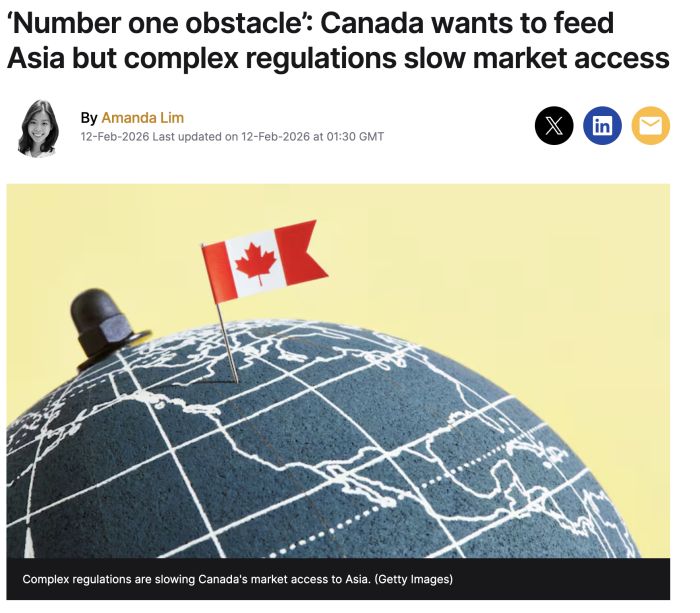
AgTech Navigator
‘Number one obstacle’: Canada wants to feed Asia but complex regulations slow market access
Antara News, February 25, 2026
Featuring: APF Canada's Canada-in-Asia Conference 2026
Excerpt: Canada believes it can help meet Asia’s growing food needs, but an industry leader says complex regulations are slowing market access, raising costs and creating uncertainty for companies.
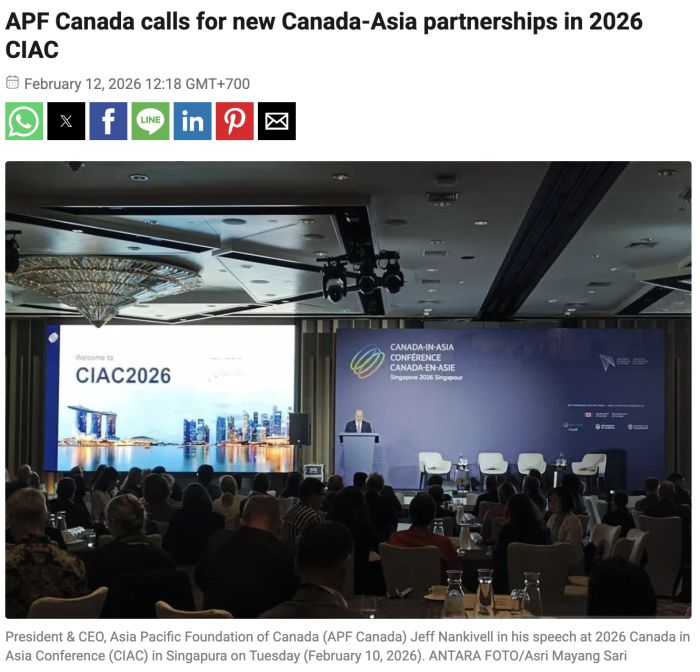
Antara News
APF Canada calls for new Canada-Asia partnerships in 2026 CIAC
Antara News, February 25, 2026
Featuring: APF Canada's Canada-in-Asia Conference 2026
Excerpt: President and CEO of the Asia Pacific Foundation of Canada, Jeff Nankivell, called for new Canada-Asia partnerships during a Singapore conference, citing the need for collaboration amid increasingly uncertain global conditions.
"We know what needs doing and the fact that you are in this room means that you are already doing it," Nankivell said in his speech at the 2026 Canada in Asia Conference (CIAC) on Tuesday.
He noted that the world is entering "uncharted territory," requiring countries to act collectively. Nankivell highlighted that in early February, Canada became the first country threatened with sweeping tariffs by the new Donald Trump administration.
Nankivell described the CIAC2026 forum as a "common table" to build new partnerships in the face of an uncertain future.
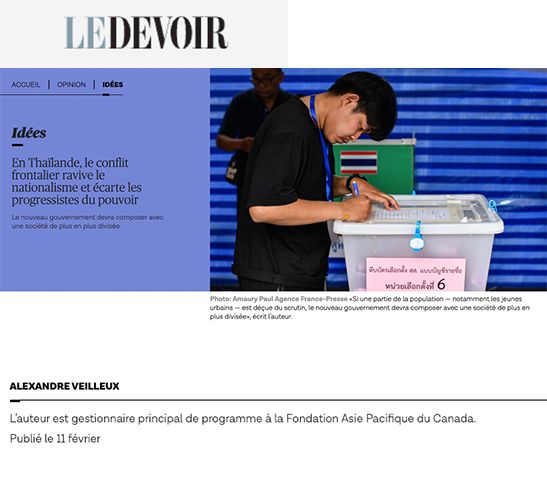
Le Devoir via Amaury Paul, Agence France-Presse
En Thaïlande, le conflit frontalier ravive le nationalisme et écarte les progressistes du pouvoir
Le Devoir, 11 fevrier 2026
Mettant en vedette : Alexandre Veilleux, L’auteur est gestionnaire principal de programme à la Fondation Asie Pacifique du Canada.
Extrait : Les électeurs thaïlandais étaient appelés, dimanche, à faire deux choix déterminants : élire le parti chargé de former le prochain gouvernement et décider de l’ouverture d’un processus de révision constitutionnelle. Après plusieurs sondages favorables au parti progressiste, le Parti du peuple, beaucoup prévoyaient un élan démocratique.
Mais la « vague progressiste » annoncée ne s’est pas matérialisée. Le parti conservateur pro‑royaliste Bhumjaithai, qui a axé sa campagne sur le patriotisme et la défense du territoire face au regain de tensions frontalières avec le Cambodge, est finalement sorti vainqueur. Cette victoire confirme la capacité des partis conservateurs à mobiliser l’électorat en période d’incertitude, en s’appuyant sur un discours nationaliste axé sur la sécurité.
Al Jazeera
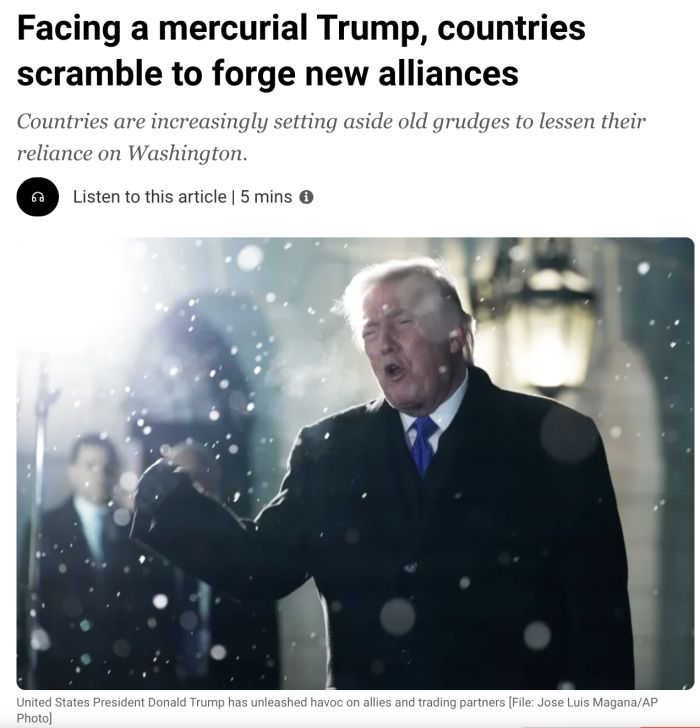
Facing a mercurial Trump, countries scramble to forge new alliances
Al Jazeera, February 10, 2026
Featuring Vina Nadjibulla, Vice-President, Research & Strategy, APF Canada
Excerpt: “Countries are trying to diversify economic and security partnerships,” said Vina Nadjibulla.
“Many US allies, especially in the Indo-Pacific region, won’t decouple from the US – the US is too important, especially for security – but they are all looking for a US-plus strategy to minimise risks."
The Hill Times
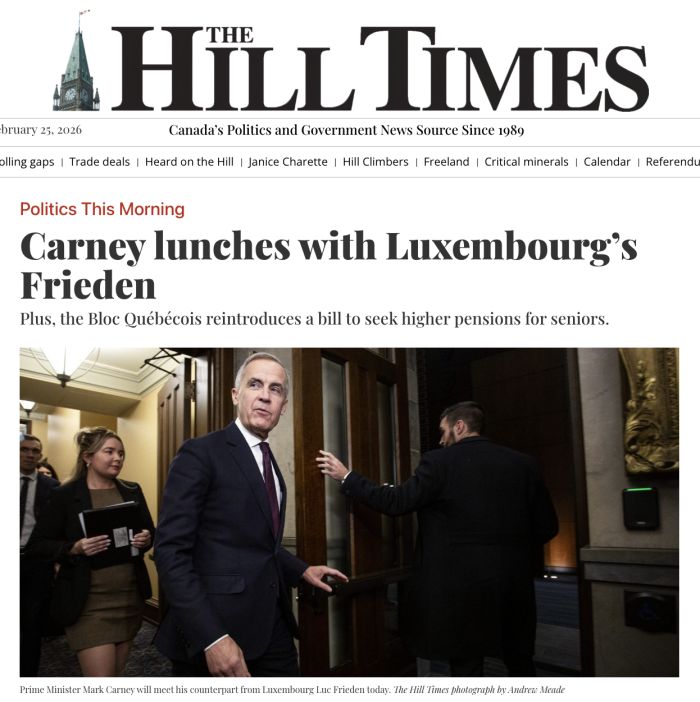
Carney lunches with Luxembourg’s Frieden
The Hill Times, February 9, 2026
Featuring: APF Canada's Canada-in-Asia Conference 2026
Excerpt: Government officials, diplomats, lobby groups, academics, policy experts, and business leaders will gather for a three-day Canada-in-Asia conference taking place in Singapore starting today.
International Trade Minister Maninder Sidhu will speak briefly at the summit tomorrow, alongside his Singaporean counterpart Gan Siow Huang.
Organized by the Asia-Pacific Foundation of Canada, the event will include panel talks on potential areas of collaboration, including critical minerals, education, energy and natural resources, finance, digital infrastructure and AI.
Other attendees mentioned in the schedule include Canada’s High Commissioner to India Chris Cooter, the CEO of Trans Mountain Mark Maki, Ontario’s Trade Minister Victor Fedeli, the chief investment officer of FinDev Canada Paulo Martelli, the director of natural resources at the Macdonald-Laurier Institute Heather Exner-Pirot, the president and CEO of Universities Canada Gabriel Miller, among others. The agenda is detailed at this link.
Canadian Affairs via X
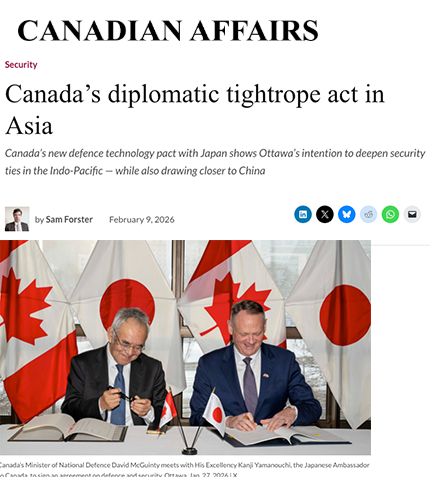
Canada’s diplomatic tightrope act in Asia
Canadian Affairs, February 9, 2026
Featuring: Vina Nadjibulla, Vice-President Research & Strategy, APF Canada
Excerpt: "The expanding network reflects Ottawa’s effort to ensure its Indo-Pacific pivot is not defined solely by China — or even by its closest Northeast Asian allies — but by a wider web of security and economic relationships.
From Nadjibulla’s perspective, walking that diplomatic tightrope is demanding but doable.
“As long as … the government’s narrative is clear, nuanced and sophisticated, and clearly outlines what it is that we’re trying to do with China and what will remain off limits, I think that would be understood in the region.
“ But for that, we do need to communicate as clearly as possible, and to engage in a lot of diplomacy with these other partners.”

Times Colonist via Press Reader
B.C. forestry looks to India, sees plenty of challenges
Time Colonist, February 7, 2026
Featuring: Vina Nadjibulla, Vice-President Research & Strategy, APF Canada
Excerpt: “We could be entering at the start of a period when the Indian middle class will continue to grow, and there’s an opportunity now to capitalize [on] that,” said Nadjibulla, adding that even a fraction of the market could be meaningful for B.C. producers.
“I think it is one of those growth markets that, while maybe far away and sometimes complicated, really needs to be explored now that we’re facing these pressures from the U.S.”