The Takeaway
Bangladesh’s 13th parliamentary election, held on February 12, 2026 — the first since the 2024 student-led uprising that ended Sheikh Hasina’s 15-year rule — marks its most consequential democratic exercise in over a decade. The vote not only signals a return to competitive electoral politics but also the close of Bangladesh’s long-dominant “two Begums” political era — the decades-long power rivalry between former female prime ministers Sheikh Hasina and Khaleda Zia — ushering in a second-generation leadership transition under the Bangladesh Nationalist Party. As governance shifts in the world’s eighth-most populous country, the outcome sets the stage for a defining test of institutional reform, economic recovery, and geopolitical positioning.
In Brief
- Fifty-one political parties contested the election, with competition led primarily between the Bangladesh Nationalist Party (BNP) and an alliance between Jamaat-e-Islami and the student-led National Citizen Party (NCP), formed in February 2025. Sheikh Hasina’s Awami League was barred from participating after its registration was revoked, pending legal proceedings linked to the 2024 protest violence that left at least 1,400 dead.
- With 59.88 per cent voter turnout, the BNP secured a landslide majority — winning 209 of 297 declared seats, bringing Tarique Rahman to power as the prime minister. Jamaat-e-Islami emerged as the principal opposition with 68 seats, while the protest-born NCP entered parliament with six seats, including its leader Nahid Islam, pointing to a parliament with a dominant ruling party and some opposition presence.
- Alongside parliamentary voting, citizens also voted in a national referendum under the July National Charter — a post-2024 uprising constitutional reform framework. Proposals included creating a bicameral parliament with a 100-member upper house, introducing prime ministerial term limits, expanding women’s representation, and strengthening judicial and parliamentary accountability, with a majority — roughly 60 per cent — voting “Yes.”
- Bangladesh deployed nearly one million security personnel — one of the largest election mobilizations in its history — to safeguard the vote. The process was monitored by roughly 400 international observers, including a 200-member EU mission and representatives from Canada. Ottawa also contributed C$2 million via the UN Development Program to support election administration and oversight.
- International reaction has been largely positive. The United States — which had earlier, in 2024, raised concerns that elections were not free and fair — described this vote as a success. Congratulations also came from Indian Prime Minister Narendra Modi, Pakistan’s Prime Minister Shehbaz Sharif, the Chinese Ambassador to Dhaka, and the Canadian High Commission in Bangladesh.
Implications
1. A “New Bangladesh” Under BNP Rule
With a decisive parliamentary mandate, the Bangladesh Nationalist Party now assumes power, led by Tarique Rahman, who took on the role of party leader following the death of his mother, former prime minister Khaleda Zia, in December 2025. He inherits a complex political landscape marked by internal party factionalism, a controversial personal past marked by corruption charges, and post-election unrest, with rival candidates alleging violence and irregularities. His many years in self-imposed exile in the U.K. — nearly 17 — also raise questions about administrative readiness and the on-ground political control.
Pre-election pledges by the BNP signal an expansive domestic agenda: welfare expansion through farmer and family cards, a job creation target of 10 million jobs, reinstatement of mid-day meal programs, an anti-corruption push, and a “Bangladesh First” foreign policy orientation.
2. Geopolitics in Motion: India, China, U.S., and Pakistan Recalibrate
As Bangladesh’s foreign policy recalibrates under new leadership, regional neighbours and Western powers are actively seeking to deepen engagement and secure strategic footholds. Indian Prime Minister Narendra Modi was the first to congratulate Tarique Rahman. The two leaders spoke over the phone following the results, and New Delhi signalled openness to continued bilateral co-operation, including a formal invitation for Rahman to visit India. However, underlying tensions remain with former Prime Minister Sheikh Hasina’s continued exile in New Delhi. When asked about Hasina’s extradition, Rehman stated that any decision on extradition would depend on the “legal process,” though domestic pressure in Bangladesh could continue to strain ties with India if repatriation demands intensify.
Following Hasina’s exit in August 2024, Dhaka — under the interim leadership of Mohammad Yunus — appeared to edge closer to Beijing, marked by high-level visits and the signing of new infrastructure, defence, and investment agreements, while also reopening channels with Pakistan, including expanded trade and military co-operation. With both Beijing and Islamabad signalling readiness to deepen ties with the BNP-led administration, expanded engagement could further erode New Delhi’s traditional strategic influence in Dhaka.
The U.S., meanwhile, has also moved to retain economic and strategic influence. Just three days before the elections, Washington signed a reciprocal trade agreement with the interim government — offering modest tariff relief (reducing rates from 20 to 19 per cent) alongside duty-free access for select textile shipments — while also voicing concerns over expanding Chinese influence and encouraging Bangladesh to consider U.S. defence systems as alternatives, positioning Dhaka’s defence procurement choices as an emerging proxy battleground for Indo-Pacific competition as Washington seeks to blunt Beijing’s growing military foothold.
3. Canada’s Economic Stakes Deepen in Bangladesh’s Transition
The recent U.S.–Bangladesh trade agreement — now subject to review by the incoming BNP administration — expands U.S. market access across key sectors, including soy products, dairy, beef, poultry, tree nuts, fruit, chemicals, medical devices, machinery, ICT equipment, and motor vehicles.
For Canada, the deal presents both competitive pressure and opportunity. Canadian agricultural exports to Bangladesh remain highly concentrated — with wheat, lentils, peas, soybeans, and potash accounting for roughly 93 per cent of shipments — and expanded U.S. access could set precedents Ottawa may seek to leverage. With exploratory discussions underway on a potential FTA and FIPA, and recent high-level trade engagement led by Canada’s Chief Trade Commissioner in November 2025, Ottawa will be watching closely to expand market access while reinforcing the rule of law and sustainable production standards.
What’s Next
1. From Protest to Power: Governance Test Begins
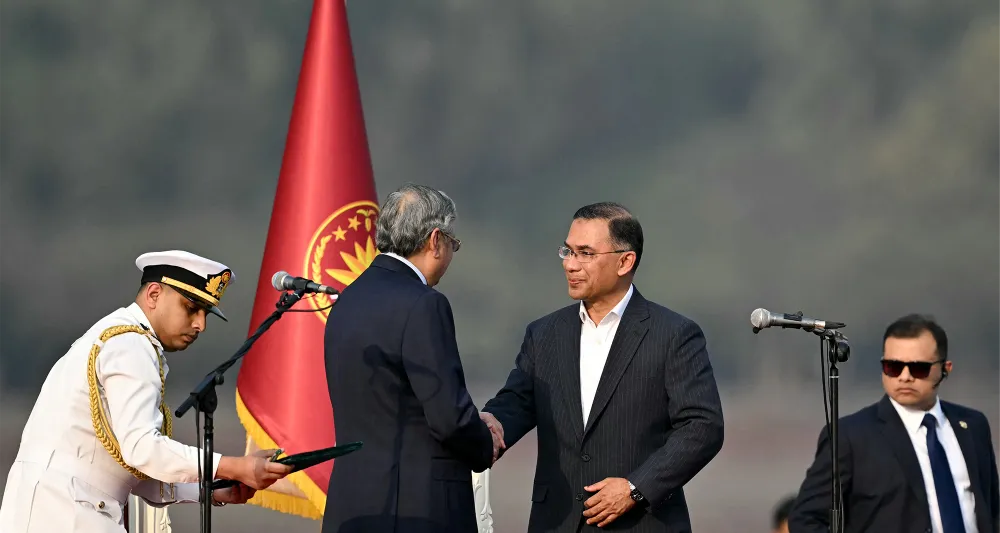
With the BNP government sworn in on 17 February — amid an opposition boycott by the Jamaat–NCP coalition over the sequencing of the July National Charter reforms implementation — attention will now shift to governance delivery. Early tests will include advancing constitutional reforms, maintaining political stability, strengthening the rule of law, protecting minority and press freedoms, and addressing youth employment and cost-of-living pressures.
Public expectations remain high following the student-led uprising, while international partners will watch for early signals on economic management and the investor climate. Bangladesh’s ability to stabilize growth and sustain reform momentum will shape trade, supply chain, and investment engagement with partners such as Canada.