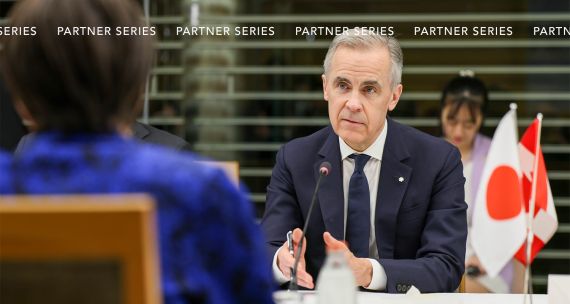
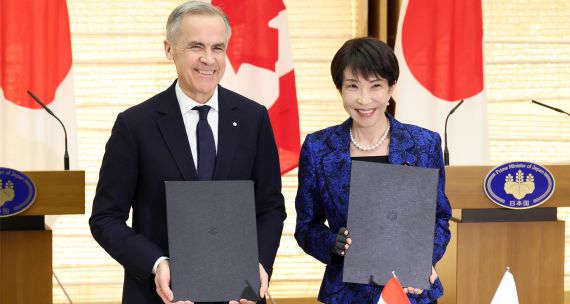
Less than a month after becoming Japan’s new prime minister, Takaichi Sanae is facing a rash of economic coercion measures from China stemming from her November 7 matter-of-fact statement that Chinese military action against Taiwan could constitute a “situation posing an existential threat” that would likely require the involvement of Japan’s Self-Defence Forces, resulting in a massive disinformation campaign and economic coercion mirroring Beijing’s past playbook against Australia and Canada.
The diplomatic crisis now engulfing Japan offers valuable lessons for Canadian Prime Minister Mark Carney, especially as Canada seeks to diversify its trade and diplomatic relations beyond an increasingly unpredictable U.S. As Japan and Canada both try to navigate the U.S.’s increasingly transactional diplomacy and Beijing’s willingness to resort to economic coercion, new opportunities are emerging for enhanced bilateral co-operation in trade diversification, security, and multilateral institutions. However, to capitalize on these opportunities, the two countries will need to overcome historical prisoner’s dilemma dynamics, which can make co-ordinated resistance challenging.
China’s response to Japanese Prime Minister Takaichi’s remarks last month was swift. The Chinese Consulate-General in Osaka posted on X (formerly Twitter) that “the intruding dirty neck” must be cut off without delay. The post was removed within a day, but managed to stoke Japan’s official ire. Soon after, Beijing issued travel warnings advising Chinese citizens to avoid Japan. The economic pressure quickly intensified with threats to Japanese seafood exports and the cancellation of over 500,000 airline tickets, while Japanese retail stocks, including Shiseido, Mitsukoshi, and Don Quijote, plummeted amid fears of lost Chinese tourism revenue.
This approach echoes Beijing’s treatment of Australia when, in 2020, then Prime Minister Scott Morrison called for an independent inquiry into COVID-19’s origins, prompting China to impose tariffs on Australian commodities, including wine and barley. More than a year earlier, Canada faced similar retaliation after it arrested Huawei executive Meng Wanzhou on a U.S. warrant for sanctions violations, which, among other things, resulted in “crippling embargoes” on various Canadian agricultural exports and a freezing of diplomatic relations.
In the recent rupture in China-Japan relations, Tokyo got some verbal reassurances from its U.S. ally, with U.S. Ambassador to Japan, George Glass, declaring of Takaichi, “We have her back.” But both Tokyo and Ottawa have reasons to question Washington’s reliability under Trump’s transactional approach, including on economic issues. For example, while Japan secured a 15 per cent tariff rate on its exports to the U.S., down from the threatened level of 25 per cent, it still has concerns about disparate treatment as Japanese automakers gained advantages over North American competitors due to their manufacturing efficiency and the attractiveness of their products.
For its part, Canada faces a 25 per cent “fentanyl emergency” tariff by the U.S. on goods that are not compliant with the Canada-U.S.-Mexico Agreement (CUSMA) rules, with Washington threatening to raise these tariff rates to 35 per cent. In March, after Trump imposed auto tariffs on Canada, Prime Minister Carney declared that the old U.S.-Canada relationship is “over,” and pledged to “fundamentally reimagine” Canada’s economy.
Beyond the very real impacts of the Trump 2.0 administration, Japan and Canada share critical interests that create natural opportunities for co-operation. Japan has focused on building partnerships with Southeast Asian countries; Ishiba Shigeru, during his roughly one-year tenure as prime minister (October 2024-October 2025), visited both Vietnam and the Philippines to strengthen regional trade ties. Takaichi, within a week of becoming prime minister on October 21, followed suit and attended the ASEAN Summit in Malaysia.
Canada, similarly, is accelerating trade talks not only with Japan, South Korea, and the EU, but also with Indonesia, through the recently concluded Comprehensive Economic Partnership Agreement. It has also initiated discussions on bilateral trade agreements with the Philippines and Thailand, and, perhaps most significantly, is nearing completion of a free trade agreement with the 11-member Association of Southeast Asian Nations and has recently announced that it is restarting trade talks with India. As members of the Ottawa Group – 14 “like-minded” World Trade Organization (WTO) members – Canada and Japan also share interests in defending the multilateral trading system. Both nations seek to reduce their dependence on a single market, particularly for critical minerals and energy resources essential to economic security. And both are in a position, facing Chinese pressure and U.S. unpredictability, to strengthen their global standing through an enhanced bilateral security dialogue.
The fundamental challenge to such co-operation, however, is a classic ‘prisoner’s dilemma’ where collective action would maximize aggregate benefits, but individualized co-operation with the more powerful actor becomes the dominant strategy. After Trump threatened to impose tariffs, Washington’s close trading partners, rather than co-ordinating resistance, each scrambled to secure their own deal: South Korea quickly negotiated bilaterally to lower the tariff level to 15 per cent, albeit with an additional commitment to invest US$350 billion in the U.S., and the EU and Japan each accepted 15 per cent baseline tariffs, also with significant investment commitments.
This pattern reveals why co-ordinated action fails. Immediate bilateral deals offer certainty, whereas multilateral resistance requires trust that partners won’t defect for better terms. Such an incentive structure favours quick capitulation over co-ordinated resistance.
To overcome this dilemma, Canada and Japan should establish regular ministerial consultations on trade strategy and share intelligence on Chinese economic coercion tactics and the U.S.’s negotiating positions. Joint démarches at the WTO regarding both Chinese coercion and U.S. unilateralism could strengthen multilateral institutions. Enhanced bilateral economic agreements could include critical mineral partnerships, joint infrastructure investments in third countries, and co-ordinated approaches to Indo-Pacific economic frameworks. In addition, regular Track 2 dialogues between business communities could identify concrete co-operation opportunities.
The sustainability of Canada-Japan co-operation would depend on aligning domestic political incentives with international co-ordination. That, in turn, would require public engagement in diplomacy to build constituencies that support diversification, creating institutional mechanisms that can outlast individual leaders, and developing metrics for success that go beyond traditional trade volumes.
Neither Canada nor Japan can afford to antagonize the Trump administration while diversifying. Both must maintain security alliances while pursuing a very limited degree of economic hedging, emphasizing shared democratic values while building alternative partnerships to the extent that it is possible.
For Canada, the reality is that its overwhelming economic integration with its southern neighbour places real limits on the extent to which it can diversify away from the U.S. Similarly, Japan’s security reliance on the U.S. and its longstanding comprehensive partnership with Washington cannot be replaced, especially within its deteriorating regional security environment.
Nevertheless, there are some useful lessons in Australia’s aforementioned experience with China’s economic coercion. In that case, the impacts of China’s retaliation proved surprisingly minimal, suggesting the costs of decoupling are lower than what had been assumed. In fact, most of the industries that were targeted successfully shifted to other markets, making China’s market matter less and thereby reducing the fear of trade weaponization and giving Australia more confidence vis-à-vis China.
Canada, under Carney’s leadership, confronts similar choices about economic sovereignty and alliance management.
The prisoner’s dilemma suggests that unless a co-ordination mechanism has careful institutional design, Japan, Canada, and their non-U.S. allies may choose bilateral accommodation over multilateral resistance. Meanwhile, the costs of continued dependence, whether on an unpredictable U.S. or a coercive China, grow daily. Success requires not just government co-ordination but business community buy-in, civil society engagement, and public understanding of the stakes involved.
The path forward demands pragmatism over ideology, recognizing that middle powers such as Japan and Canada must navigate between great power competition while protecting their own interests. As both nations have learned from China’s economic coercion, apparent vulnerability can be turned into a strength when nations work together to demonstrate resilience and adaptability.
As they say in Alberta, “When your neighbour’s barn is on fire, you don’t haggle over the price of water.” Canada and Japan, facing similar pressures from both East and West, would do well to remember that in times of trial, true friendship means standing together rather than cutting separate deals.