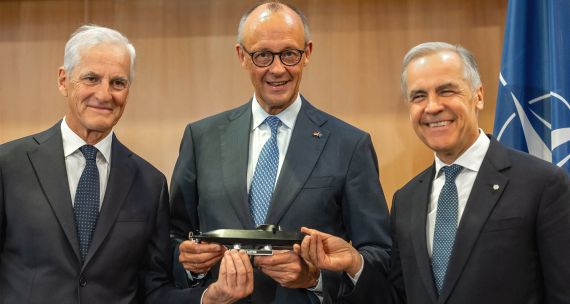
Prime Minister Mark Carney’s decision to select Germany’s ThyssenKrupp Marine Systems (TKMS), in partnership with Norway, as the supplier of Canada’s next submarine fleet is one of the most consequential defence procurement choices Canada has made in decades.
It will shape the Royal Canadian Navy, Canada’s Arctic and maritime posture, and the country’s defence-industrial partnerships for a generation.
The decision, announced ahead of Carney’s departure for the annual NATO Summit — held this year in Ankara — is understandably being read as a reminder that Canada’s default strategic reflex still leans heavily toward NATO.
TKMS offered Canada the 212CD submarine, being developed with Norway, and made a strong case around interoperability, lower delivery and integration risk, Arctic and North Atlantic experience, and the advantages of working with two NATO allies at a moment when Canada is under pressure to translate higher defence spending into real capability.
While the long-anticipated announcement of which bid won is an important part of the story, it isn’t the whole story. The hard-fought competition between TKMS and South Korea’s Hanwha Ocean also revealed how much Canada’s strategic landscape has changed. What might once have been a straightforward, no-contest transatlantic procurement became a serious choice between a European NATO consortium and a major Indo-Pacific defence-industrial power.
The fact that this was not an easy decision is itself significant. The comparative analysis of the two bids has for months given both equal credence and legitimacy — itself a signal from Canada’s defence and security establishment of a shift in the country’s procurement ecosystem.
Carney himself acknowledged as much at Monday’s announcement, stressing that both bids were strong and that the choice was difficult in a way that sounded like more than just lip service. It shows that Canada’s Indo-Pacific engagement is no longer simply about trade missions, diplomatic presence, or strategy documents. It is beginning to shape hard-power choices.
Canada’s choice of TKMS should therefore not be read as a rejection of South Korea or the Indo-Pacific. Carney made that point explicitly, stressing that the decision does not signal any diminished Canadian interest in the Indo-Pacific. It is better understood as a decision that reflects the enduring pull of NATO, Arctic capability, transatlantic defence-industrial integration and procurement risk.
Those considerations are real. Canada has long underinvested in defence and now has to move quickly to build capabilities that allies will recognize as meaningful. A German-Norwegian platform backed by two NATO partners offered a compelling answer to that challenge.
Canada urgently needs new submarines. The current Victoria-class fleet was purchased, used, from the United Kingdom in 1998 and is approaching the end of its service life.
The Canadian Patrol Submarine Project is intended to acquire up to 12 conventionally powered submarines, with the first four vessels required by mid-2030s to avoid a capability gap. Ottawa has been clear that the future fleet must be deployable in the Arctic, with the range, endurance, stealth and persistence needed to operate across Canada’s three oceans.
This is not a niche capability. Submarines are central to sovereignty, deterrence, intelligence-gathering and maritime domain awareness. For a country surrounded by the Atlantic, Pacific and Arctic oceans, and facing a more contested maritime environment, undersea defence capability is no longer optional. It is a core element of national security.
The decision also sits at the intersection of Carney’s broader foreign policy agenda. Canada is trying to rebuild hard-power credibility while diversifying its economic and strategic relationships. That requires a more disciplined kind of statecraft: one that links defence procurement, industrial policy, energy security, technology partnerships and diplomacy.
In this case, the two finalists offered different strengths. TKMS brought a proven record as a leading builder of conventional submarines, a NATO-aligned platform, and the political backing of Germany and Norway. Its bid squared with the message Carney will want to take to NATO: that Canada is serious about capability, burden-sharing, defence-industrial integration and allied interoperability.
At a time when Canada is working to demonstrate that its defence spending commitments are credible, the German-Norwegian offer gave Ottawa a familiar and strategically legible answer.
Within Carney’s “variable geometry”, Canada’s Atlantic, Arctic and Pacific interests share a rapidly expanding Venn overlap. South Korea is central to these calculations.
Hanwha Ocean offered something different. Its KSS-III proposal emphasized range, endurance, speed of delivery, industrial ambition and a broader strategic partnership with South Korea. Hanwha and the South Korean government mounted an unusually public and ambitious campaign by Canadian procurement standards.
South Korean officials travelled repeatedly to Canada. A South Korean submarine visited British Columbia after a trans-Pacific voyage to demonstrate the country’s technology and operational reach. Hanwha advertised heavily, built Canadian partnerships and framed its proposal not just as a submarine bid, but as a broader economic and strategic partnership.
That campaign mattered, and it surely made the choice much tougher than it might have been otherwise. Hanwha’s bid showed that Indo-Pacific partners are prepared to compete seriously for Canadian strategic attention. Many Canadians were introduced to South Korea’s defence sector for the first time.
South Korea is already a major technology, automotive, energy and industrial partner for Canada. But it is also becoming one of the world’s most important defence exporters, with strengths in shipbuilding, armoured vehicles, artillery, munitions, aerospace, drones and advanced manufacturing.
Hanwha’s campaign helped move South Korea in Canadian eyes from an important economic partner to a serious strategic and defence-industrial partner.
That shift should not be underestimated. For decades, Canadian defence procurement has been shaped primarily through a North Atlantic frame: the United States, the United Kingdom, NATO and, more recently, select European partners.
Those relationships remain essential. But they are no longer sufficient. The defence-industrial base Canada needs will not be built through transatlantic relationships alone. It will also require deeper partnerships with trusted Indo-Pacific partners, especially South Korea, Japan and Australia.
Canada’s security environment is not divided neatly between the Atlantic, Arctic, and Pacific, any more than it is bifurcated bluntly between physical and economic security. Russia’s war of aggression against Ukraine, China’s military modernization, North Korea’s weapons programs, disruptions in global supply chains, and pressure on the Arctic all point to a more connected threat environment in a smaller, shock-sharing world.
Within Carney’s “variable geometry”, Canada’s Atlantic, Arctic and Pacific interests share a rapidly expanding Venn overlap. South Korea is central to these calculations.
It combines industrial scale, technological sophistication, democratic alignment and a willingness to work with partners on concrete projects. It is already deeply integrated into global supply chains in batteries, semiconductors, autos, shipbuilding and advanced manufacturing. It is also a country that understands deterrence, alliance management and the urgency of defence readiness. For Canada, that combination is highly relevant.
The challenge now is to ensure the momentum generated by Hanwha’s campaign does not dissipate. Carney’s call with South Korean President Lee Jae Myung over the weekend and his commitment to continue discussions in Ankara on the margins of the NATO Summit create an immediate opportunity to turn disappointment over the submarine decision into a broader defence-industrial agenda.
Ottawa and Seoul should move quickly to identify defence-industrial projects beyond submarines: ship repair and sustainment, maritime domain awareness, naval technologies, armoured vehicles, munitions, drone and counter-drone systems, cyber, AI-enabled defence applications, and Arctic-capable technologies.
Canada should also continue deepening energy and critical-minerals cooperation with South Korea, including LNG, uranium, hydrogen, batteries and secure supply chains. The goal should be to move from episodic engagement to a pipeline of meaningful, ongoing bilateral initiatives.
The submarine decision was a test of Canada’s changing strategic orientation. South Korea may not have prevailed this time, but Hanwha and the South Korean government made their case, and Ottawa took it seriously.
Above all, the process proved that the Indo-Pacific is no longer peripheral to Canada’s hard-power choices. It is part of the same strategic map.
This piece first appeared in Policy magazine on July 6, 2026.