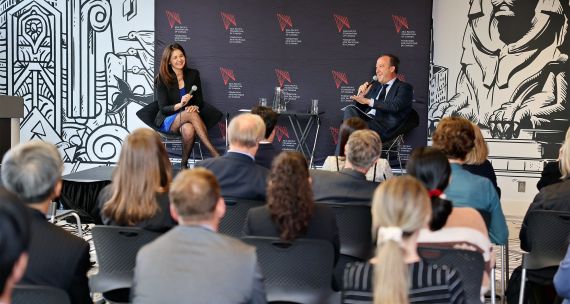
Senior officials and researchers from across the Comprehensive and Progressive Agreement for Trans-Pacific Partnership (CPTPP) member countries and the European Union (EU) met in Tokyo in mid-May to explore avenues for a more structured relationship between the two blocs, which together account for nearly one-third of global trade.
Part of the Track 1.5 dialogue on economic security was focused on a practical set of questions: What specific provisions would a CPTPP-EU framework need to defend open economies against neo-mercantilist and predatory state behaviour? What governance architecture would keep the rules-based trading system relevant in areas where the World Trade Organization (WTO) has not kept pace? What should be done to bolster the WTO, not undermine it?
The first question is one of form. Multilateral negotiations have a gravitational pull toward treaty-level instruments. In this case, that instinct could work against timely progress in the establishment of a collaborative framework. Rather, a less formal memorandum of understanding (MoU) is a more appropriate vehicle for this nascent stage of CPTPP-EU co-operation, for reasons worth setting out.
An MoU does not require parliamentary ratification across 39 jurisdictions. The inaugural CPTPP-EU Trade and Investment Dialogue Joint Ministerial Statement in November 2025, in Melbourne, and the Yaoundé Statement at the 14th Ministerial Conference of the WTO in March 2026, in Cameroon, called on senior officials from both blocs to develop work plans for a more structured relationship.
An MoU could lend those work plans legal and operational weight at the executive level without triggering the ratification timelines that delay more formal multilateral instruments. And by building the MoU in a modular fashion, allowing optional protocols and ‘coalitions of the willing’ on specific workstreams rather than demanding universal agreement on comprehensive agreement, issues between parties in critical areas such as subsidies disciplines, investment screening, and digital trade could be more readily addressed.
There are useful precedents here — some Canadian, some not. Canada has extensive experience with MoU-based co-operation frameworks across defence, intelligence, and trade facilitation, including the Five Eyes arrangements and various bilateral MoU structures under the Canada-United States-Mexico Agreement.
The U.S.-led Indo-Pacific Economic Framework’s Supply Chain Agreement of 2024 offers a more recent model: plurilateral, operationally specific, and designed to function alongside rather than in competition with WTO commitments.
A CPTPP-EU MoU could also remain open to additional like-minded participants, for instance, South Korea, which has CPTPP accession ambitions, and potentially Norway, Iceland, and Switzerland, all of which sit outside the EU but share its regulatory values. Keeping that door open is in Canada's long-term interest as the country deepens its trade diversification agenda.
A framework designed for a different era
The core legal challenge for any CPTPP-EU framework is that the WTO's foundational subsidies disciplines that underpin both trade blocs were negotiated in a different geoeconomic era.
The Agreement on Subsidies and Countervailing Measures (SCM) reflects the 1994 economy: discrete government financial transfers to identifiable firms delivered through transparent budget lines in market economies where private sector commercial pricing benchmarks exist.
The SCM Agreement was not designed to address the subsidy practices that now define industrial competition: preferential financing from state-backed institutions, below-market equity from sovereign vehicles, energy and land costs set by policy rather than price signals, and investment-linked subsidies delivered through infrastructure programs.
For Canada, this creates a specific asymmetry. Canadian exporters compete in CPTPP markets against goods produced under these conditions, while Canada's own support programs remain transparent, challengeable, and benchmarkable in ways that state-directed competitors are not. Canada has felt the consequences of this asymmetry in sectors ranging from softwood lumber to solar panels and electric vehicles, where Canadian industries have faced competitive pressure from supply chains heavily shaped by non-market state support.
A CPTPP-EU MoU could address these gaps by establishing a Joint Subsidies Transparency Mechanism with standardized notification templates for state-owned enterprise activity, drawing on CPTPP Chapter 17 (State-Owned Enterprises and Designated Monopolies) as a baseline.
A standardized notification template on subsidies would mean every party reports the same categories of information in the same structure to all parties of the MoU, making these reports easily comparable and actionable. It could also help initiate work toward a harmonized methodology for non-market economy trade remedy investigations. When Canada, Australia, Japan, and the EU investigate unfair foreign pricing, they each use different methods to calculate what the real cost of production should be, often arriving at different conclusions and, therefore, different proposed remedy tariffs. Exporters exploit that inconsistency by redirecting shipments toward whichever market applies the weakest remedy. A harmonized methodology would close that gap.
The case for solidarity
Canada's experience with economic coercion is well-documented. The suspension of Canadian canola exports to China beginning in 2019 and the broader agricultural trade disruptions that followed illustrate both the vulnerability of commodity exporters to targeted market leverage and the limitations of bilateral diplomatic responses when the underlying commercial relationships are asymmetric.
Similar episodes affecting Australia, including the wine, barley, coal, and beef measures imposed between 2020–22, and Lithuania's experience in 2021 and 2022, reflect a pattern of using market access as a coercive instrument, and the current multilateral framework has no operational response architecture in place.
A CPTPP-EU MoU could establish a Joint Economic Coercion Monitoring Mechanism, drawing on the EU's Anti-Coercion Instrument as a reference model, with structured information sharing and a common evidentiary record. A Solidarity and Substitution Compact, under which other parties would commit to facilitate market access for exports diverted by coercive measures, could give the monitoring mechanism a practical dimension. Canada's agricultural export capacity, the diversification of its canola and pulse markets across Asia following the aforementioned China episode, and the demonstrated ability of Australian exporters to find alternative buyers across the Association of Southeast Asian Nations (ASEAN) and South Asia all suggest the commercial foundation for such an arrangement already exists.
From resilience rhetoric to resilience metrics
Supply chain resilience has occupied considerable political bandwidth since 2020, but the policy conversation has not yet produced shared measurement standards. Currently, governments announce programs to reduce reliance on single suppliers or countries — but then frequently fail to publish the underlying data in a way that would let anyone check whether those programs are working.
A CPTPP-EU MoU could address this gap in measurement standards by establishing a Joint Critical Inputs Registry for materials, components, and technology stacks where any single non-party source exceeds a defined concentration threshold.
Canada's position in this conversation is distinctive. Canada has significant deposits of 31 of the 34 minerals commonly found on critical minerals lists, and a growing critical minerals infrastructure including projects in British Columbia, the Northwest Territories, Ontario, and Quebec. The federal Critical Minerals Strategy, launched in 2022 and updated in early 2026, and the commitments under the Canada-EU Strategic Partnership on Raw Materials, Batteries, and Renewable Hydrogen signed in 2023 provide a policy foundation that a CPTPP-EU MoU could build on.
Diversification benchmarks, stockpile co-ordination for materials including rare earths, gallium, germanium, and antimony, and mutual recognition of trusted supplier certification across parties could give this architecture practical operating procedures that build upon the aspirational language of these policies.
Technology governance beyond the WTO's reach
The WTO's Joint Statement Initiative on E-Commerce, even once fully incorporated into the multilateral framework, will not address the governance gaps that are opening in artificial intelligence, quantum information technology, and biotechnology. These are areas where Canada has important interests and relevant policy experience.
Canada's Voluntary Code of Conduct on the Responsible Development and Management of Advanced Generative AI Systems, published in September 2023, was among the first national-level instruments to address large-scale AI model governance. Prime Minister Mark Carney’s government recently built on this foundation with the newly released National Artificial Intelligence Strategy: AI for All.
The Hiroshima AI Process Code of Conduct and the EU AI Act's provisions on general-purpose AI systems together provide a converging international baseline. A CPTPP-EU MoU could formalize connections between these instruments through a Trusted AI Code establishing shared principles on model evaluation, red-teaming (a testing process where a group of ethical hackers simulates a real-world attack to identify vulnerabilities), and incident reporting for cutting-edge AI models, and extend that collaboration.
On data governance, Canada's bilateral digital economy arrangements, including its co-operation with Japan under the Data Free Flow with Trust framework and its participation in the Digital Economy Partnership Agreement accession process, position it well to contribute to a Trusted Data Bridges architecture for cross-border data flows. The objective would be genuine interoperability rather than a race to the lowest common denominator in standards.
A window worth using
The provisions outlined at the May 2026 Tokyo conference “Rebuilding a Rules-Based International Trade Order: The Role of CPTPP-EU Cooperation and Beyond” describe a framework that is WTO-consistent in substance and WTO-extra in scope.
Most of the relevant building blocks already exist as national or bilateral instruments across the EU and CPTPP membership. The EU Foreign Subsidies Regulation, the Anti-Coercion Instrument, the IPEF Supply Chain Agreement, Japan's JOGMEC stockpile architecture, the Hiroshima AI Process, and Canada's amended Investment Canada Act all represent operational experiences that a CPTPP-EU MoU could aggregate and co-ordinate.
Vietnam's 2026 CPTPP Chairmanship, combined with its agreement to focus the dialogue on CPTPP-EU co-operation, creates a favourable convening environment. Carney's support for this agenda, signalled most recently at Yaoundé, aligns the framework with Canada's broader Indo-Pacific Strategy objective of deepening rules-based trade architecture in the region.
The political question facing participating governments is whether to use this window deliberately or succumb to complacency; the geoeconomic pressures that make this framework necessary are also the pressures that make negotiating it more difficult over time. Getting the architecture right now, while the appetite for multilateral solutions remains, is worth the effort.