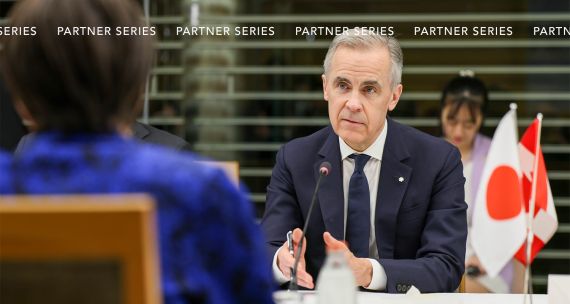
On March 6, 2026, Canadian Prime Minister Mark Carney met with Japanese Prime Minister Takaichi Sanae in Tokyo, where the two leaders signed a new Comprehensive Strategic Partnership covering defence, economic security, energy, technology, and trade ties.
The agreement came during the Japan leg of Carney’s broader Indo-Pacific tour, which also included visits to India and Australia. While the tour itself signalled Canada’s intent to strengthen engagement across the region, the Tokyo meeting produced the most concrete institutional outcome: a new framework designed to deepen co-ordination between two advanced economies navigating a “more divided” and uncertain geopolitical landscape.
The significance of the Tokyo meeting lies less in the symbolism of an Indo-Pacific tour than in the institutional substance of the new partnership. In his January 2026 address at the World Economic Forum in Davos, Carney argued that the post–Cold War rules-based order had entered a “rupture,” urging countries like Canada to strengthen domestic economic resilience while building coalitions with other middle powers to counter economic coercion and supply-chain vulnerabilities.
Within this framework, the Indo-Pacific plays a critical role in “shaping Canada’s future over the next half-century,” according to Ottawa’s 2022 Indo-Pacific Strategy, with Japan emerging as a particularly important partner. The two countries already share deep economic integration through the Comprehensive and Progressive Agreement for Trans-Pacific Partnership, as well as decades of political and security co-operation. Japanese leaders consistently frame Canada as a “like-minded partner” supporting Japan’s concept of a Free and Open Indo-Pacific (FOIP).
The new partnership consolidates existing co-operation while repositioning the bilateral relationship around economic security, resilient supply chains, and strategic co-ordination between two middle powers. As Ottawa seeks to expand partnerships beyond North America, Japan offers a stable anchor in the Indo-Pacific.
From established co-operation to a strategic framework
The partnership did not start from scratch. Over the past decade, Canada and Japan have developed an extensive set of bilateral arrangements spanning defence co-operation, energy policy, science and technology collaboration, and trade facilitation.
Existing agreements include the Security of Information Agreement (July 2025) and the Defence Equipment and Technology Transfer Agreement (January 2026), which provide the institutional basis for military co-ordination and information sharing.
In addition, the two countries have built mechanisms for economic co-operation through the Canada–Japan Joint Economic Committee, as well as memoranda of understanding on battery supply chains and clean energy collaboration. These arrangements have already created channels for government agencies, research institutions, and private-sector actors to co-ordinate across a wide range of sectors.
The new partnership does not replace these arrangements. Instead, it elevates and integrates them within a broader strategic framework. The partnership introduces a Comprehensive Strategic Roadmap, guiding detailed co-operation across multiple sectors, and directs foreign ministers and senior officials to oversee implementation and co-ordinate new initiatives such as cyber, artificial intelligence, space, and emerging security issues.
Economic security at the centre of strategic partnership
Economic security has emerged as the central pillar of the new partnership.
The roadmap identifies a wide range of sectors where Canada and Japan plan to strengthen co-ordination, including critical minerals, semiconductors, artificial intelligence, batteries, and advanced manufacturing technologies. These sectors have become increasingly important as governments attempt to secure access to key inputs needed for digital infrastructure, electric vehicles, and clean energy systems.
The two countries also committed to launching a new Economic Security Dialogue, which will provide a platform for policymakers to co-ordinate on issues such as supply-chain resilience, export controls, investment screening, and responses to economic coercion. The roadmap’s language on “non-market policies,” “harmful overcapacity,” and export restrictions mirrors recent G7 debates over the impact of state-driven industrial policies on global markets. Although China is not explicitly named, the terminology reflects growing concern among advanced economies about supply-chain concentration and subsidized overproduction in sectors such as batteries, electric vehicles, and critical minerals processing.
For Canada, these areas align closely with its comparative advantages. The country holds significant reserves of critical minerals such as lithium, nickel, cobalt, and rare earth elements — resources essential to battery manufacturing and advanced electronics. Japan, by contrast, is a global leader in high-value manufacturing but remains heavily dependent on imported raw materials — mostly from China.
This structural complementarity provides a natural foundation for strategic resource diplomacy and long-term co-operation. By strengthening resource and supply-chain partnerships with Canada, Japan can diversify access to key inputs needed for its manufacturing sectors. At the same time, Canada gains opportunities to expand exports and attract investment into emerging industries tied to the global energy transition.
Defence co-operation and regional stability
Security co-operation also features prominently in the new partnership, although the framework largely builds on existing defence arrangements rather than introducing entirely new commitments.
Canada and Japan agreed to expand co-ordination between the Royal Canadian Navy and the Japan Maritime Self-Defense Force, including increased bilateral exercises, strategic planning activities, and joint operations. The two governments also signed three bilateral Memoranda of on international emergency responses, reflecting shared priorities around disaster relief and humanitarian assistance in the Indo-Pacific region.
These initiatives complement existing defence agreements while reflecting Ottawa’s broader effort to deepen security ties with Japan and other “like-minded middle powers” across the Indo-Pacific. Canadian officials have emphasized that future co-operation will extend beyond operational co-ordination to include defence-industrial collaboration and expanded military engagement in the region. While Japan’s security architecture remains firmly anchored in its alliance with the United States, Tokyo has increasingly emphasized the importance of working with “like-minded partners” to support the vision of a FOIP. In this context, Canada’s role lies less in reshaping the regional balance of power than in strengthening the wider web of security partnerships.
Expanding co-operation beyond traditional sectors
Beyond defence and economic security, the new partnership also expands co-operation into areas that have received less attention in previous Canada–Japan initiatives.
One notable example is food security. The roadmap highlights Canada’s role as a reliable supplier of agricultural products to Japan, a country that imports a large share of its food supply. Strengthening agricultural trade and supply-chain resilience has therefore become an important component of Japan’s broader economic security strategy.
The partnership also emphasizes areas of collaboration in the Arctic. Canada and Japan agreed to deepen co-operation in Arctic scientific research, environmental monitoring, and climate-related policy discussions. Although Japan is not an Arctic state, it has long maintained an interest in Arctic governance and research through its observer status in the Arctic Council.
In addition, the partnership reinforces collaboration on energy security and resource supply chains, climate change mitigation, and clean energy technologies, including hydrogen, carbon capture and storage, and small modular reactors. These areas reflect both countries’ efforts to advance energy transition strategies while maintaining energy security.
Finally, the roadmap places renewed emphasis on people-to-people ties, including academic exchanges, research collaboration, and cultural programs. The two governments also referenced the upcoming 100th anniversary of diplomatic relations in 2028, which may provide additional opportunities to strengthen institutional links between universities, research institutes, and policy communities.
The Comprehensive Strategic Partnership, therefore, represents more than a symbolic diplomatic upgrade: it signals a shift toward a more structured Canada–Japan relationship centred on economic security, resilient supply chains, and selective strategic co-operation. If implemented effectively, the partnership could facilitate Canada’s broader Indo-Pacific strategy by positioning Ottawa as a reliable economic and security partner in an increasingly ruptured global order.
• Edited by Vina Nadjibulla, Vice-President Research & Strategy, and Ted Fraser, Senior Editor, APF Canada