The Takeaway
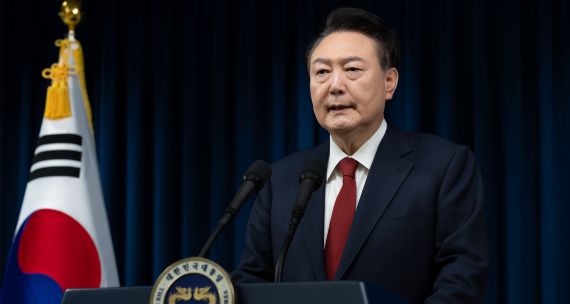
On February 19, the Seoul Central District Court sentenced former South Korean president Yoon Suk Yeol to life imprisonment after finding him guilty of leading an insurrection tied to his declaration of martial law on December 3, 2024. Former defence minister Kim Yong Hyun received a 30-year sentence, and several senior military and police officials were also convicted.
This marks the first time in South Korea’s constitutional history that a sitting president has been found guilty of insurrection. The ruling draws a clear boundary around presidential emergency powers, particularly the authority to declare martial law and deploy military forces under exceptional circumstances. At the same time, it does not fully address the underlying political polarization that contributed to the martial law and its aftermath.
In Brief
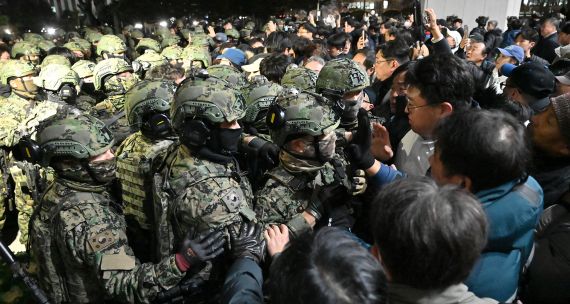
- The court convicted Yoon of leading an insurrection under Article 87 of the Criminal Act, one of the most serious offences under South Korean law. The charge does not require deaths to be involved in the offence; it applies where force is used with “the intent to disrupt or overthrow constitutional order.” The court concluded that the decisive act was Yoon’s approval of troop mobilization to the National Assembly during the martial law declaration on December 3, 2024. Although Yoon’s defence argued that no deaths occurred, the judges emphasized that the use of armed force against the legislature itself satisfied the legal threshold for insurrection.
- The prosecution had sought the death penalty. Instead, the court settled on life imprisonment, the most severe punishment practically enforced in South Korea, given the country’s long-standing moratorium on executions. The sentence places Yoon alongside former president Chun Doo-hwan, who ultimately received a life sentence for his role in the 1979 military coup and the 1980 Gwangju uprising. The court noted that the conviction was based on how martial law was executed, finding insufficient evidence of long-term premeditation. This ruling follows an earlier five-year jail term in a separate proceeding related to abuse of authority and obstruction charges stemming from the same martial law proclamation.
Implications
The verdict delineates the limits of executive authority within South Korea’s constitutional system. While the constitution permits emergency powers, including martial law, under extraordinary circumstances, the court made clear that such authority “cannot be used to disable or intimidate the legislature.” Yoon’s defence argued that the declaration fell within presidential prerogative and was a response to escalating confrontation with the opposition-controlled assembly. The court rejected that claim. Even where martial law is constitutionally permitted, and even though the incident, in Yoon’s case, only lasted a few hours before lawmakers overturned the decree, the act itself — using armed forces against a constitutional body — constituted insurrection.
The court referred not only to the immediate constitutional breach but also to the broader consequences for Korean democracy. These include damage to police neutrality, reputational costs to South Korea’s international standing, and the intensification of political polarization with potentially lasting social effects. At the same time, the institutional response demonstrated resilience: the National Assembly reconvened, the judiciary adjudicated the case independently, and the proceedings unfolded transparently. The crisis was ultimately contained within legal processes rather than resolved through extra-constitutional means.
Legal resolution, however, does not necessarily mean political reconciliation. Supporters of Yoon criticized the ruling as politically motivated, while some opposition figures described it as “an unsatisfactory ruling.” These divergent reactions reflect a polarized political environment that predated the December 2024 crisis. The verdict may therefore reinforce competing partisan narratives even as it affirms the functioning of constitutional safeguards.
What’s Next
1. Ongoing legal proceedings
Yoon and his legal team are expected to appeal. They have argued that judicial authority has been subordinated to “incited public opinion and political power.” In addition to the insurrection conviction, Yoon faces separate criminal proceedings, including charges related to abuse of authority (currently at the appellate level), alleged national security violations, and perjury. These cases ensure that legal scrutiny will continue beyond this ruling, and the appellate process alone could extend into 2027.
2. International implications
The immediate impact on South Korea’s foreign policy trajectory is expected to be limited. Trade, alliance commitments, and Indo-Pacific strategy remain institutionally anchored. For Canada, bilateral co-operation in trade, supply chains, and security is unlikely to be materially affected. Institutional continuity remains strong. A broader implication is the demonstration of institutional and democratic resilience, as South Korea addressed an acute constitutional crisis through established judicial processes rather than through extra-constitutional confrontation.
• Edited by Vina Nadjibulla, Vice-President Research & Strategy, and Ted Fraser, Senior Editor, APF Canada