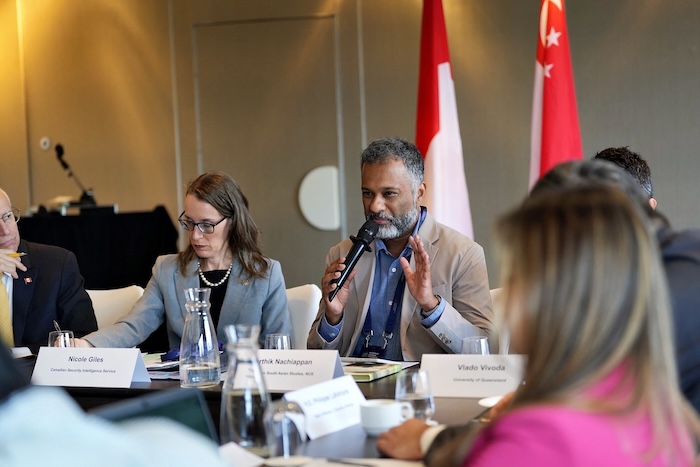
This strategic roundtable, Critical Minerals, Economic Security, and Strategic Partnerships, was convened on February 10, 2026, in Singapore by the Asia Pacific Foundation of Canada, on the margins of its Canada in Asia Conference, in partnership with the Canadian Security Intelligence Service (CSIS).
On February 10, 2026, APF Canada and the Canadian Security Intelligence Service (CSIS) co-hosted a roundtable in Singapore on the role of critical minerals on economic security and strategic partnerships in the Indo-Pacific. Convened under Chatham House Rule during APF Canada’s annual Canada-in-Asia Conference, the session brought together policymakers and regional experts from Canada and Southeast Asia for a candid exchange on supply-chain concentration, rising demand, and geopolitical uncertainty.
Participants addressed areas of vulnerability, how Southeast Asia views diversification, and what market realities mean for new supply. While the discussion ranged across geopolitics, environmental governance, and industrial policy, it repeatedly returned to one structural theme: supply chains are shaped less by where minerals are found than by where they are processed.
Where leverage lies: Processing over extraction
The discussion opened with a point of broad agreement: the core vulnerability in today's mineral markets is not geological scarcity; midstream capacity – refining, processing and purifying raw ores into industrial-grade materials – is the primary constraint. Deposits of minerals exist across multiple jurisdictions, but refining remains tightly concentrated in a few countries. That concentration gives processing countries outsized influence over global supply chains.
Recent Chinese export controls affecting gallium and rare earths were referenced as illustrations of how processing dominance can translate into economic pressure. These developments were discussed as part of a broader pattern in which supply chains intersect with geopolitical tensions. At the same time, demand is increasing rapidly. Electrification, data centre growth, artificial intelligence infrastructure, renewable energy expansion, and transmission buildouts all require substantial mineral inputs. Participants noted that these are structural shifts. The scale of projected infrastructure expansion suggests significant demand growth over the next decade.
Supply expansion remains slow. New mines take years to develop, and refining capacity – located largely in a few countries – limits how quickly raw materials can be processed and brough to market. Regulatory approvals, infrastructure requirements, financing constraints, and community acceptance shape timelines. Together, these constraints make it difficult for supply to keep pace with accelerating demand.
Geopolitical unpredictability adds another layer to this imbalance. China's dominant role in processing featured prominently in the discussion, though concerns extended more broadly to dependence on any single partner. Trade measures, tariffs, and export restrictions have heightened awareness of these vulnerabilities, particularly for countries such as Canada that rely on a narrow range of markets. Diversification was therefore framed less as confrontation and more as risk management.
Economic security was framed broadly throughout the discussion, extending beyond geopolitics to include cybersecurity, investment screening, and regulatory co-ordination. Mining operations rely increasingly on digital systems, making cybersecurity a part of supply resilience. Several participants stressed the importance of incorporating security considerations – both geopolitical and technological – early in project development rather than addressing after investments have been made.
Southeast Asia: Diversification without alignment
A defining contribution of the roundtable came from Southeast Asian participants, who kept returning to the question of framing. In ASEAN contexts, economic security is typically discussed in terms of growth, competitiveness, and development, rather than strategic rivalry. Initiatives explicitly framed as countering a specific country can trigger domestic sensitivities among ASEAN members. Diversification, from this perspective, is not about choosing sides. Several speakers described a "China-plus" approach: maintaining economic ties with China while expanding partnerships elsewhere to reduce overdependence. This reflects a long-standing regional practice of hedging rather than multi-alignment. That distinction shapes how partnerships are evaluated.
 For partners such as Canada, this nuance matters practically. Engagement framed around resilience, industrial upgrading, and standards co-operation is more likely to gain traction than narratives built around bloc politics. Canada's relatively quieter historical regional presence was noted as an advantage, as it allows Canada to position itself as a pragmatic, non-coercive partner.
At the same time, Southeast Asia's ambitions extend beyond extraction. Across ASEAN, the direction is clear: move up the value chain. The Philippines was referenced as a major nickel producer that currently directs most of its exports to China. There is growing interest in the region in developing domestic processing, refining, and recycling capacity to capture more value and create skilled employment. Malaysia's experience hosting rare-earth processing facilities illustrates similar dynamics: environmental concerns remain politically sensitive, yet midstream capacity has contributed to local technical expertise and industrial ecosystem development.
Thin markets, investment constraints and risk allocation
Beyond geopolitics, the discussion returned repeatedly to market structure. New mining and processing projects are capital-intensive and slow to develop. Smaller markets are more susceptible to price volatility. Price fluctuations can be sharp, and strategic behaviour can have outsized effects. The commodity cycle formed part of this analysis. The past decade was marked by subdued prices and limited greenfield investment. Dominant producers consolidated positions, particularly in niche minerals. Structural demand growth may now strengthen prices and incentivize new supply, but volatility remains a feature of these markets.
This volatility complicates investment decisions. To address the issue of bankability, participants debated whether policy tools such as strategic stockpiles, co-ordinated purchasing arrangements, and price guarantees could reduce downside risk and create predictable demand signals. That said, there was caution about unco-ordinated intervention. Subsidies that are not co-ordinated risk waste and fiscal strain, and any effective intervention requires partners to work together to avoid duplication. The fundamental question surfaced repeatedly: who absorbs the losses when prices fall, or if projects fail to reach production?
Environmental and social governance considerations add further complexity. Accelerating permitting may help close supply gaps, but weakening environmental standards risks social conflict and project delays. Rare-earth processing involves complex waste management, including radioactive by-products. This generates sustained local opposition, and participants were clear that undermining ESG protections is not a shortcut, as it tends to create new instability downstream.
Canada's ESG standards were viewed as a genuine comparative strength. There was interest among Southeast Asian participants in regulatory knowledge-sharing and environmental governance capacity-building. Strong ESG performance was framed not as an obstacle to investment but as a foundation for projects that are durable and financeable.
Clarifying the constraints on diversification
The roundtable underscored that critical minerals policy now sits at the intersection of industrial strategy, environmental governance, and geopolitical risk. Southeast Asia should be approached as an industrial partner rather than merely a supply source. The region's ambitions to expand into processing and downstream activities align well with shared diversification objectives. Co-operation on standards, technical expertise, and regulatory capacity can strengthen resilience across the chain rather than just at one end.
 How this co-operation is framed matters. In ASEAN, conversations grounded in development and industrial upgrading land far better than overt security language. Respect for regional autonomy by external partners is less about courtesy than about making co-operation work. Participants stressed that diversification does not imply decoupling. Most Southeast Asian states will continue calibrated "China-plus" strategies, and effective engagement means working within that reality, not around it. Financing and co-ordination are the principal practical bottlenecks. Geological availability does not by itself guarantee supply security, and credible de-risking mechanisms and co-ordinated approaches to purchasing or price stabilization may be necessary to translate political commitments into operational projects. ESG leadership reinforces credibility here too. Maintaining high environmental standards and sharing best practices strengthens Canada's reputation as a reliable partner, and long-term resilience depends on institutional legitimacy as much as mineral output.
The discussion generated clarity about the stakes: demand for critical minerals will keep rising, processing concentration will remain a structural challenge, and geopolitical uncertainty is not going away. Resilience will require steady partnerships, co-ordinated policy tools, and ecosystems that are commercially viable, not just politically desirable. The discussion suggested space for pragmatic co-operation, despite the structural constraints identified.
Implications for Canada’s Indo-Pacific engagement
For Canada, the discussion sharpened three interrelated realities. First, upstream strength alone is insufficient. The core vulnerability identified at the roundtable lies in processing concentration. Canada’s resource base does not automatically translate into supply security or strategic leverage if refining and downstream capacity remain concentrated elsewhere. Diversification, therefore, should be understood in system-wide terms, not simply as redirecting raw exports.
Second, Southeast Asia should be read through its own policy logic. Regional partners are pursuing diversification as hedging, not alignment. Their emphasis is on industrial upgrading, value capture, and resilience. For Canada, this means that co-operation framed around standards, regulatory capacity, and midstream collaboration is likely to resonate more than securitized narratives. The Philippines’ interest in expanding processing capacity and Malaysia’s experience with rare-earth refining illustrate that ASEAN economies are positioning themselves within higher segments of the value chain. Engagement that aligns with these ambitions is more likely to be durable.
Third, market constraints are not peripheral—they shape feasibility. Thin markets, capital intensity, and volatility complicate private investment decisions. If diversification is to move beyond declaratory policy, questions of price stability, co-ordinated purchasing, and risk allocation will need to be addressed. At the same time, ESG standards emerged not as obstacles but as stabilizing factors. Canada’s regulatory credibility was viewed as a comparative strength, particularly in a region where environmental and social sensitivities can determine project outcomes.
Taken together, the roundtable suggested that Canada’s opportunity in the Indo-Pacific lies in calibrated, standards-based partnerships. Processing bottlenecks, regional hedging strategies, and investment constraints define the operating environment. Working within those constraints—rather than around them—will shape whether diversification efforts become operational realities.
• Edited by Vina Nadjibulla, Vice-President Research & Strategy, Erin Williams, Director, Programs, and Ted Fraser, Senior Editor, APF Canada