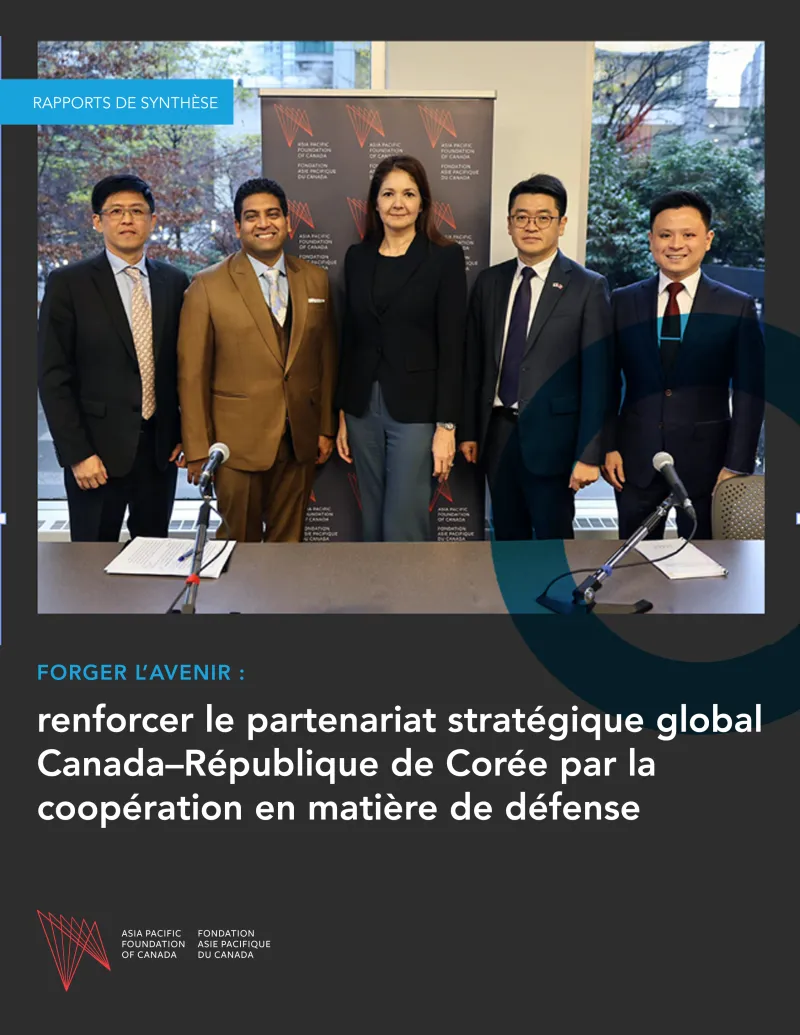
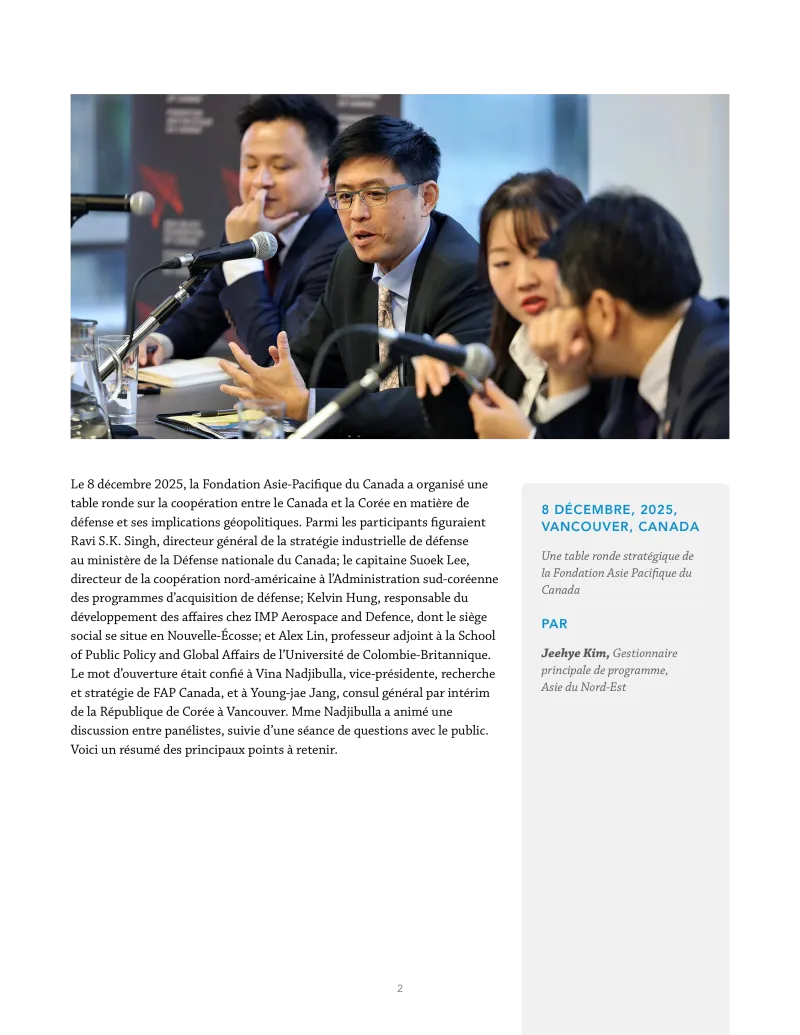
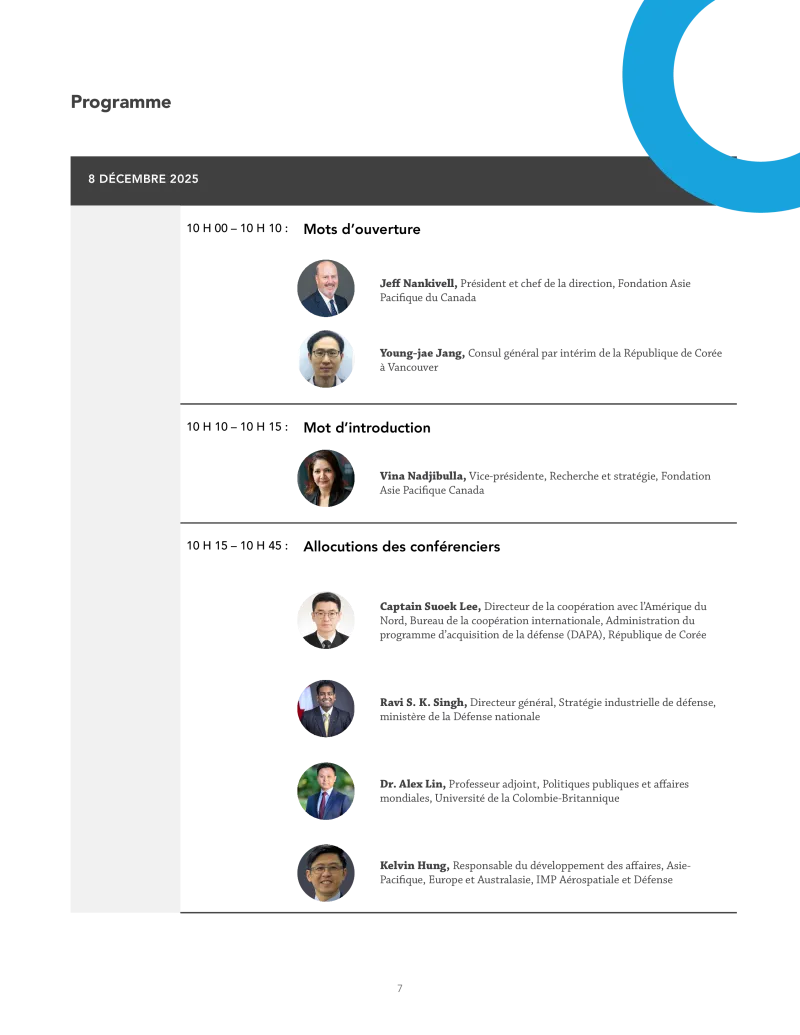
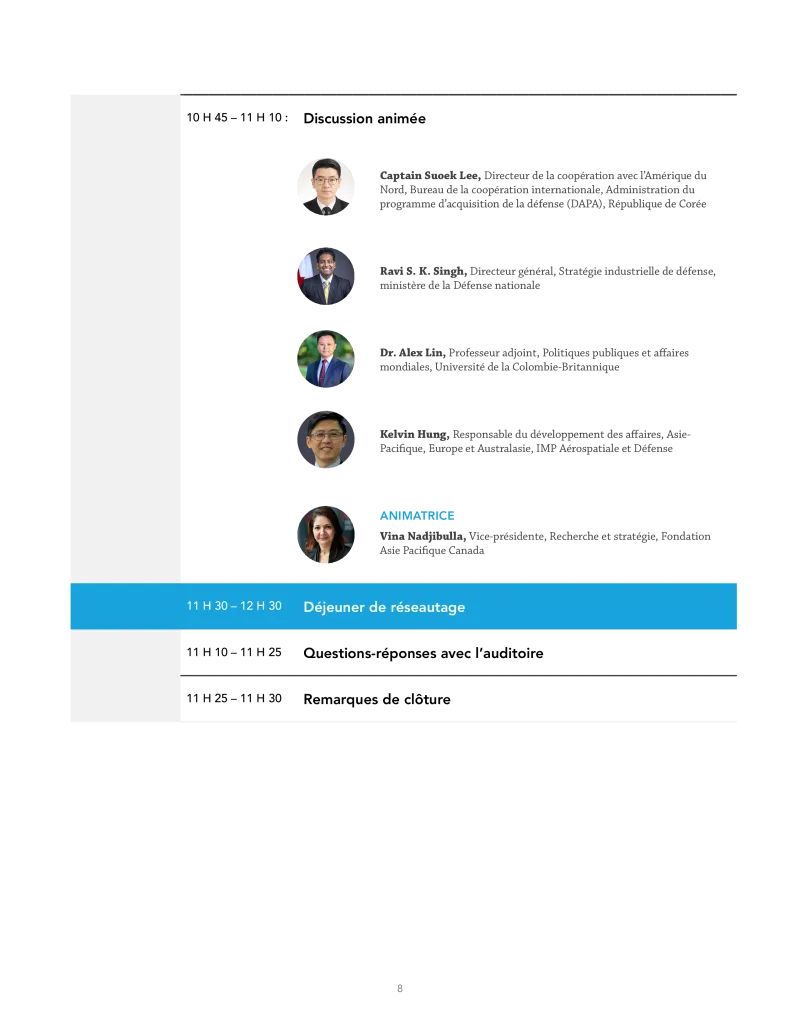
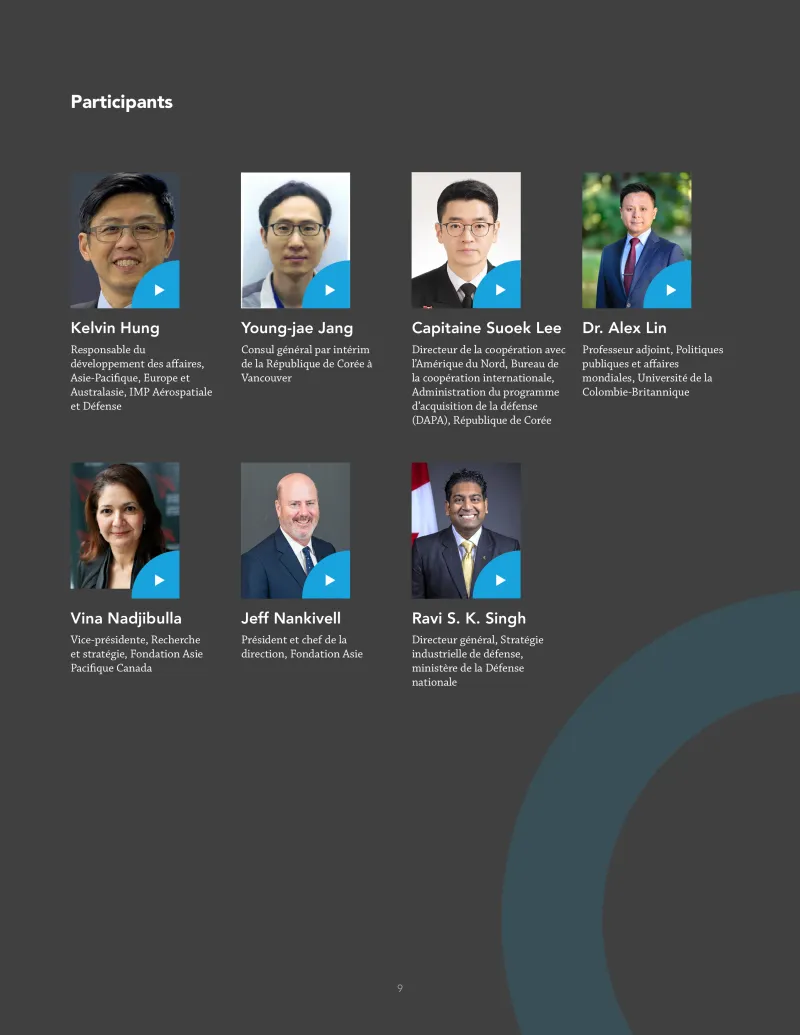
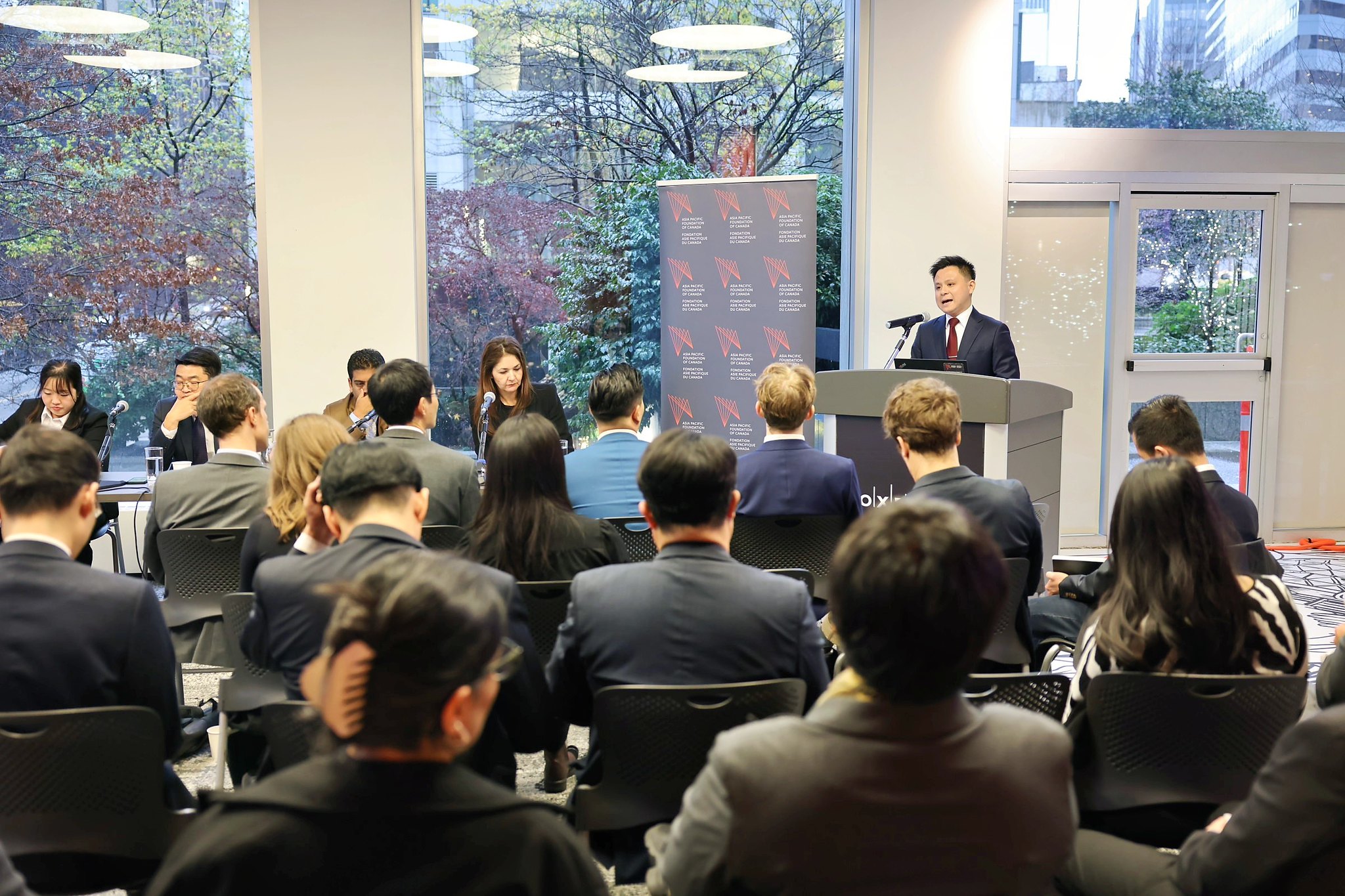
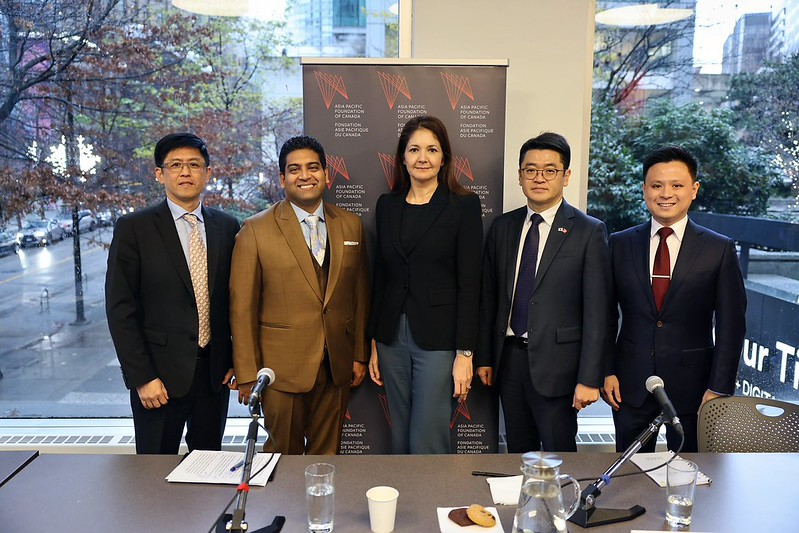
On December 8, 2025, the Asia Pacific Foundation of Canada hosted a strategic roundtable discussion in Vancouver, Canada, on Canada-Korea defence co-operation and its geopolitical implications. Panel discussants included Ravi S.K. Singh, Director General of Defence Industrial Strategy for Canada’s Department of National Defence; Captain Suoek Lee, Director for North America Cooperation of South Korea’s Defense Acquisition Program Administration; Kelvin Hung, Head of Business Development for IMP Aerospace and Defence, headquartered in Nova Scotia; and Alex Lin, Assistant Professor at the University of British Columbia’s School of Public Policy and Global Affairs. Opening remarks were provided by Vina Nadjibulla, APF Canada’s Vice-President Research & Strategy, and Young-jae Jang, Acting Consul General of the Republic of Korea in Vancouver. Ms. Nadjibulla moderated a discussion with the panellists, which was followed by a Q&A with the audience. The key takeaways are summarized below.
Opening Remarks: Strategic Momentum and Political Significance
Ms. Nadjibulla highlighted how the Canada-Korea relationship has evolved to a comprehensive strategic partnership and one of the clearest successes of Canada’s Indo-Pacific Strategy. In fact, among Canada’s Indo-Pacific partners, South Korea is the one with which Canada has advanced the furthest in the last two years across the full spectrum of engagement—diplomatic, security, defence-industrial, economic, and people-to-people ties.
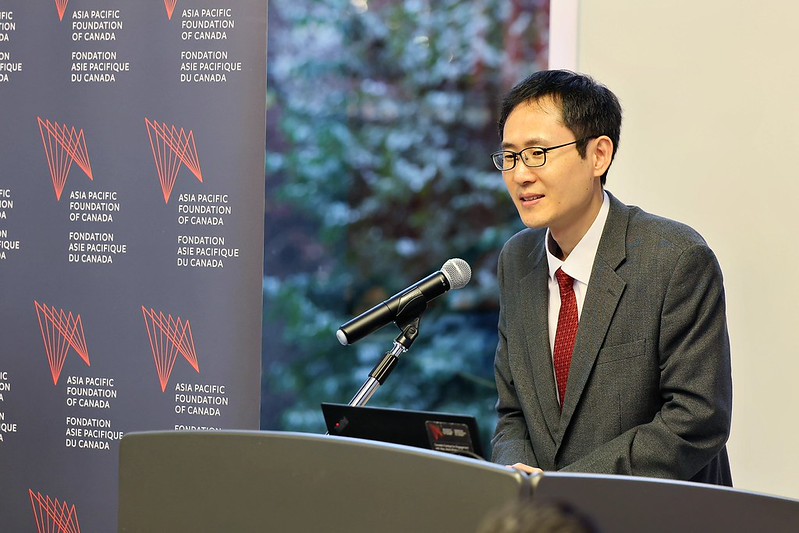
Acting Consul Jang added that bilateral relations have recently reached several milestones, including the 10th anniversary of the Korea–Canada Free Trade Agreement and the 75th anniversary of the Korean War, during which Canada contributed soldiers. High-level diplomacy and reciprocal leadership visits have reinforced this momentum: South Korean President Lee Jae-myung made Canada his first overseas destination, joining the G7 Summit in June 2025, while Canadian Prime Minister Mark Carney visited South Korea for APEC-related engagements in October 2025.
New forms of energy and technology co-operation have added strategic depth to the relationship. For example, the first-ever shipment of liquified natural gas (LNG) from Canada’s west coast to South Korea in 2025 highlighted Canada’s growing role as an Indo-Pacific energy supplier. And longstanding co-operation on nuclear energy, evidenced by the 50th anniversary of South Korea’s adoption of Canada’s CANDU reactor technology, underscores the maturity of bilateral ties.
Multilaterally, Canada’s invitation to South Korea to engage more deeply with the G7, including participation in the G7 energy and foreign ministers’ meetings, has elevated Seoul’s role as a global stakeholder.
Defence and Security as a Core Pillar
The panellists described defence and security co-operation as the most dynamic dimension of the Canada–Korea relationship. The Security and Defence Cooperation Partnership, signed by Carney and Lee in October 2025, is the first of its kind for Canada in the Indo-Pacific, and covers joint exercises and interoperability efforts, promotes research and development exchanges on emerging technologies, and expands trilateral co-operation with other like-minded partners in the region.
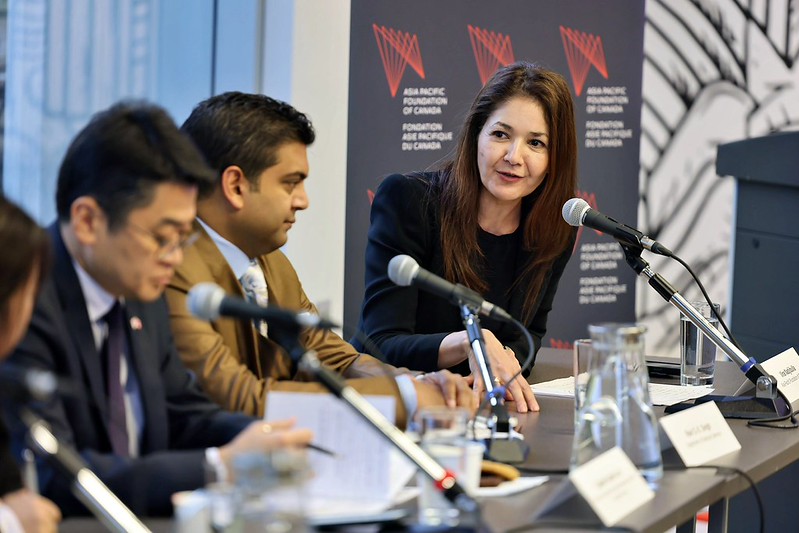
Ms. Nadjibulla also highlighted the importance of institutionalized consultation mechanisms, notably the “2+2” dialogue between the two countries’ foreign and defence ministers, with South Korea being the first Indo-Pacific country with which Canada has established such a format. These mechanisms operationalize co-operation and serve as a model for Canada’s broader defence engagement in the Indo-Pacific.
Finally, participants emphasized that the partnership must be understood as part of the growing strategic linkages between the Euro-Atlantic and Indo-Pacific security theatres. Mounting concerns in both regions about China, Russia, and North Korea’s co-ordinated threats reinforce the need for South Korea to think beyond the Korean Peninsula. Canada’s geographic position as a bridge between the Atlantic and Pacific, and as a major player in Arctic security, raises its strategic value to South Korea.
Canada’s Defence Industrial Strategy: From Platforms to Ecosystems
A central theme of the discussion was the growing convergence of economic security and national security in Canada. Canada’s forthcoming Defence Industrial Strategy reflects a shift away from a narrow focus on military platforms toward a broader ecosystem approach encompassing innovation, supply chains, human capital, and industrial resilience. The Strategy aims to provide clarity and predictability to industry rather than serve as a procurement list. Its core logic is that modern sovereignty depends not only on military assets but also on industrial depth and technological fluency.
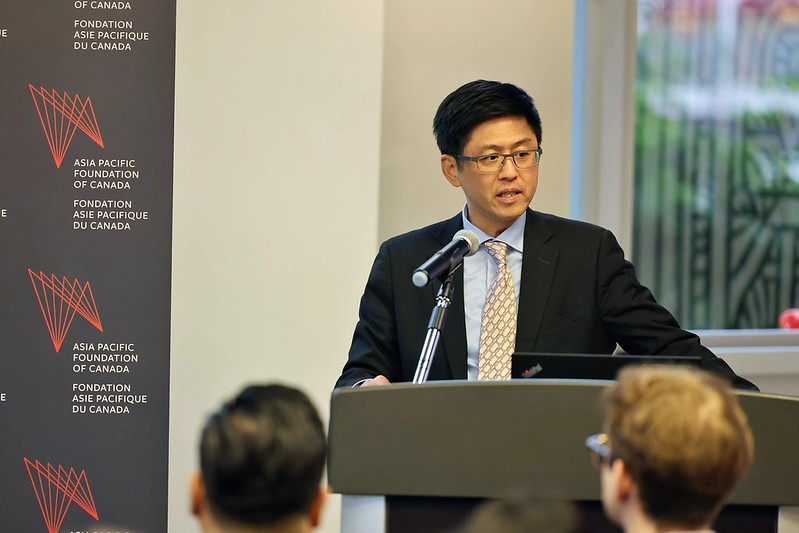
Canada’s comparative advantages include its world-class research capabilities in artificial intelligence (AI), quantum, cybersecurity, and advanced materials, as well as its wealth of critical minerals. However, as speakers pointed out, Canada cannot replicate the entire defence manufacturing spectrum on its own, making partnerships essential. The panellists agreed that South Korea’s strengths were highly complementary to Canada’s.
South Korea’s Strengths Make It a Natural Defence-Industrial Partner for Canada
Driven by the challenging security landscape on the Korean Peninsula, South Korea has developed one of the world’s most advanced and integrated defence industrial ecosystems, spanning research, production, exports, and sustainment across all domains. Of particular importance is its submarine capability, built on decades of operational and industrial experience.
Institutionally, South Korea’s Defense Acquisition Program Administration (DAPA) closely parallels Canada’s newly established Defence Investment Agency, creating opportunities for structured government-to-government co-ordination. As the speakers suggested, the complementarities are clear: Canada offers scientific talent, advanced aerospace capabilities, and critical minerals, while South Korea contributes scale manufacturing, shipbuilding, batteries, and advanced production capacity.
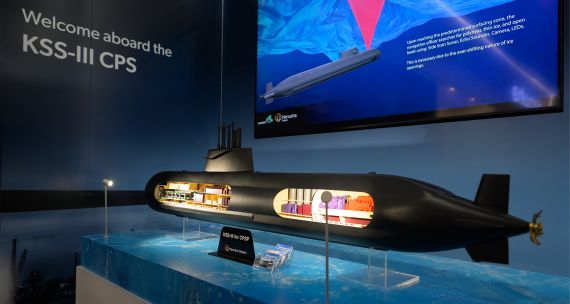
The discussion also touched on the Canadian Patrol Submarine Project (CPSP), which may become the most consequential test of the bilateral defence-industrial relationship. Valued at up to C$60 billion, the CPSP is widely seen as more than just a procurement decision—it is a potential anchor for decades of strategic industrial collaboration between the two countries.
The South Korean participants emphasized that the CPSP is not simply a contract, but a means for deeper integration across in-service support, training, technology transfer, and supply-chain resilience. Industry representatives suggested that the project’s Industrial and Technological Benefits (ITB) framework should be designed to foster long-term capabilities rather than short-lived offsets. This could include joint operation of a shared submarine platform to enhance interoperability, strengthening maritime security, and creating pathways for collaboration in fields such as sonar systems.
Hybrid Threats and Democratic Resilience
Ms. Nadjibulla reminded the audience that the Canada-Korea security partnership includes shared concerns about hybrid threats and the application of dual-use technology. One panellist drew the audience’s attention to the threat of disinformation and influence operations by China and Russia—threats that affect Canada and South Korea domestically, through polarization and erosion of trust, and internationally, by undermining alliances and shared narratives about regional security priorities. Combating hybrid threats was framed as crucial to democratic resilience and sustaining public support for defence co-operation in both countries. Integrated multilateral approaches such as the G7-plus frameworks were highlighted as particularly useful, as they link Canada’s key Indo-Pacific partners, such as South Korea, with its Euro-Atlantic allies.
An insight shared by one participant was that middle powers may be well-positioned to articulate credible narratives supporting the rule-based order—an increasingly contested concept, but one that Canada and South Korea have a strong interest in defining and defending.
Next Steps
While acknowledging the opportunities of the burgeoning Canada-Korea defence partnership, Ms. Nadjibulla pointed to possible challenges, given Canada’s close historical ties to the Euro-Atlantic theatre and its orientation toward NATO and the U.S., requiring a mindset shift and clearer strategic prioritization to fully embrace Indo-Pacific partnerships. In addition, there are differences in Canada's and South Korea’s threat perceptions, particularly the latter’s primary focus on North Korea versus Canada’s broader geographic concerns.
Participants also noted Canada’s institutional and regulatory complexity, and identified federal-provincial fragmentation as a potential obstacle to bilateral industrial collaboration. Industry participants emphasized the need for streamlined government-to-government mechanisms. This could include, for example, sharing operational data and getting clearance for industry actors to enhance co-ordination between key stakeholders, such as the Canadian Commercial Corporation (CCC) and South Korea’s DAPA, and reducing bureaucratic frictions. Canada’s Bureau of Research, Engineering and Advanced Leadership in Innovation and Science (BOREALIS) was mentioned as an example of such efforts.
Participants also noted capability gaps between the two countries, particularly in naval capacity, which would require sustained investment and clear strategic timelines from both sides. Finally, it was generally agreed that Canada and South Korea must deepen co-operation, through regular dialogue, on integrated threat assessments, particularly regarding China’s maritime behaviour.
Overall, the roundtable underscored that Canada–Korea relations have entered a new strategic phase. Defence and industrial co-operation now sit at the heart of the partnership, supported by converging strategic interests, complementary capabilities and resources, and a shared sense that security is inseparable from industrial resilience, technological innovation, and societal cohesion. If effectively institutionalized and sustained, Canada–Korea co-operation—anchored in projects like the CPSP and broadened to include hybrid threats and emerging technologies—has the potential to serve as a model for middle-power alignment in an era of intensifying geopolitical competition.