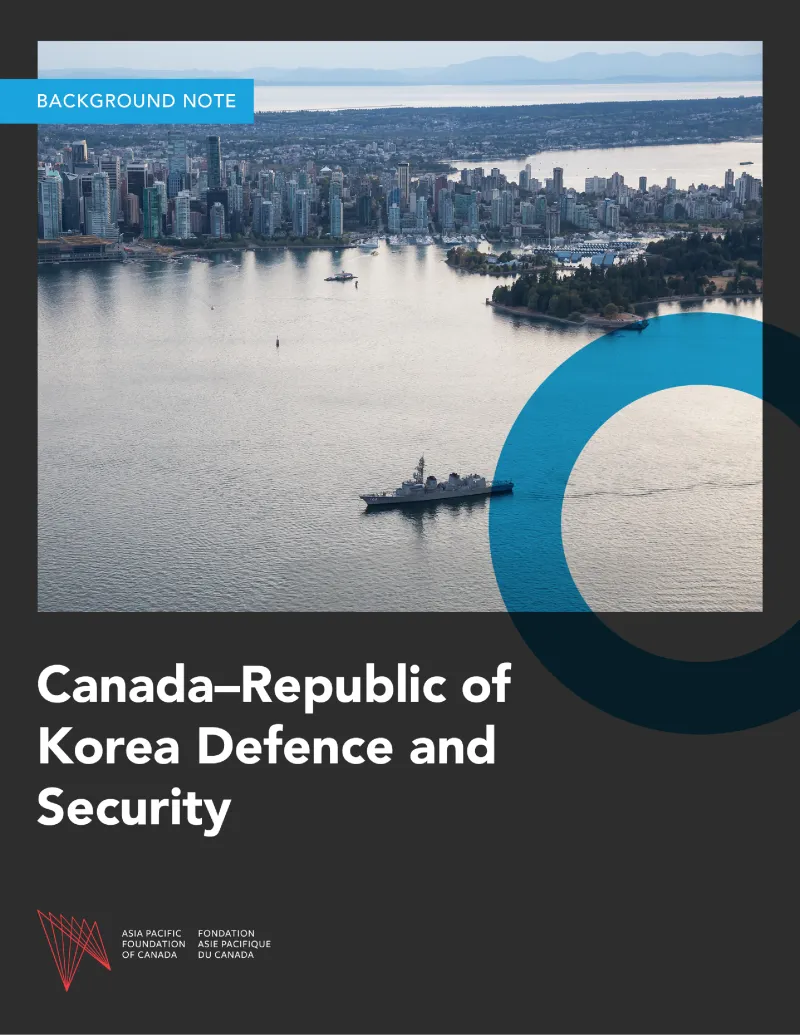
A Background Note in support of APF Canada's December 8, 2025, Strategic Roundtable on Strengthening the Canada-Republic of Korea Comprehensive Strategic Partnership Through Defence Co-operation in Vancouver, Canada.
In recent years, Canada and South Korea have elevated a formerly trade-centric partnership into a multifaceted strategic partnership, rapidly expanding their defence and security co-operation, most notably through the 2015 Canada-ROK Free Trade Agreement.
The Canada–South Korea security partnership is now one of Canada’s most dynamic relationships in the Indo-Pacific. While the two countries are not formal treaty allies, over the past few years, Ottawa and Seoul have begun treating each other as like-minded strategic partners, with a relationship anchored in shared democratic values and a rules-based international order, spelled out in such documents as Canada’s Indo-Pacific Strategy (2022) and Korea’s Global Pivotal State Strategy (2022).
Recent Milestones in Bilateral Defence Co-operation
This shift reflects converging interests: managing great-power competition and securing supply chains and emerging technologies that underpin national security. The 60th anniversary of bilateral relations in 2022 marked a pivotal moment as both governments deliberately upgraded their co-operation across policy, military, and industrial domains.
The 2022 Comprehensive Strategic Partnership (CSP) established pillars on security and defence, economic resilience, critical minerals, climate and energy security, and broader societal co-operation. This comprehensive scope signals that the relationship spans the full security spectrum. For defence, the CSP produced immediate steps: the renewal of the Defence Materiel Co-operation Memorandum of Understanding (MoU) (first signed in 2009; renewed in December 2022), the launch of a high-level economic security dialogue, and commitments to deepen information-sharing and critical minerals collaboration.
The 2024 CSP Action Plan operationalized these ambitions by aligning the partnership with both countries’ Indo-Pacific strategies. It prioritized defence co-operation on classified information-sharing, defence R&D, and emerging security issues such as maritime and cyber security. The Action Plan also laid the groundwork for the inaugural Foreign and Defence (2+2) Ministerial Meeting, held for the first time in November 2024. The ‘2+2’ mechanism — previously reserved by Seoul for mainly treaty allies — signalled a new level of trust and established a standing mechanism to guide bilateral security co-operation.
Defence industrial integration also expanded. In June 2024, the Canadian Commercial Corporation and the ROK’s Defense Acquisition Program Administration signed an MoU on Defence Industry and Procurement Co-operation. The agreement promotes defence-industry partnerships, familiarizes both sides with government-to-government procurement processes, and facilitates joint bids and co-production opportunities. This begins to shift the defence relationship beyond transactional procurement toward long-term industrial co-operation.
In October 2025, the two governments elevated the partnership further by launching the Canada-ROK Security and Defence Co-operation Partnership (SDCP) — Canada’s first dedicated bilateral defence roadmap with an Indo-Pacific partner. The SDCP institutionalizes annual ‘2+2’ ministerial meetings, director-general-level policy talks, Joint Materiel and Joint Defence R&D Committees, and expanded navy, army, air force, and space staff talks. It sets out practical areas of collaboration: more joint exercises and personnel exchanges, interoperability and logistics frameworks, expanded intelligence-sharing, closer NATO co-ordination, and enhanced defence-industry linkages. It also prioritizes emerging domains such as cyber, space, artificial intelligence (AI), and hybrid threats. Taken together, these developments create an increasingly dense architecture of predictable engagement across ministries, militaries, and industry.
Download the Full Report