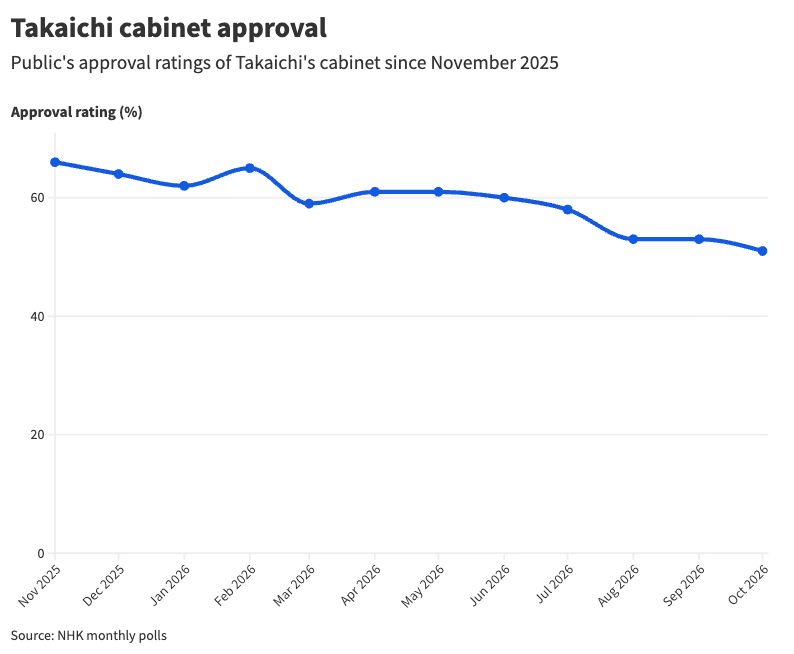
Over the last 12 months, Japan's "Iron Lady," Takaichi Sanae, has navigated the twists and turns of U.S. tariff diplomacy, a spat with China, an energy crisis, inflation, mounting debt, and more, but her polling numbers — despite dipping from a historic 'honeymoon' high — remain miraculously resilient.
Takaichi, the first woman to become Japanese prime minister, formally came to power on October 21, 2025, weeks after securing the leadership of Japan's ruling Liberal Democratic Party (LDP).
Her political fortunes have ebbed and flowed. She called a "risky" snap lower-house election for February and subsequently secured a historic 'supermajority,' but is stuck with a minority in Japan's upper house. She's also hardened the country's immigration policies, overseen so-so economic growth, and is aiming to cut Japan's food consumption tax from eight per cent to one per cent for a period of two years.
But Takaichi also supported an unpopular update to a law that will ensure only men can be emperors of Japan and, just last week, her handpicked (and scandal-plagued) farm minister resigned just a month into the job.
Takaichi started her political career in 1993 as an independent in Japan's House of Representatives. Three years later, she joined the LDP.
Between Trump and Xi
Takaichi has, by most accounts, skillfully managed her relationship with U.S. President Donald Trump, leaning occasionally on flattery. (In return, Trump once called her a “person of great wisdom and strength.")
Earlier this month, Takaichi even relaunched "a so-called Japanese version of the U.S. Department of Government Efficiency," in a bid to cut costs. (Although much of Japan's debt is held domestically, the country does have the highest public debt ratio among advanced economies — "roughly double the G7 average," according to the IMF.) Trump has complained to Takaichi, however, about the yen's continued slide against the U.S. dollar.
China has been the bigger issue for Takaichi, with the two countries locked in a spat for much of her premiership: Beijing was outraged after Takaichi said that a Chinese naval blockade of Taiwan would represent a "survival-threatening situation" for Japan.
In a speech this month, she appeared to double down on her position, saying: "Attempts to change the status quo by force must never be tolerated anywhere in the world. Japan will continue to champion this principle on the global stage."
Beijing has repeatedly tried to paint Takaichi as an unpopular, militant leader. This week, for example, even as a Japan Times headline read: "One year in, Takaichi administration’s public support remains largely intact," a Chinese state-run media outlet reframed the debate, arguing: "One year on, Sanae Takaichi’s ‘approval rating bubble’ is about to burst."
Canada–Japan relations, meanwhile, have blossomed under Takaichi: the two countries upgraded ties to a Comprehensive Strategic Partnership in March, spanning defence, energy, trade, and technology. Japan is Canada’s fourth-largest source of foreign direct investment; bilateral trade is valued at close to C$40 billion.