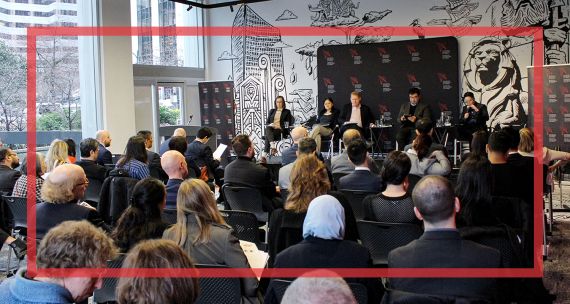
On March 13, 2026, the Asia Pacific Foundation of Canada partnered with the Georgetown Center for Asian Law to host a panel discussion in Vancouver, B.C., on "Foreign Interference in Open Societies: Risks, Limits, and Guardrails."
Panel discussants included Thomas Kellogg, Executive Director of the Georgetown Center for Asian Law; Lynette Ong, Distinguished Professor of Chinese Politics at the University of Toronto and Senior Fellow (non-resident) at APF Canada; Eric Lai, Senior Fellow at the Georgetown Center for Asian Law; and Sze-Fung Lee, Independent Researcher.
The panel was moderated by Elizabeth Donkervoort, Senior Advisor of APF Canada’s China Program.
APF Canada President and CEO Jeff Nankivell opened the event by stressing its centrality to APF Canada's mission. Beyond highlighting opportunities in the Indo-Pacific, he emphasized, APF Canada's role is to prepare Canadians to engage with the region in ways that protect their prosperity, security, and democratic values. He grounded the event in a broader imperative: to see the world "as it is," even as we work toward the world "as it should be."
While the discussion centred on the People's Republic of China (China) — consistently assessed as one of the most sophisticated and pervasive sources of foreign interference (FI) globally — the moderator was careful to note that this focus should not be read as minimizing the interference operations conducted by other states.
Lynette Ong presented findings from a 2024 public opinion survey by the Munk School of Global Affairs & Public Policy on Canadian attitudes toward FI. Most Canadians view FI as a serious threat to democratic health, and a large segment of Chinese, Hong Kong, Tibetan, Taiwanese, and Uyghur respondents reported experiencing transnational repression (TNR) — frequently through online harassment and threatening phone calls. The findings also exposed a policy gap: no widely understood reporting channel currently exists for those affected.
Thomas Kellogg addressed the limits of formal legal processes, noting that TNR perpetrators operating outside the U.S. and Canada are largely beyond the reach of domestic law. Framing his remarks around Hong Kong diaspora communities — now the primary voice for pro-democracy advocacy as Hong Kong slides into soft authoritarianism — he highlighted tactics including bounties and imprisonment of family members. Kellogg stressed that diplomacy must anchor any government response to PRC-affiliated TNR, with trade and engagement tied to human rights considerations, and called for stronger immigration and resettlement protections for vulnerable communities, such as people from Hong Kong.
Sze-Fung Lee focused on the multifaceted, integrated nature of TNR campaigns, cautioning against fixating on moments of exposure — when harm becomes visible — and overlooking the earlier stages of planning and preparation. They introduced a country-agnostic tactical framework for analyzing the tactics, techniques, and procedures used in FI and TNR operations, walking the panel through its application to PRC-affiliated campaigns as a blueprint for prevention.
Eric Lai discussed Hong Kong's consolidation of authoritarianism, focused on controlling communities both within and outside the Special Autonomous Region (SAR). Citing two new policy documents from Hong Kong and Beijing, he warned that their efforts to control overseas activities are likely to intensify. Lai described how authorities deploy psychological pressure, cognitive influence, and lawfare against diaspora and local communities, and offered insights on integrating top-down policy with bottom-up community-driven responses.
Key insights
FI and TNR must be understood as systematic, multi-stage operations involving surveillance, proxy mobilization, and coercion. Interference operations target diaspora communities and, increasingly, non-Chinese nationals, with significant implications for civic participation, social cohesion, and democratic institutions across Canada and other democracies.
FI is not only a national security issue, but a multi-dimensional challenge spanning human rights, democratic governance, and information integrity. A narrow security framing risks overlooking the cumulative psychological effects of cognitive and coercive tactics on individuals, communities, and democratic institutions.
China also uses economic leverage strategically in its interference operations. As Canada deepens engagement with China in a period of global economic volatility, it must ensure that commercial considerations do not come at the expense of Canadian values of human rights and democracy.
Legal measures alone are insufficient. Effective responses must be whole-of-society, value-based, and carefully calibrated to not only avoid stigmatizing diaspora communities but to proactively disrupt operations to prevent harm.
This approach demands sustained investment, not only in security infrastructure but in the resources, information, and technical support communities need to assess and address FI.
Operational tactics and characteristics
Public debate around FI typically begins only when a case becomes visible, such as harassment at a protest, detention of family members, or online disinformation campaigns, by which point individuals and communities have already been harmed.
However, Chinese interference operations consist of multiple stages. Identifying operations — including reconnaissance, surveillance, and the infiltration of diaspora communities — earlier on is essential to preventing escalation and disrupting future interference campaigns.
Additionally, activities that appear harmless in isolation can accumulate and be used to intimidate, surveil, or delegitimize individuals and distort information environments. An illustrative example is the co-ordinated spread of false narratives about MP Michael Chong’s identity — including claims about his background, political views, and family heritage — aimed at discrediting him among Chinese-speaking communities in Canada. Other common interference tactics used by Chinese agents and their affiliates include:
Outsourced repression: Co-opting or coercing otherwise legitimate non-state actors such as hometown associations or community groups to conduct surveillance, intimidation, or narrative manipulation campaigns on behalf of China.
Abductions and forced repatriations: Circumvent formal extradition processes and violate both the sovereignty of host states and the rights of targeted individuals.
Shadow policing: The unauthorized activities of police, intelligence officers, or their affiliates operating in a host country to conduct surveillance, intimidation, or other forms of coercion of targeted individuals and communities.
AI-enabled disinformation: Used to scale campaigns using deepfakes (manipulated videos and audio) to discredit activists and sow confusion.
Lawfare: Exploitation of laws in the host country, or in China, to support harassment, intimidation campaigns, and the discrediting of targets.
Impacts and risks
TNR widely felt among diaspora communities
Research and testimony suggest people of Chinese, Hong Kongese, Tibetan, Uyghur, and Taiwanese heritage are disproportionately affected by the most severe form of Chinese interference: TNR. Tactics may be direct or indirect, often involving psychological pressure and threats against relatives, friends, or close associates who remain in China to suppress diaspora activism.
TNR is highly effective at chilling civic participation across communities. Individuals may avoid protests or association with “sensitive” figures for fear of being identified and placing family members in China at risk. TNR also leads to broader concerns about travelling to countries with close ties to Beijing, or even transiting their airspace, noting incidents such as the forced flight diversion and detention of Belarusian activist Roman Protasevich.
An expanding and enduring threat
Recent policy documents suggest that Chinese interference and TNR campaigns are likely to intensify. The recent white paper Hong Kong: Safeguarding China's National Security Under the Framework of One Country, Two Systems identified the "reverse flow" of political activism by overseas activists back into Hong Kong as a significant risk to national security. A separate law passed at the National People's Congress in March 2026 on ethnic unity stipulates that overseas activities deemed to threaten China's ethnic unity can be punished under Chinese law. Tibetan, Uyghur, Hong Kongese, and other vulnerable Chinese communities living in Canada and elsewhere are likely to experience the brunt of this intensification.
Deeper engagement requires greater vigilance
China uses economic leverage strategically to build influence among elites in key sectors — including law, business, and politics — within democratic countries. In the context of global economic volatility, deeper engagement with China can heighten these dynamics. Panellists warned that engagement shouldn’t come at the expense of human rights, public safety, or freedom of expression and noted that coercive practices such as hostage diplomacy, coercion, and the targeting of diaspora communities make economic engagement less stable in the long term.
Canada's response: persistent gaps
Canada has taken a leading role in addressing FI in recent years. The Public Inquiry into FI led by Justice Marie-Josée Hogue was one of the most rigorous government-led efforts to grapple with FI globally. Canada is also among a small number of democracies to have enacted dedicated foreign influence legislation and has helped elevate the issue internationally through its leadership within the G7. While these measures mark important progress, further action is needed in Canada and in other jurisdictions to counter FI.
Institutional fragmentation limits effectiveness. Responses to FI remain siloed across foreign policy, law enforcement, human rights bodies, and victim support services. Co-ordination and communication across these entities is lacking, leaving victims of FI uncertain about where to seek protection or redress.
Community trust is fragile. Diaspora communities are too often treated as sources of information rather than as stakeholders with rights, knowledge, and a role as partners in countering interference. This sense of disempowerment is compounded when local authorities lack the capacity to respond effectively to reports, particularly at earlier stages. In some cases, victims have even been advised to avoid protests or limit lawful public activity. Such experiences deepen mistrust and leave affected communities feeling unsupported and unwelcome in the very countries meant to protect them.
Guardrails for countering foreign interference
The whole-of-society approach necessary to countering FI in open societies requires more than updated legislation, infrastructure, or increased defence spending. It demands sustained political will to enforce laws in ways that reflect both the evolving tactics and their systemic impacts. It also requires partnership with affected communities, not as victims, but genuine partners in strengthening democratic resilience.
Panellists identified several actionable steps policymakers can take as the next phase of efforts to counter FI:
Focus on earlier stages of interference operations. Identify early indicators of FI operations, based on well-documented tactics, and empower affected communities to recognize and respond to these early indicators. Risk-monitoring and mitigation practices from other sectors, such as cybersecurity, offer useful models for strengthening early detection and response.
Protect communities without stigmatizing them. Approaches should be evidence-based, focused on state-linked actors and systems, and avoid treating diaspora communities as inherently suspect. Policies must also address the specific vulnerabilities diaspora communities face by providing targeted support, such as greater immigration certainty for those at risk.
Close capability and trust gaps in frontline response. Improve information-sharing across government, civil society, and affected communities. Integrate diaspora and victim perspectives in law enforcement training on FI and TNR to improve operational responses and to build public trust.
Recognize the strategic leverage of democratic values in engagements with China. Open societies have more leverage than they think, especially when acting in concert with like-minded countries. Canada and its allies should make clear that the targeting of people living in democratic countries is not a peripheral concern, but a core issue in the relationship with Beijing.
Address technological vulnerabilities that amplify FI. Rapid advances in AI and other emerging technologies accelerate the scale, precision, and reach of interference operations. A whole-of-society response requires investments in democratic infrastructure, including independent fact-checking capacity and systems for the rapid detection and response to AI-generated content. These safeguards are essential for countering interference and strengthening democratic resilience more broadly.
• Edited by Vina Nadjibulla, Vice-President Research & Strategy, and Ted Fraser, Senior Editor, APF Canada.