Executive Summary
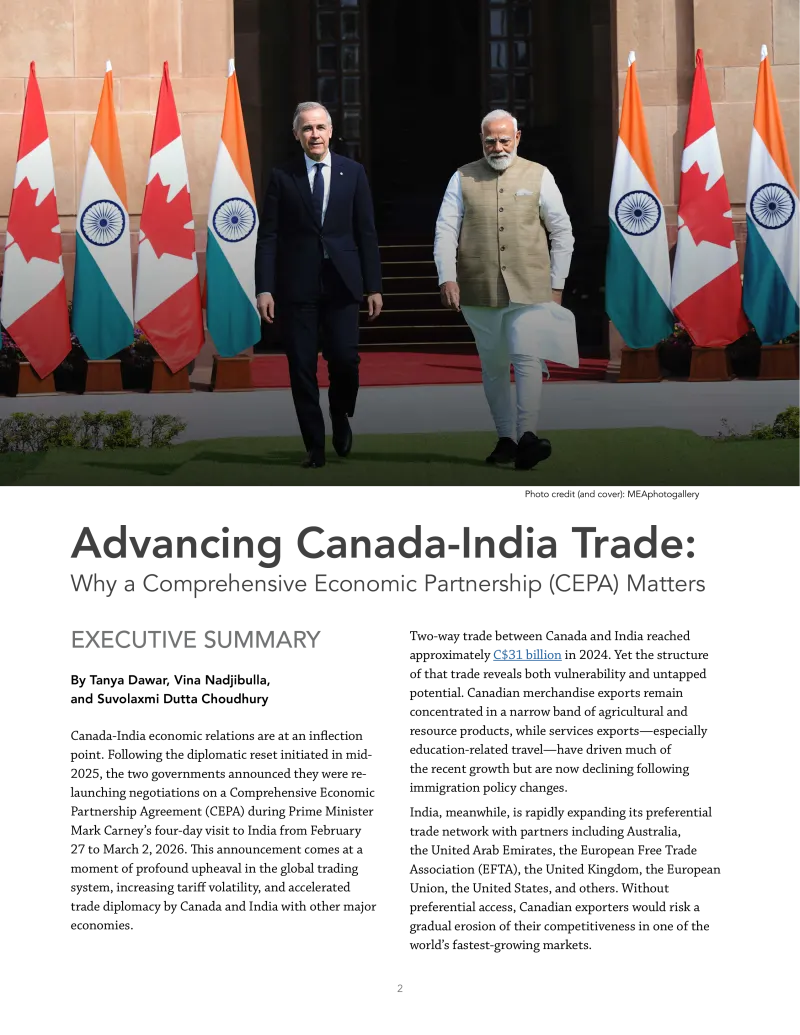
Canada–India economic relations are at an inflection point. Following the diplomatic reset initiated in mid-2025, the two governments announced they were re-launching negotiations on a Comprehensive Economic Partnership Agreement (CEPA) during Canadian Prime Minister Mark Carney’s four-day visit to India from February 27 to March 2, 2026. This announcement comes at a moment of profound upheaval in the global trading system, increasing tariff volatility, and accelerated trade diplomacy by Canada and India with other major economies.
Two-way trade between Canada and India reached approximately C$31 billion in 2024. Yet the structure of that trade reveals both vulnerability and untapped potential. Canadian merchandise exports remain concentrated in a narrow band of agricultural and resource products, while services exports—especially education-related travel—have driven much of the recent growth but are now declining following immigration policy changes.
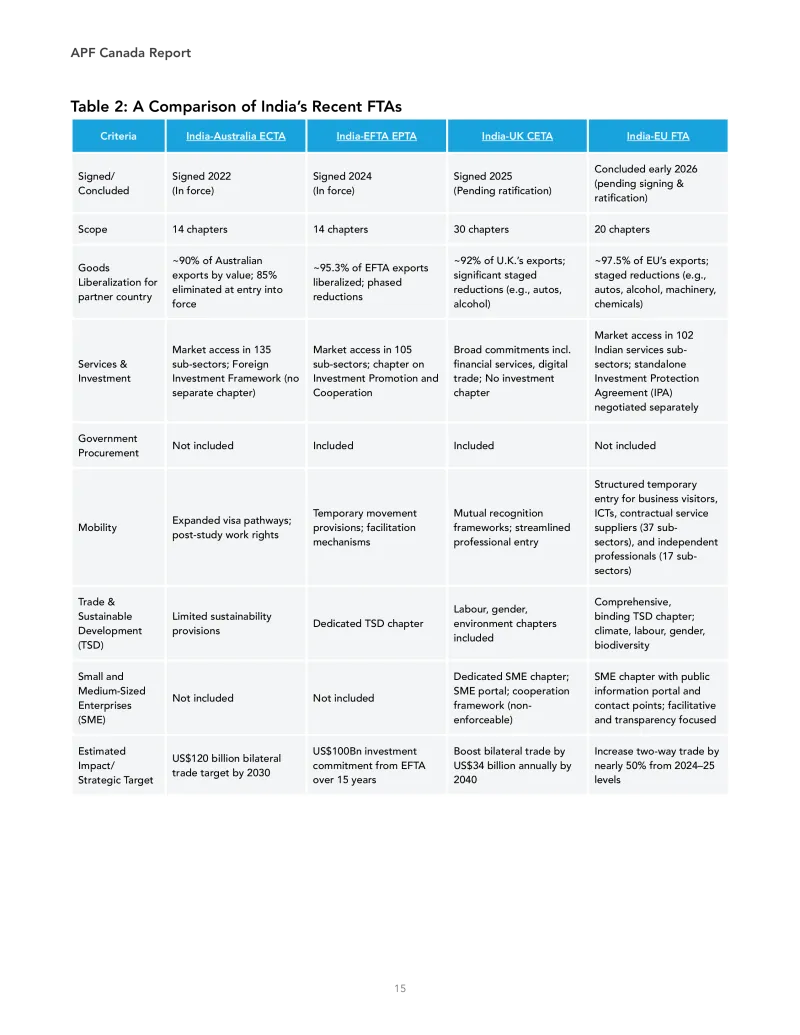
India, meanwhile, is rapidly expanding its preferential trade network with partners including Australia, the United Arab Emirates, the European Free Trade Association (EFTA), the United Kingdom, the European Union, the United States, and others. Without preferential access, Canadian exporters would risk a gradual erosion of their competitiveness in one of the world’s fastest-growing markets.
Key Takeaways:
1. Canada–India trade, while substantial, is structurally imbalanced and under-leveraged.
Two-way trade has been driven heavily by services—particularly education-related travel. However, merchandise trade remains modest relative to economic size, and Canada’s exports are highly concentrated in a narrow band of agricultural and resource products.
2. Canada’s services surplus with India is vulnerable to policy shocks.
Services trade—especially travel linked to international students—has powered recent growth in bilateral trade. But changes in immigration policy and study permit reductions in 2024–25 have already begun to reduce Canadian services exports. A more resilient Canada-India economic partnership must shift toward higher-value commercial services, including digital, financial, engineering, and R&D collaboration.
3. Tariff asymmetry leaves Canadian exporters disadvantaged in India’s fastest-growing sectors.
Canadian goods face Indian tariffs ranging from moderate (5–10%) to prohibitive (up to 125% on automobiles). Meanwhile, India has concluded trade agreements with Australia, the UAE, EFTA, the U.K., and others, granting competitors preferential access. Without a Comprehensive Economic Partnership Agreement, Canadian firms will continue losing market share in sectors where Canada is globally competitive.
4. Canadian provincial export strengths align closely with India’s growth priorities.
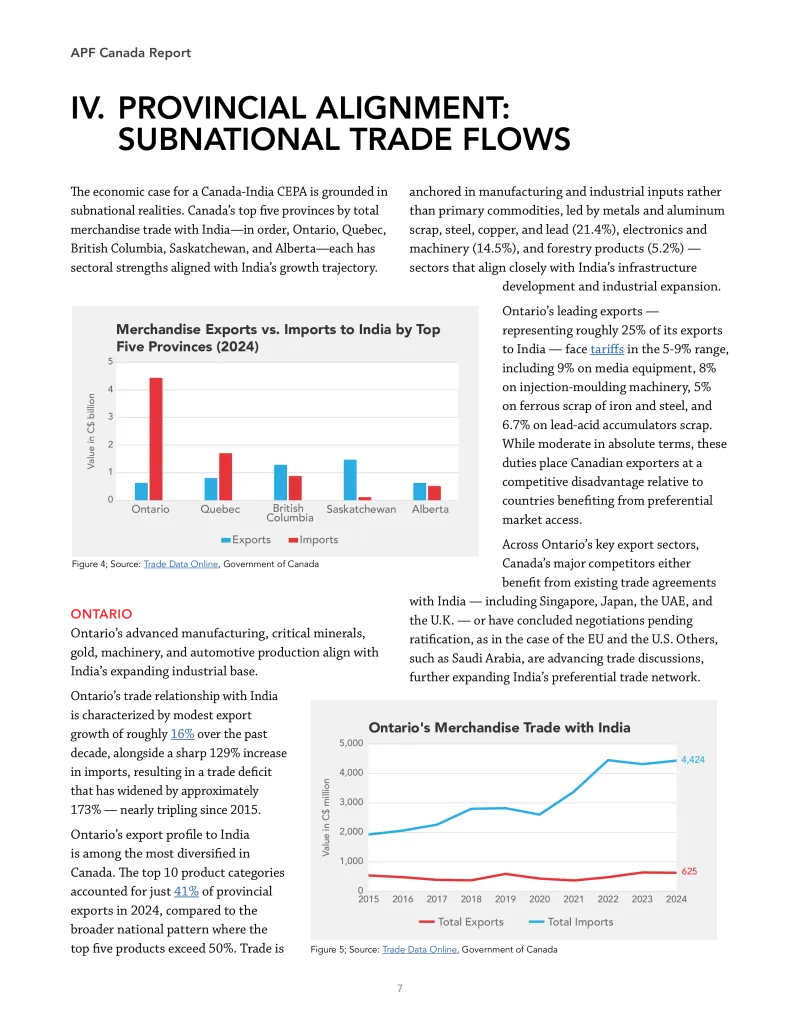
Ontario’s advanced manufacturing and critical minerals; Quebec’s aerospace, forestry, and metals; British Columbia’s energy, copper, and LNG; Saskatchewan’s agri-food, potash, and uranium; and Alberta’s energy and agri-food all have sectoral complementarities with India’s industrial, energy, and infrastructure expansion. The economic case for a CEPA is regionally grounded.
5. Investment ties are large but have been impacted by recent political tensions
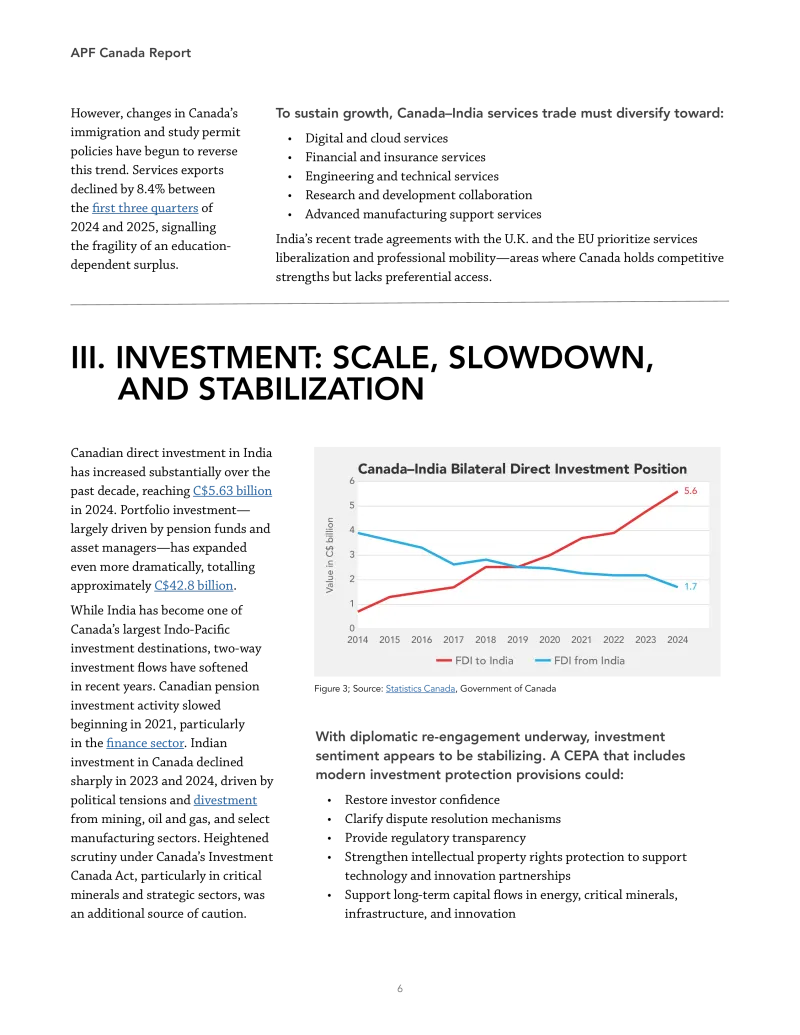
Canadian portfolio and pension investments in India remain significant but have slowed. Indian investment in Canada has declined sharply following political tensions and heightened scrutiny under the Investment Canada Act. A CEPA with modern investment protection provisions could help stabilize and expand two-way capital flows.
6. Energy and critical minerals could anchor a broader economic reset.
The C$2.6 million deal to supply uranium to India, secured on March 2, signalled the two countries’ renewed energy co-operation, which also includes trade in liquefied natural gas (LNG), crude oil, clean fuels, and critical minerals. Translating this political momentum into commercially viable projects will help build trust and create tangible wins to underpin a wider trade agreement.
7. A CEPA is no longer optional—it is strategic.
In an era of U.S. tariff volatility and China-related economic risk, trade and economic diversification has become a strategic imperative. India is negotiating trade agreements at speed with other major economies. Unless Canada follows through on the recent CEPA commitment, Canada will forfeit the opportunity to gain preferential access to the Indian market and risk strategic marginalization in one of the world’s fastest-growing economies.