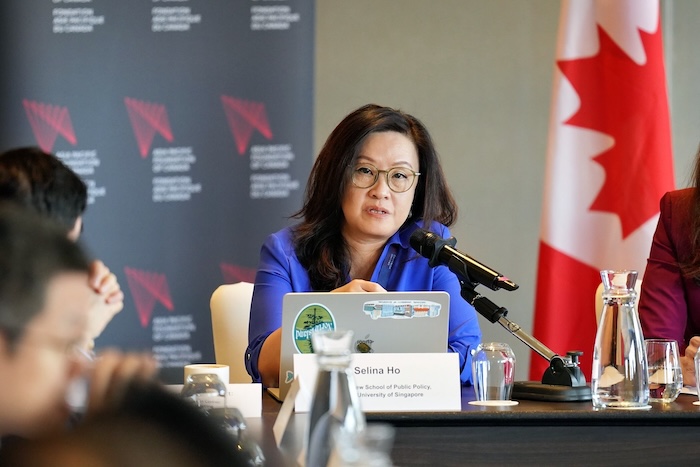
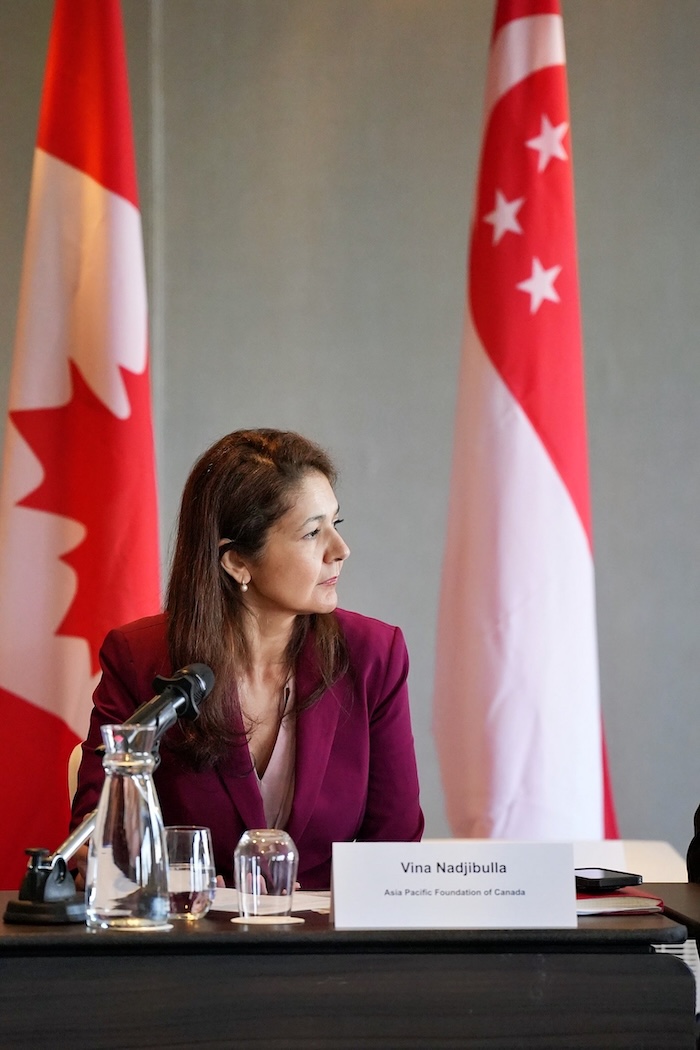
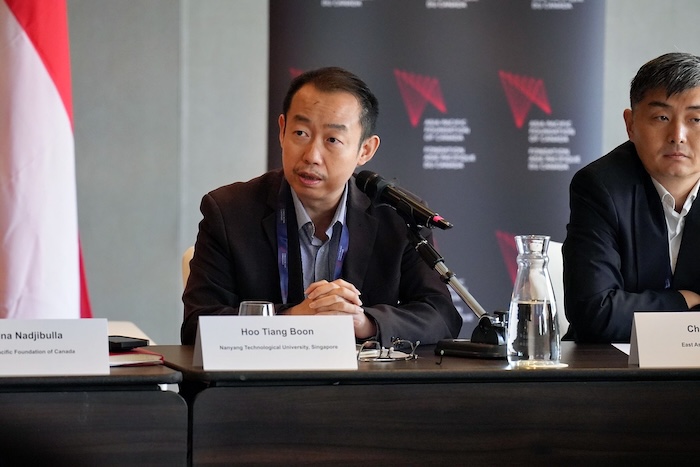
On February 11, 2026, APF Canada convened an expert roundtable in Singapore on the margins of this year’s Canada-in-Asia Conference. Titled China Unbound? Domestic Pressures and Regional Consequences, the roundtable examined how developments inside China are shaping its engagement with Southeast Asia and how regional governments are responding. The session featured officials, regional scholars, and policy practitioners for a candid exchange on China’s domestic trajectory and its regional implications.
The discussion focused on the interaction between China’s internal political economy and its external behaviour, including whether China’s recent posture reflects growing strength, rising insecurity, or adjustment to mounting economic pressures at home. It also focused on how Southeast Asian governments are responding to these shifts while navigating U.S.-China strategic competition.
Three themes emerged during the exchange. First, China’s regional posture appears shaped less by a single trajectory of expansion or decline than by by continued adjustment to domestic pressures. Second, Southeast Asian states are managing China’s growing influence through diversification and strategic autonomy rather than exclusive alignment. Third, regional tensions are more likely to accumulate gradually than unfold through a decisive rupture. Together these dynamics point to a fluid regional environment in which competition, hedging, and cooperation coexist.
Domestic pressures and external adjustment
The discussion began with a shared premise that China’s domestic constraints are increasingly shaping its external posture. Demographic decline, property sector weakness, and rising local government debt were repeatedly cited as structural pressures that will weigh on growth over the coming decade.
One participant suggested that local government liabilities may exceed what is visible at the central level, reflecting the widespread use of off-budget financing vehicles and other local borrowing channels. Pandemic-era spending and the subsequent property downturn have further strained local fiscal systems, exposing deeper vulnerabilities in municipal and provincial public finance.
Stress within segments of the financial system was also highlighted. Difficulties among smaller banks and trust companies – including a few recent failures – illustrate continuing strain in parts of the credit system. These developments were not viewed as evidence of imminent systemic crisis, but they underline the limits within which policymakers are operating.
A related question concerned whether meaningful economic reform remains politically feasible under current conditions. Some participants argued that structural reform would ultimately require political change, but that Beijing has shown little appetite for either such reform or change. Its policy responses are therefore likely to remain incremental rather than transformative.
China’s recent growth pattern was another point of discussion. Export performance has played an unusually large role in sustaining economic expansion. Available estimates indicate that net exports accounted for more than two-thirds of GDP growth in 2024–2025, their largest contribution in decades. Weak domestic consumption alongside strong industrial output has reinforced the economy’s external orientation. At the same time, Beijing retains significant fiscal resources and administrative capacity. From this perspective, financial adjustment would likely involve debt restructuring and gradual consolidation rather than systemic disruption.
These domestic pressures are also shaping China’s external economic strategy. The April 2025 Central Conference on Work Related to Neighbouring Countries – the first such meeting since 2013 – was cited as evidence of renewed strategic attention to China’s regional periphery. The shift in terminology from “periphery diplomacy work” to “periphery work” suggests a more integrated policy framework combining economic, political, and security instruments.
A growing shift of Chinese manufacturing investment toward Vietnam, Malaysia, Thailand, and Indonesia illustrates this outward adjustment. Provincial governments and research institutions appear to be supporting firms relocating production into these markets. Chinese electric vehicles and manufactured goods have simultaneously expanded their presence in Southeast Asian markets as access to U.S. and European markets has tightened. These trends raise questions about how sustainable China’s outward economic expansion will be. Continued export-driven growth could intensify pressure from industrial overcapacity in sectors such as steel, solar panels, and electric vehicles. Anti-dumping investigations initiated by several Southeast Asian governments such as Malaysia, Indonesia and Vietnam, signal emerging strain.
Meanwhile, Chinese firms operating in the region are also adapting to local conditions. Greater reliance on domestic labour, joint ventures with local partners, and closer attention to regulatory frameworks have become more common. These adjustments suggest a process of adaptation rather than simple market displacement.
The relationship between domestic financial constraints and outward expansion therefore remains uncertain. Economic pressures could encourage further expansion into external markets, but tighter financial conditions at home could also limit overseas investment.
Southeast Asia: Influence without alignment
China's growing economic footprint in Southeast Asia has not translated into straightforward political influence, a gap that reveals as much about the region's own preferences as it does about Beijing's ambitions. Survey data referenced during the session indicate that regional elites widely identify China as the most influential external actor in Southeast Asia, particularly in economic terms. At the same time, ASEAN remains the institution with which regional elites identify most strongly.
 This pattern suggests that China’s economic weight does not automatically translate into regional political leadership. Chinese political norms and governance models have limited resonance across Southeast Asia, creating structural limits on Beijing’s ability to shape regional order. Recognition of China’s economic importance therefore coexists with efforts by Southeast Asian governments to preserve strategic autonomy. ASEAN centrality remains a key organizing principle, and regional states continue to diversify external partnerships rather than consolidate relations with any single power.
Maritime disputes, sovereignty concerns, and domestic political constraints shape the limits of alignment. Anti-Chinese sentiment in Indonesia and Malaysia, environmental and labour controversies linked to Chinese investment projects, and criminal networks involving Chinese actors in parts of Southeast Asia were cited as recurring sources of political sensitivity. Even so, Beijing appears conscious of the limits. Foreign Minister Wang Yi’s remarks downplaying maritime disputes as a defining issue in China-ASEAN relations were read by participants as tacit recognition that security assertiveness carries diplomatic costs.
Where diplomatic and political influence has met resistance, China's security engagement with the region has expanded to fill some of the gaps. Military exercises with Southeast Asian partners have become more frequent, and China has emerged as an arms supplier for countries facing restrictions on Western procurement. Another development is the growing presence of Chinese private security companies. Following legislation enacted in Myanmar in early 2025, Chinese private security firms have been permitted to operate at facilities including Kyaukphyu Port. Personnel in these firms often have security or intelligence backgrounds, reflecting patterns already visible in other regions where Chinese infrastructure investments have expanded.
Security risks and strategic space
When the discussion shifted to Taiwan and Japan-China relations, participants repeatedly returned to the broader question of whether regional tensions are approaching a breaking point or are more likely to evolve through sustained pressure and incremental escalation.
On the Taiwan question, assessments diverged. One view held that near-term conflict remains less likely than often portrayed. Several constraints were highlighted, including domestic political dynamics in Taiwan, continued economic interdependence across the Taiwan Strait, and the reputational risks for China’s leadership associated with a failed military operation. Survey data from China indicating very limited public support for the use of force reinforced this perception. Taken together, these factors suggest that Beijing remains incentivized to avoid outright conflict.
 A second interpretation focused less on invasion scenarios and more on gradual escalation. Expanding military exercises, increasingly close encounters between naval and air assets, cyber pressures, and sustained economic or maritime coercion could intensify tensions without crossing the threshold of war. Under this scenario, instability emerges through cumulative pressure and miscalculation rather than deliberate conflict initiation.
Japan-China relations were another focal point of discussion. Japan-China tensions, participants noted, cannot be read in isolation from Taiwan. It was precisely Tokyo's exposure to any Taiwan contingency that gave Japanese Prime Minister Sanae Takaichi's remarks their weight. Her characterization of Taiwan’s security as an existential Japanese national security concern prompted a strong response from Beijing, including trade measures and a widely circulated statement by a Chinese consular official in Osaka. Tokyo has since avoided further escalation, leaving the pace of any stabilization largely dependent on Beijing’s next steps. Historical memory continues to shape this relationship. Narratives surrounding Japanese wartime aggression remain embedded in the Chinese Communist Party’s domestic legitimacy narrative, constraining Beijing’s room for diplomatic compromise even when practical incentives for stabilization exist.
Participants pointed to the 2014 four-point consensus between the late Japanese prime minister Shinzo Abe and Chinese President Xi Jinping following the Senkaku/Diaoyu crisis as a precedent for partial stabilization. That agreement allowed tensions to ease without resolving the underlying dispute or halting Chinese patrol activity around the islands. A separate line of discussion considered the U.S.’s potential role in managing tensions. One possible source of movement on the Japan-China impasse, one participant suggested, may come from outside the bilateral relationship itself. U.S. President Donald Trump’s willingness to engage Xi Jinping directly outside conventional diplomatic channels was cited as a potential pathway to de-escalation, particularly given expectations that Xi may visit the U.S. later in 2026.
Throughout the discussion, the prevailing assessment was that regional instability, if it emerges, is more likely to develop through accumulated pressure and episodic crises than through a single decisive event.
Implications for Canada
The discussion concluded with reflections on what these dynamics could mean for Canada’s engagement in Southeast Asia. Regional partners continue to signal interest in diversified external partnerships, and Canada is generally viewed as a constructive presence that is not associated with the alignment pressures of major-power rivalry. This perception creates space for engagement grounded in economic cooperation, institutional partnerships, and policy dialogue.
Demand for Canadian trade and investment remains strong across parts of the region, though participants noted a persistent gap between that demand and the regulatory conditions typically required by Western investors. In practice, this reflects investment constraints and governance standards rather than political resistance. Canada’s environmental and community-impact standards were identified as a potential comparative advantage in this context. While such standards have occasionally generated friction in the past, they may carry increasing weight in a regional environment where some Chinese-linked mining and infrastructure projects have raised concerns over environmental and social impacts.
Canada does not play a primary security role in the region, but the broader strategic environment nonetheless shapes the context for its engagement. Developments surrounding Taiwan, maritime disputes in the South China Sea, and adjustments to U.S. force posture in Japan, Korea, and the Philippines all influence regional risk perceptions and policy choices. Within this environment, ASEAN-centred cooperation, research partnerships, and sustained policy dialogue were seen as practical avenues for Canadian engagement.
• Edited by Vina Nadjibulla, Vice-President Research & Strategy, Erin Williams, Director, Programs, and Ted Fraser, Senior Editor, APF Canada