The controversy around Liberal MP Michael Ma’s comments on forced labour in China is an early test of how Prime Minister Mark Carney’s China policy is being put into practice — and whether it can remain pragmatic without drifting into equivocation, accommodation or self-censorship.
Carney’s recalibration — toward a more interest-based approach aimed at stabilizing ties with Beijing while widening Canada’s options in a period of growing economic insecurity and overdependence on the United States — has clear strategic logic. In a world of coercive interdependence, middle powers need more room to manoeuvre.
China remains one of Canada’s most important economic relationships. And Canada has real interests in rebuilding relations with China in areas such as trade, energy, agriculture, and selective multilateral cooperation. Therefore, a more pragmatic, interest-driven approach is both necessary and overdue.
In Carney’s own Davos framing, pragmatism was meant to be paired with principle. His call for a “principled and pragmatic” foreign policy was rooted in the argument that middle powers must act with honesty and uphold values such as human rights, sovereignty, and territorial integrity. It was never intended to imply that, in trying to avoid friction with Beijing, Ottawa would begin to hedge on established facts, soften its language on documented human rights abuses, or narrow its own political space on issues such as Xinjiang and Taiwan.
Yet, that risk is already visible in how the government has responded to the issue of forced labour in China raised by Ma’s line of questioning. The public response from Ottawa was notable less for what it said than for what it avoided saying. Asked directly whether there is forced labour in China, Mr. Carney responded that there is child labour and forced labour “around the world,” adding only that there are “parts of China that are higher risk.” That formulation is not incorrect. But it marks a clear shift in tone from the Canadian government’s earlier, far more direct and focused language.
That earlier position was explicit as evidenced by a Global Affairs Canada backgrounder stating that “Canada is gravely concerned with evidence and reports of human rights violations” against Uyghurs and other minorities, including “forced labour within the Xinjiang Uyghur Autonomous Region, and mass transfers of forced labourers from Xinjiang to provinces across China.”
It also made clear that Canada’s forced-labour import prohibition “provides a basis for enforcement against goods produced by forced labour originating in or transferred from Xinjiang.” In briefings to Parliament as recently as 2024, senior officials continued to use similarly direct language, stating that Canada is “gravely concerned” by reports of forced labour and other human rights abuses in Xinjiang.
That clarity was backed by policy tools. Canada’s prohibition on importing goods produced wholly or in part by forced labour came into force on July 1, 2020, as part of its implementation of CUSMA labour obligations. Since January 2024, the Fighting Against Forced Labour and Child Labour in Supply Chains Act has added new reporting requirements for certain entities and federal institutions. Canada also introduced Xinjiang-specific business measures, including a Xinjiang Integrity Declaration and a business advisory warning firms about legal, reputational, and supply-chain exposure linked to Xinjiang.
This history matters. It shows that Ottawa’s earlier position was not vague or generic. It was explicit, and it was tied to concrete policy tools. The question now is whether it still has the political will to enforce them. That question is particularly important because Canada’s enforcement record so far has been modest. Since 2021, Canada has detained multiple shipments over forced-labour concerns, but only two have ultimately been blocked from entering the country after authorities determined they were produced with forced labour— both from China.
This is what makes the government’s statements this week so concerning. The problem is not merely that the rhetoric has changed. It is that it is changing in the wrong direction at precisely the moment when enforcement should be the priority. If Ottawa now prefers to speak about forced labour only in generic terms — as though Xinjiang were simply one example of a global issue rather than a specific, documented case the government itself has repeatedly identified — it risks softening the political will needed for stronger enforcement.
The risk of self-restraint is also becoming apparent in Ottawa’s approach to Taiwan. While Canada’s formal policy has not changed, recent decisions suggest a heightened sensitivity around actions that might invite Beijing’s displeasure. In January, Liberal MPs were advised to cut short a visit to Taiwan, and a long-negotiated trade facilitation agreement with Taipei remains unsigned. Taken together, these developments point to a growing caution in Ottawa’s approach to Taiwan — one that risks narrowing Canada’s room to maneuvre.
That caution may be tactical. But the broader danger is that, in the name of improved relations with Beijing, Ottawa begins to limit its own flexibility — on human rights, on Taiwan, on investment scrutiny, and on the broader terms of economic engagement with China. Beijing, for its part, is unlikely to interpret such restraint as diplomatic sophistication. It is more likely to see it as evidence that pressure works — that the more Canada self-censors, the more room there is to demand further restraint.
This is not the time to loosen guardrails, waver in enforcing Canada’s economic security tools, or soften clarity on the principles and human rights concerns that should underpin them. If Canada is going to do more with China — including in strategically sensitive sectors such as EVs — it needs more clarity and more enforcement, not less.
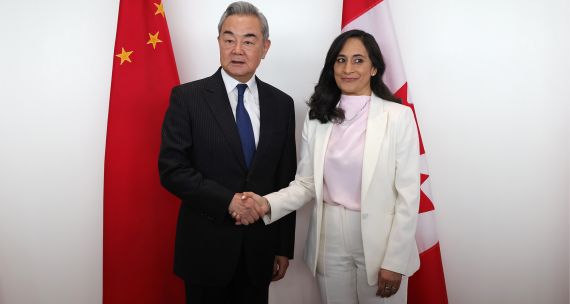
Carney’s January visit to China established a series of mechanisms meant to institutionalize and deepen cooperation, and Minister François-Philippe Champagne’s visit this week to advance the finance and economic dialogue will be part of that effort. The more robust economic engagement becomes, the greater the need for clarity and guardrails.
If Ottawa is serious about expanding trade and investment with China, it must be equally clear about the conditions under which it is prepared to do so. What kinds of Chinese investment does Canada actually want — and in which sectors? What screening mechanisms will apply? How will Ottawa distinguish between commercially beneficial engagement and strategically sensitive exposure? And how will it ensure that deeper economic ties do not blur critical lines on research security, infrastructure, sensitive technologies, and supply-chain integrity?
These are not secondary questions to be worked out later. They go to the heart of what kind of relationship Canada is now trying to build with China. The message Ottawa should be sending is straightforward: Canada is prepared to engage China where interests align, but it will also speak plainly about human rights abuses, uphold its legal obligations, and enforce its own rules with greater seriousness.
We should also be realistic about what is possible in our relationship with China. Some friction with Beijing is not a failure. It is inevitable. Indeed, it is the price of having a China policy that reflects Canadian choices rather than Chinese preferences. A mature China policy is not one that avoids friction. It is one that can absorb it — while remaining clear-eyed about where Canada’s interests lie, where its laws apply, and where its principles still have to hold.
Carney’s China recalibration has strategic logic. Its success will ultimately be measured by whether Canada can do two things at once: engage China where interests align, and hold the line where Canadian values, laws, and strategic interests require it. The challenge for Ottawa is not simply to stabilize relations with Beijing, but to do so without slipping into self-censorship, equivocation, or quiet accommodation. That is the real test now underway.
This article first appeared in Policy Magazine on March 31, 2026