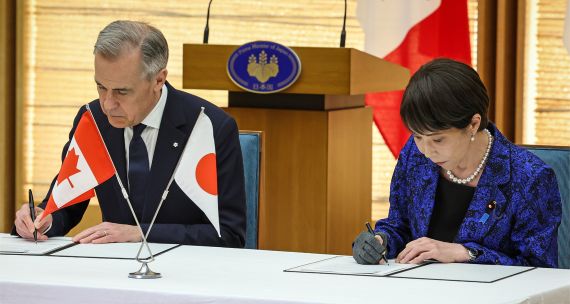
On March 6, 2026, Canadian Prime Minister Mark Carney and Japanese Prime Minister Takaichi Sanae met in Tokyo and elevated bilateral relations to a “Comprehensive Strategic Partnership.” The agreement reflects a broader convergence between Canada and Japan as like-minded Indo-Pacific partners committed to democracy, the rule of law, and a stable international order at a time of growing geopolitical uncertainty.
Space security is part of that convergence. The accompanying Comprehensive Strategic Roadmap identifies co-operation in space domain awareness (SDA), responsible behaviour in space, and the resilience of space-based services as priorities for bilateral co-operation. This builds on earlier civil space co-operation between the Canadian Space Agency and the Japan Aerospace Exploration Agency (JAXA), but it also marks a shift: Canada–Japan space co-operation is moving from primarily scientific and industrial collaboration toward a more explicit security partnership.
Space domain awareness is the right place to begin. It is practical, operationally useful, and directly connected to the wider goals named in the roadmap. SDA helps states understand what is happening in orbit, identify hazards and threats, support resilient space operations, and build the evidentiary basis for responsible behaviour. It is also an area where Canada and Japan bring complementary strengths within existing U.S.-led and allied space security structures.
This brief examines why Canada and Japan should deepen co-operation in space security now, why SDA offers a practical starting point, and how bilateral co-operation can strengthen resilience, responsible behaviour, and allied co-ordination in an increasingly congested and contested space environment.
Why SDA now?
Space systems are now critical infrastructure. Communications, positioning, navigation, timing, Earth observation, data services, disaster response, defence, and economic activity all depend on satellites. This means space security has two increasingly connected dimensions: the use of space-based capabilities to support activity on Earth, and the safety, sustainability, and protection of satellites and orbital systems themselves. When space systems are disrupted, the effects can cascade across terrestrial infrastructure, military operations, public services, and economic activity.
These dependencies are growing in a more congested and contested environment. States are investing in space capabilities to support defence, intelligence, economic power, and technological advantage, while commercial space services have become central to modern military operations. The global space economy is projected to reach US$1.8 trillion by 2035, driven by expanding demand for communications, navigation, Earth observation, and other space-enabled services. The war in Ukraine has shown both the value of commercial satellite communications and imagery, and the vulnerability created by reliance on a small number of providers.
At the same time, the rapid growth of large constellations, rising demand for radio-frequency spectrum, and increasing orbital congestion are creating new risks of collision, interference, misinterpretation, and cascading disruption. Global governance has not kept pace with these developments.
Within this increasingly complex environment, space domain awareness refers to the timely, relevant, and actionable understanding of the operating conditions in space. It allows militaries, governments, and operators to plan, integrate, execute, and assess space-related activities. In practical terms, SDA combines the ability to locate and track objects in orbit with the capacity to interpret activity, assess risk, and support timely operational or policy responses.
SDA matters because awareness is the starting point for resilience. Resilience does not only mean building satellites that can withstand disruption or replacing services after they fail. It also depends on the ability to detect, characterize, and respond to changing conditions before they cascade into wider harm. Shared SDA can improve warning, support collision avoidance and manoeuvre decisions, enable continuity planning, and provide a stronger basis for co-ordination during incidents. Combining observations from multiple sensors, operators, providers, and states can also reduce dependence on any single source of information by enabling comparison and cross-validation.
SDA also supports the implementation of norms in space. Norms of behaviour depend on the ability to observe, characterize, and communicate patterns of activity over time. SDA provides the evidentiary basis for identifying risky operations, distinguishing routine activity from potentially harmful conduct, supporting notifications and consultations, and building confidence in assessments of space events. In this sense, SDA helps make behaviour in space observable, resilience actionable, and governance more credible.
Finally, SDA has clear alliance value. The terminology around SDA and space situational awareness is not always used consistently, but both depend on collecting, fusing, interpreting, and sharing data from multiple sources. No single country can see, track, and understand everything happening in space on its own. Co-operation strengthens coverage, cross-validation, interpretation, and response. For Canada and Japan, SDA offers a practical starting point for bilateral co-operation that can reinforce existing U.S.-led and allied space security structures without creating a separate architecture. The value of this co-operation lies less in symmetry than in complementarity: Canada brings niche SDA contributions and operational experience within allied structures, while Japan brings a broader and rapidly developing space security architecture with strong regional demand for SDA.
What Canada brings to Japan
Canada’s space security architecture is shaped less by full-spectrum autonomy than by integrated contribution in priority areas. Recent policy frames space in terms of sovereign capability and national resilience, but Canadian defence operations continue to rely on a mix of national, allied, government, and commercial systems. This has produced a distinct profile: Canada adds value not by standing apart from allied space security structures, but by contributing targeted capabilities within them. For Japan, this makes Canada useful as both an operational partner and an institutional reference point.
Canada’s most established contribution to SDA is anchored in Sapphire, Canada’s first dedicated military space surveillance satellite. Sapphire gave Canada a recognized role in tracking objects in orbit and contributing data to the U.S. Space Surveillance Network (SSN), a combination of radars as well as optical and infrared sensors used to detect, track, identify, and catalogue objects orbiting the Earth. That role is now being extended and diversified through the Surveillance of Space 2 project, which will add ground-based optical observatories and a Sensor Tasking and Reporting System, strengthening Canada’s contribution to allied SDA. Canada’s niche is also expanding through commercial and experimental capabilities. NorthStar Earth & Space is expanding commercial space-based SDA services, while the LISSA project, a Canada–U.K. collaboration involving Defence Research and Development Canada, the U.K.'s Defence Science and Technology Laboratory, Magellan Aerospace, and the University of Manitoba, will test nanosatellite-based surveillance of objects over the less-monitored South Pole region. Together, these efforts point to a Canadian SDA contribution that is becoming more distributed across public, commercial, allied, and experimental systems.
Canada also brings adjacent experience in turning space-based data into operational awareness. Systems such as the RADARSAT Constellation Mission and Polar Epsilon 2 are not SDA systems, but they demonstrate Canadian experience with the reception, processing, and dissemination of satellite-derived surveillance data for defence, maritime domain awareness, Arctic monitoring, and whole-of-government use. Canada’s northern geography and high-latitude space infrastructure further support this role by strengthening access to polar-orbiting satellites and the timely movement of space-derived information to users. This experience is relevant to Canada–Japan SDA co-operation because effective SDA depends not only on sensors, but also on the ability to fuse data, generate usable assessments, and move information to the authorities and operators who need it.
The institutional dimension is equally important. Canada’s connection to the U.S.-led Combined Space Operations Center (CSpOC) is operational: the Canadian Space Operations Centre contributes data and analysis to CSpOC, and Canadian personnel have served there in operational roles. Japan’s role is different: it is a member of the broader Combined Space Operations Initiative, but is not integrated into CSpOC in the same way. This distinction matters. CSpOC reflects day-to-day operational integration, while the Combined Space Operations Initiative provides the wider political and military framework through which Canada and Japan can build co-operation.
For Japan, co-operation with Canada therefore offers more than access to sensors or data. It provides a pathway into a trusted partner’s experience with space-based surveillance, allied data-sharing, operational integration, public-commercial capability development, and the use of SDA to support resilience and responsible behaviour in orbit.
What Japan brings to Canada
Japan’s space security architecture is undergoing a major upgrade, with SDA being one key area. In 2020, Japan established the Space Operations Squadron, which was its first space domain mission of the Japan Self-Defense Forces (JSDF) with the mission of operating its own SSA system. What began as a modest squadron of 20 personnel is expanding, the latest upgrade being the establishment of the Space Operations Wing with 670 personnel in March 2026. The wing is scheduled to become a command by the end of the fiscal year 2026, with 880 personnel. Japan also plans to launch a dedicated SDA satellite within FY2026.
Japan’s space security architecture has a strong Japan–U.S. alliance component. Japan and the U.S. signed an SSA data-sharing agreement in 2013, which allowed Japan to access the SSN operated by the U.S. Space Force. In 2025, an American SDA payload hosted on Japan’s Quasi-Zenith Satellite System (QZSS) was successfully launched on Japan’s H3 rocket. This marked the first time the U.S. military paid for a payload to be hosted on a foreign satellite. It also symbolizes a bilateral public-private partnership involving the U.S. Space Force, the MIT Lincoln Laboratory, Japan’s National Space Policy Secretariat and the Mitsubishi Electric Corp. While the QZSS is only a regional navigation system, this U.S. SDA payload ‘piggybacking’ allows coverage over the Asia-Oceania region, where the SSN has the fewest assets. Japan’s acute threat awareness of anti-satellite attacks, cyberattacks, and jamming in the space domain adds value to its alliance with the U.S. as well as its strategic partners such as Canada.
Japan’s strength in space security is based on its capabilities in the most important technological areas for independent action in space and in future development. Japan has the capabilities to launch to the most useful orbits — low Earth orbit (LEO) and geostationary orbit (GEO) — secure satellite communications, regional positioning, navigation and timing systems, and Earth observation and intelligence, surveillance, and reconnaissance (ISR) industries. Though Japan has long been active primarily as a civilian space power, threat perceptions and a changing external environment are driving Japan to double down on these independent capabilities and future technologies. Some of these plans include the next-generation defence satellite communications (Kirameki), Japan Low Earth Orbit Satellite Communication (J-LEO), and a private-sector low Earth orbit imagery constellation intended to provide high-frequency imagery in support of Japan’s stand-off defence capabilities (JV Tri-Sat Constellation).
This institutional expansion is consistent with Japan’s recent Space Domain Defense Guidelines, which place SDA at the centre of efforts to improve rapid and accurate battlespace awareness and integrate space more fully into defence planning.
The scheduled launch of Japan’s own SDA satellite in 2026 signifies its nascent capability in this domain. There is already significant co-operation between the Ministry of Defense and JAXA on SSA data collection and analysis. Japan’s admission to the U.S.-led Combined Space Operations Initiative in 2023 can be attributed not only to its independent space capabilities, but also to its demonstrated political commitment to integrate space into its national security architecture.
For Canada, Japan — a trusted democratic partner with expanding SDA capabilities — offers an Indo-Pacific anchor for space security co-operation, mature space industrial and launch capacity, and deep U.S. alliance integration. A partnership with Japan will provide Canada with direct exposure to regional threats from China, North Korea, and Russia. As Japan and Canada deepen their bilateral defence relationship, SDA offers a practical way to build trusted co-operation that strengthens, rather than duplicates, existing allied structures.
Adding value within allied space security structures
A Canada–Japan SDA partnership would not replace U.S.-led space security structures. Nor should it be understood as an effort to build a separate allied bloc. Its value lies in strengthening existing structures by making space awareness more distributed, resilient, and trusted.
The U.S. remains central to allied space situational awareness through the SSN. Since the 2011 U.S. National Security Space Strategy, Washington has expanded SSA data-sharing with allies, partners, satellite operators, and commercial firms. Canada and Japan were among the early government partners in this effort. But SSA data-sharing is not simply a one-way process in which the U.S. provides data and others receive it. Partner governments and satellite operators can also contribute positional data, sensor diversity, regional coverage, and independent assessments that improve the quality of the catalogue and strengthen confidence in shared awareness.
This is where Canada–Japan co-operation can add practical value. Both countries are integrated into U.S.-led space security networks, but they bring different geographic, institutional, and technical strengths. Canada contributes experience in space-based surveillance, high-latitude relevance, commercial SDA innovation, and long-standing operational integration with the U.S. Japan brings Indo-Pacific regional position, rapidly expanding SDA capacity, advanced space industrial capabilities, and deepening U.S.-Japan operational co-ordination. Bilateral co-operation between them would strengthen the wider allied system by creating additional pathways for data-sharing, cross-validation, interpretation, and co-ordinated responses.
The Combined Space Operations Initiative provides an important foundation for this co-operation. Canada and Japan are both members of this 10-country framework, alongside Australia, France, Germany, Italy, New Zealand, Norway, the U.K., and the U.S. The Combined Space Operations Initiative is designed to improve co-operation among spacefaring allies and partners, including through greater interoperability, resilience, information-sharing, and burden-sharing. A Canada–Japan SDA partnership would therefore build on an existing allied framework while adding a more focused bilateral channel between North American and Indo-Pacific space security architectures.
The partnership would also have value for alliance-learning. Canada’s long-standing experience with NORAD offers a useful point of comparison for Japan, not because NORAD is an SDA model, but because it shows how shared warning, assessment, and operational co-ordination with the United States can be institutionalized over time. Japan is now developing its own joint command structures and deepening operational co-ordination with the U.S., including through the establishment of U.S. Space Forces-Japan at Yokota Air Base in December 2024 and the creation of the JSDF Joint Operations Command in March 2025.
For Canada–Japan SDA co-operation, the relevant lesson is that national capabilities become more valuable when they are connected to trusted mechanisms for shared assessment and co-ordinated response. Canada is not a template for Japan, but it does offer a useful comparison for how a middle power can integrate national capabilities into U.S.-led decision-making while still building its own capacity. This approach aligns with broader calls for Canada to translate its Indo-Pacific presence into focused partnerships with anchor states such as Japan and smartly scoped security contributions.
Finally, bilateral SDA co-operation can create spillovers beyond defence operations. Japan’s Space Strategy Fund and JAXA’s co-funded business promotion framework are intended to support international collaboration between Japanese companies and foreign partners. A stronger Canada–Japan space security relationship could help connect public, commercial, and research actors in both countries, while also supporting dialogue on responsible behaviour in space, resilience of space-based services, and shared approaches in multilateral forums such as the "Open-Ended Working Group on the Prevention of an Arms Race in Outer Space (PAROS) in All Its Aspects."
Conclusion: A practical starting point for deeper co-operation
Canada–Japan space security co-operation should begin with SDA because it is practical, necessary, and politically feasible. It does not require either country to build a fully autonomous space security architecture or to step outside existing alliance relationships. Instead, it allows both countries to strengthen a shared evidentiary base for understanding what is happening in orbit, improve resilience through more distributed sources of awareness, and connect operational co-operation with wider expectations of responsible behaviour in space.
This is where a bilateral partnership can add value. Canada and Japan are already embedded in allied space security networks through their respective relationships with the U.S. and their participation in the Combined Space Operations Initiative. More deliberate bilateral co-operation would create a bridge between North American and Indo-Pacific space security architectures while reinforcing, rather than duplicating, existing allied structures. It would also help ensure that SDA is not treated only as a military capability, but as an enabling function for safer, more resilient, and more predictable space operations.
The next step should be a focused Canada–Japan SDA dialogue that brings together defence, civil space agencies, commercial providers, and policy experts. This dialogue should identify where Canadian and Japanese capabilities are complementary, including space-based surveillance, ground infrastructure, data processing, high-latitude and regional coverage, commercial innovation, and operational integration. It should also examine how bilateral co-operation can support resilience of space-based services through redundancy, data-sharing, cross-validation, and co-ordinated response.
Canada and Japan should also use SDA co-operation to advance norms of behaviour in space. Shared awareness is essential for identifying risky operations, distinguishing routine activity from potentially harmful conduct, supporting notifications and consultations, and building confidence in assessments of space events. In this sense, SDA is not separate from responsible behaviour. It is one of the conditions that makes behaviour observable, credible, and actionable.
A Canada–Japan SDA partnership will not solve the wider challenges of space security. But it can make a practical contribution where capability, governance, and diplomacy overlap. In a more congested and contested space environment, the ability to see, understand, and co-ordinate is becoming a strategic necessity. Canada and Japan are well placed to build that capacity together.
• Edited by Jeehye Kim, Senior Program Manager, Northeast Asia, and Ted Fraser, Senior Editor, APF Canada