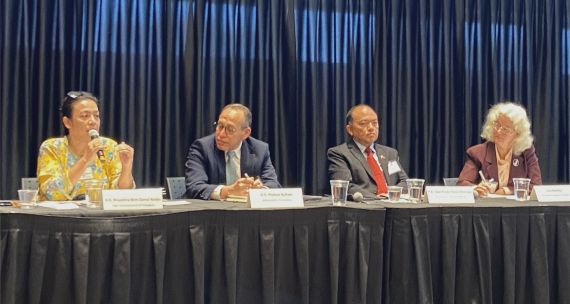
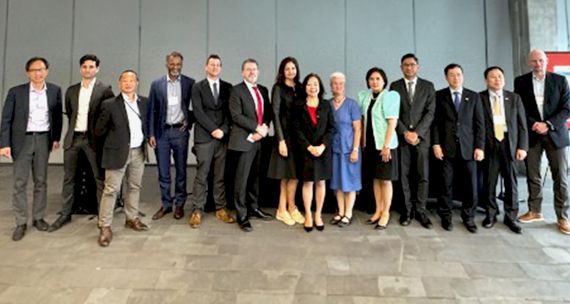
At an economic symposium in Ottawa on October 13, 2026, participants from Canada, Southeast Asia and beyond exchanged views on how Canada and the Association of Southeast Asian Nations (ASEAN) are building economic resilience and accelerating market penetration. Capitalizing on Southeast Asia’s economic dynamism at the heart of global supply chains and Canada’s resources, innovative technologies, and expertise, bilateral trade grew almost 24 per cent from 2024 to 2025 to $52.5 billion. And yet, practical challenges remain in translating potential into momentum. Participants expressed considerable optimism in the capacity of bilateral and regional free trade agreements to accelerate access to markets and build resilience, reaffirming shared confidence in the rules-based trading system and commitment to international law.
The symposium provided a rich exchange of views on the forthcoming ASEAN Summit in Manila in November, the anticipated conclusion of the ASEAN-Canada Free Trade Agreement (ACAFTA), and the celebration of 50 years of dialogue relations between Canada and ASEAN in 2027. In addition to strategic insights from business leaders, other topics that generated interest were the prospects for Canadian LNG exports to contribute to energy security in Southeast Asia and New Zealand’s approach to economic engagement with ASEAN.
Pooling business, government, diplomatic, and academic perspectives
The symposium, the fourth such event organized by the York Centre for Asian Research’s (YCAR) Canada-ASEAN Initiatives, was hosted by the University of Ottawa’s Telfer Management School, with support from the ASEAN Committee of Ottawa (currently chaired by Indonesia) and the Asia Pacific Foundation of Canada. It brought together stakeholders from the Canadian federal government and the diplomatic, business, and academic communities.
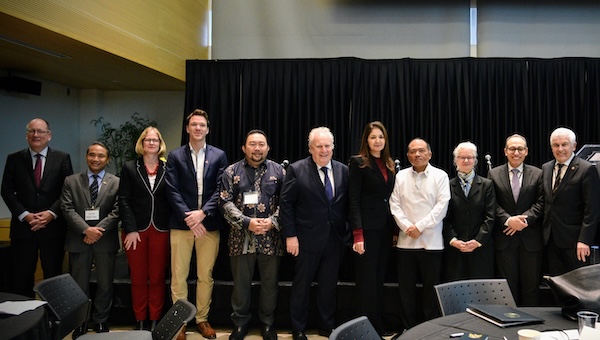
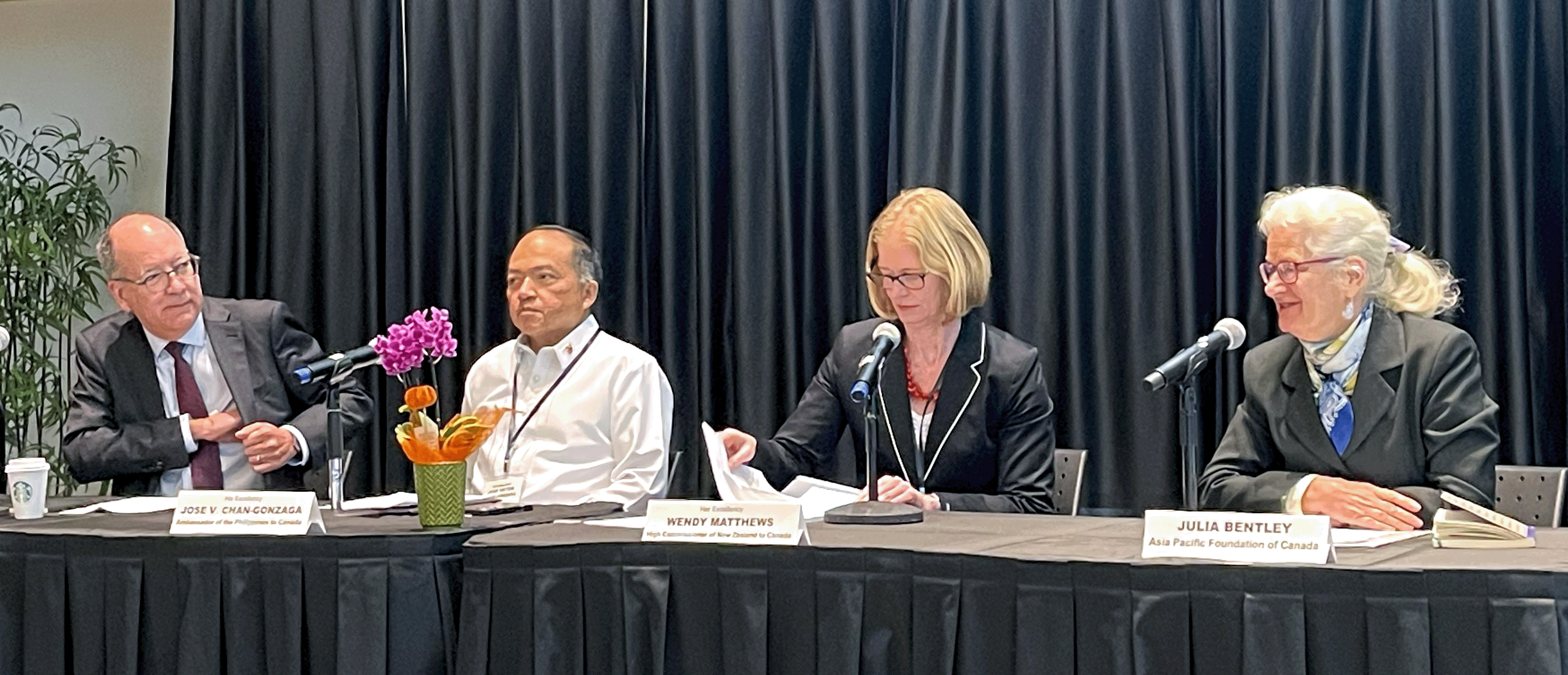
Speakers included Global Affairs Canada’s Chief Trade Negotiator for ASEAN, Jay Allen, and Director General for Southeast Asia and Oceania, Alan Bowman. From the Indo-Pacific diplomatic community, speakers included Ambassador Muhsin Syihab of Indonesia, Ambassador of the Philippines Jose Victor Chan-Gonzaga, and New Zealand High Commissioner Wendy Matthews. Senator Clément Gignac, co-chair of the Canada-ASEAN Parliamentary Friendship Group, provided a parliamentary perspective on Canada’s engagement with Southeast Asia.
Strategic business insights were shared by Jean Charest, Honorary Chair of the Canada-ASEAN Business Council, and Motria Savarin-Roy of Sun Life Geostrategic Economics, while think-tank views were provided by Alexandre Veilleux, Senior Program Manager with the Asia Pacific Foundation of Canada, and Vina Nadjibulla, CEO of the Centre for Strategic Statecraft.
Strategic insights from business leaders
Speakers from the Canada-ASEAN Business Council and Sun Life suggested ways to intensify Canada’s trade with ASEAN, including by investing in long-term partnerships and understanding the diversity of local markets. They also called for closer people-to-people ties between Canada and ASEAN, including in higher education and training, and through the mutual recognition of professional credentials, along the lines of the 2008 Québec-France Agreement. Importantly, the speakers argued, shared recognition of credentials could help reduce regulatory obstacles to professional mobility and help attract talent from ASEAN to Canada, contributing to deeper supply chain integration and co-production of high-value goods and services. At the same time, they argued, business councils and business schools in Canada need to step up their Asia competency game and develop programs targeting deeper engagement with Southeast Asia.
In the face of a sluggish economic growth and low productivity, compounded by persistent trade disruptions inflicted by the current U.S. administration, Canada is moving rapidly in a new direction, actively pursuing closer co-operation with Europe, the Indo-Pacific, and the Middle East. This has led to renewed interest in Canada in exploring new trade architecture and the potential for bloc-to-bloc engagement between the Comprehensive and Progressive Transpacific Partnership (CPTPP) and the European Union. At the same time, Canada needs to consider the fact that the primary trading partner for economies across Southeast Asia is China. Participants noted that Canadians should be asking what Canada’s position is on China’s application to join the CPTPP, and why Canada is not a member of the Regional Comprehensive Economic Partnership (RCEP) linking ASEAN members with China, Japan, South Korea, Australia, and New Zealand.
Canadian companies entering Southeast Asia were advised to invest in building cultural awareness toward long-term trusted relationships and leveraging local expertise and local partnerships. They were also advised to visit the markets often, built trust and establish opportunities together with Southeast Asian partners ahead of the anticipated entry into force of ACAFTA.
International companies have found success in Southeast Asia by collaborating with local partners and adapting their products and services to local demographics, cultures, and lifestyles. For example, partnerships have been important to Sun Life in offering customized insurance products in Malaysia and Shariah-compliant financial services in Indonesia, and to Canadian aviation company CAE in operating a regional training hub in Kuala Lumpur, supported by facilities in four other Southeast Asian countries.
ASEAN, ACAFTA, and the ASEAN Summit in Manila
2027 will mark the 50th anniversary of Canada’s role as an ASEAN dialogue partner, and there was considerable anticipation that the conclusion of ACAFTA would serve as a fitting achievement for that significant milestone. While more than 90 per cent of the text has been agreed, the last 10 per cent includes thorny issues such as market access and rules of origin. The 11 members of ASEAN require government certification regarding the origin of products; in Canada, this determination is made by exporters.
In 2023, the Canada-ASEAN relationship was elevated to a strategic partnership, whose implementation for the next five years is mapped out in the Plan of Action adopted in July 2026. The Plan of Action calls for a “commercially meaningful” ACAFTA that diversifies trade, strengthens supply chain resilience, and expands opportunities for businesses. Implementing the agreement effectively will require closing the awareness gap between Canadian and Southeast Asian companies.
ACAFTA is expected to serve as a foundational agreement for deepening Canada’s entrée into the region. Canada already has trade access to four ASEAN members through the CPTPP: Malaysia, Singapore, Brunei, and Vietnam. It aims to have bilateral trade agreements with three more ASEAN economies shortly: the Canada-Indonesia Economic Partnership Agreement (CEPA) agreed to in 2025, the Canada-Philippines Free Trade Agreement under negotiation, and the Canada-Thailand Free Trade Agreement for which negotiations are about to be launched. ACAFTA will add market access for Canada to three additional ASEAN economies: Laos, Cambodia and Myanmar.
Which sectors will benefit most from ACAFTA’s provisions related to tariffs, non-tariff barriers, and services market access will depend on which companies choose to use the agreement. Ultimately, the intention of free trade agreements – including ACAFTA – is to create a predictable economic and policy environment to ensure that capital and ideas can move freely, regulations are deconflicted, and resilience is strengthened.
Speakers from both the public and private sectors underlined their expectation that trade diversification would continue to be a major Canadian objective in the future, adding they do not expect a decrease in interest in economic engagement with ASEAN, or Asia more broadly, regardless of developments in the U.S. However, they argued that, for Canada to capitalize fully on ACAFTA, it will need to strengthen its domestic east-west trade corridors.
Progress in Canada’s bilateral engagement in Southeast Asia
Within Canada’s Indo-Pacific Strategy, Vietnam, the Philippines, and Indonesia are identified as priorities. The last year has seen high-level progress in engagement with all three. President Prabowo Subianto of Indonesia visited Ottawa in September 2025, witnessing the signing of the Canada-Indonesia CEPA, Canada’s first bilateral trade agreement with an ASEAN member. President Ferdinand Marcos, Jr. of the Philippines visited Canada in July 2026, when the bilateral relationship was upgraded to a strategic partnership. Vietnamese President To Lam’s visit to Canada in September this year marked a historic first, and all eight chapters in the Joint Statement on the Strategic Partnership Between Canada and Vietnam arising from that meeting cover areas critical to resilience.
Aspirations for Canadian Prime Minister Mark Carney’s anticipated bilateral visit to Manila on the margins of the ASEAN Summit in November include leveraging the recently upgraded relationship to advance co-operation on energy security, trade and investment, economic resilience, and human capital development. The conclusion of negotiations on the Canada Philippines bilateral FTA, along with ACAFTA and the Digital Economy Framework Agreement (DEFA), are priority deliverables for Manila’s ASEAN chairmanship this year. Manila also seeks progress on mutual recognition of professional qualifications and credentials, which will require engagement with Canadian provinces.
Prospects for Canadian LNG as a contributor to Southeast Asian energy security
Energy security was discussed at the symposium as an area of shared interest to Canada and ASEAN. Canada’s expanding liquified natural gas LNG export capacity offers an opportunity to support Southeast Asia’s energy security. Some Southeast Asian economies rely on the volatile LNG spot market, leaving them vulnerable to price spikes during supply disruptions. Long-term contracts with Canada could help mitigate these risks, but early planning will be essential to secure future supplies before additional LNG capacity becomes available.
A question from the audience touched on the challenge for Southeast Asia of meeting rapidly growing energy demand while transitioning to cleaner energy systems. This is particularly relevant to countries like the Philippines, where demand is expected to grow significantly in the coming decades, driven by industrial growth, artificial intelligence, and data centres. Manila has maintained its coal moratorium policy and liberalized renewable energy investment, but coal-fired plants remain a major source of electricity, while renewable energy has yet to meet projected demand at the required scale and reliability.
Canadian LNG and nuclear energy are viewed in Southeast Asian countries like the Philippines as a potential part of their broader energy diversification and resilience strategies. The development of either LNG or nuclear energy projects in ASEAN requires long lead times, sound regulatory regimes, supporting infrastructure, technical and institutional capacity, and a skilled workforce. Clear policy signals and commercially viable arrangements are also essential to attract private investment.
New Zealand’s approach to engagement with ASEAN
Canada’s trade with ASEAN constitutes a mere 3 per cent of its global trade, or roughly the magnitude of Canada-U.S. trade in just 20 days. By comparison, ASEAN-New Zealand trade represents almost 10 per cent of New Zealand’s global trade, and the two sides benefit from the Australia-New Zealand-ASEAN Free Trade Agreement (AANZFTA), which entered into force in 2010, resulting in a doubling in trade. New Zealand’s economic engagement with Southeast Asia is facilitated by RCEP, and like Canada, New Zealand is a member of the CPTPP.
New Zealand and Australia have undertaken capacity building activities with ASEAN under the AANZFTA Implementation Support Program to contribute to economic co-operation activities and ensure participatory countries can benefit from the opportunities of AANZFTA. The program has allowed ASEAN economies to more effectively monitor the agreement’s tariff preference utilization environment and facilitated a regional qualifications framework, allowing greater movement of students and workers. New Zealand also provides NZ-ASEAN short-term training courses in areas that ASEAN has highlighted as a priority, delivering a variety of courses for scholars from ASEAN countries in trade policy, good governance, and food and agribusiness value chains.
New Zealand is also exploring with ASEAN partners how to build more resilient supply chains to withstand future disruptions. It has pioneered a new framework for resilience with Singapore: the world-first Agreement on Trade in Essential Supplies, where the two sides committed not to impose export restrictions on one another for essential supplies, including fuel, during future supply crises.
A compelling narrative for deepening Canada-ASEAN economic engagement
The specialized knowledge and collective energy on display at the symposium, and the views shared by ambassadors, think-tank representatives, and government and business leaders, provided practical insights and a compelling narrative for translating potential into momentum for deepening Canada’s economic engagement in Southeast Asia.
• This report was edited in collaboration with Julie Nguyen.