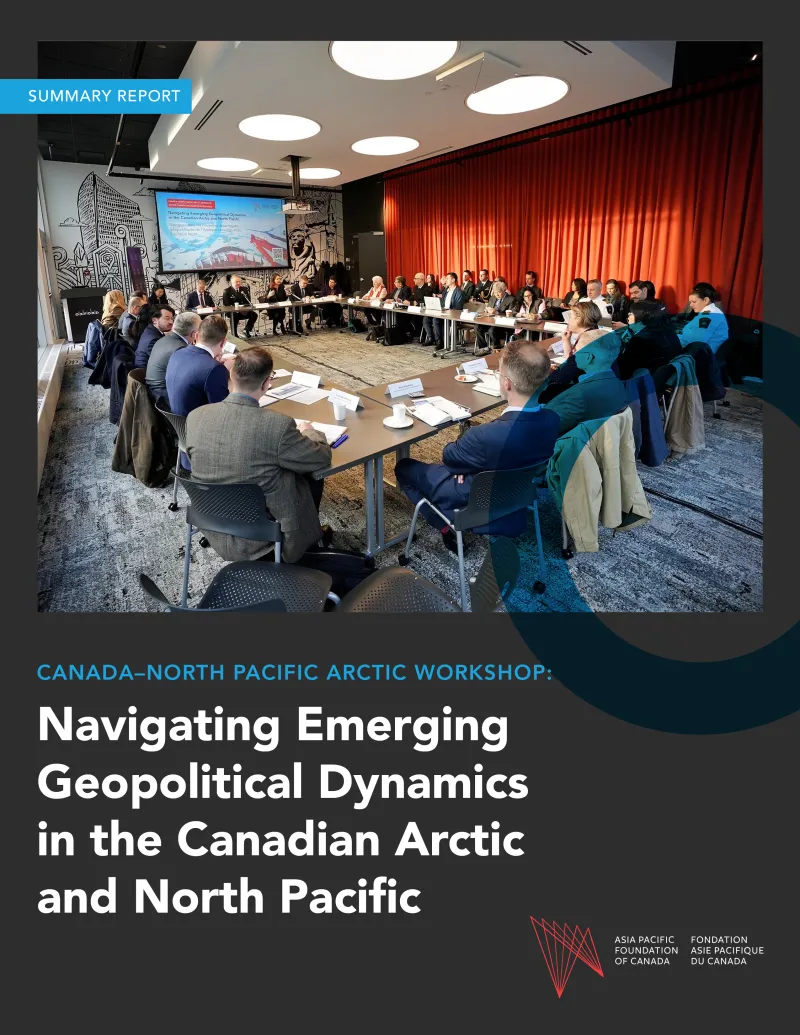
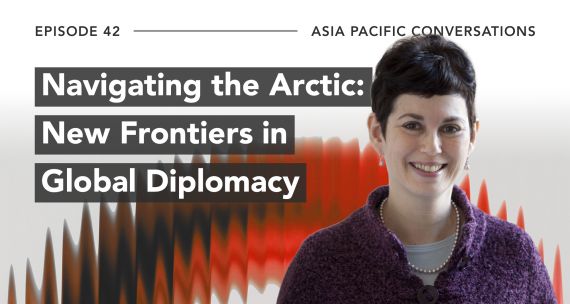
On January 20, 2026, APF Canada convened a Strategic Roundtable on Navigating Emerging Geopolitical Dynamics in the Canadian Arctic and North Pacific in Vancouver, Canada. The event was organized with funding from the Department of National Defence and featured a 1.5 day closed-door roundtable followed by a public panel on January 20 translating key insights for broader audiences.
The Arctic is undergoing a profound transformation. Rapid environmental change, intensifying geopolitical competition, and accelerating technological advances are converging to reshape the region’s strategic landscape. While Canada’s Arctic policy discussions have historically been anchored in the Euro-Atlantic context, the North Pacific dimension — particularly involving Japan and South Korea — has become increasingly salient but remains underexamined.
Against this backdrop, the Asia Pacific Foundation of Canada convened a public panel on January 20, bringing together Canadian, U.S., Japanese, and South Korean experts to assess evolving Arctic risks and opportunities.
Speakers:
- Elizabeth Wishnick, Adjunct Senior Research Scholar, Weatherhead East Asian Institute, Columbia University
- Sung-Ho Kang, Principal Research Scientist, Division of Polar Climate Research, Korea Polar Research Institute (KOPRI)
- Jennifer Spence, Director of the Arctic Initiative, Harvard's Belfer Center for Science and International Affairs
- Natsuhiko Otsuka, Senior Fellow, Sasakawa Peace Foundation
Moderated by Vina Nadjibulla, Vice-President, Research & Strategy, APF Canada.
The discussions explored how climate change, China-Russia co-operation, maritime activity, and technological innovation are altering Arctic governance and security dynamics, and what this means for Canada’s sovereignty, infrastructure, and partnerships. The event underscored the need for evidence-based analysis, pragmatic co-operation, and deeper engagement with North Pacific partners as Canada recalibrates its Arctic and Indo-Pacific strategies.
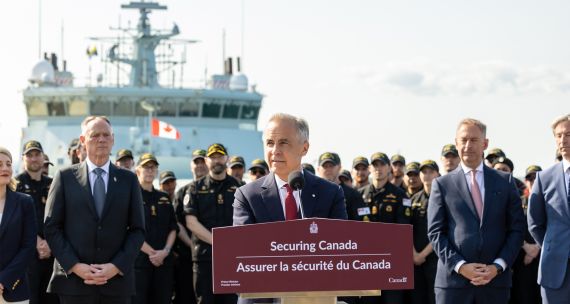
This event took place at a moment of broader reassessment in Canadian foreign policy. On the same day as the public panel, Canadian Prime Minister Mark Carney delivered a major speech at Davos calling for greater strategic realism, warning against complacency about the durability of the rules-based international order, and urging middle powers to invest in their own capabilities while building pragmatic partnerships. That framing strongly informed the discussions, particularly around how Canada should navigate Arctic security without exaggerating threats or abandoning co-operation.
Shifting geopolitical context
Participants emphasized that the Arctic can no longer be understood as insulated from global geopolitical turbulence. While the region was long framed as an area of “Arctic exceptionalism,” — the idea that the region is insulated from geopolitical tensions elsewhere — Russia’s invasion of Ukraine in 2022 marked a decisive rupture that compounded earlier strains on co-operation caused by the 2014 annexation of Crimea and the COVID-19 pandemic, which disrupted diplomatic and scientific networks critical to Arctic governance.
At the same time, the Arctic is now affected by broader systemic uncertainty. Panellists highlighted how changes in U.S. foreign policy, evolving NATO dynamics, and heightened great-power competition have introduced new unpredictability into Arctic affairs. For middle powers like Canada, this moment demands strategic clarity: recognizing hard security realities while avoiding exaggerated threat narratives that risk crowding out co-operation and sound policymaking.
The North Pacific Arctic: An emerging focal point
A central theme of the discussion was the growing importance of the North Pacific Arctic, particularly the Bering Sea and adjacent waterways. While public discourse often focuses on Greenland or the European Arctic, experts stressed that tangible Russia–China co-operation has been most visible in the North Pacific. This includes joint naval and coast guard exercises, strategic bomber activity, and co-ordination linked to the Northern Sea Route.
Panellists examined China’s Arctic engagement in a historical and strategic context. They traced the roots of China–Russia co-operation to the post-2008 global financial crisis and noted how China’s technological rise — particularly in dual-use capabilities such as satellite systems, shipbuilding, and undersea technologies — has reshaped Arctic dynamics. Since 2022, China has increasingly been an investor and technology provider for Russia’s Arctic ambitions, even as mutual distrust persists beneath the surface of their partnership.
At the same time, speakers cautioned against overstating China’s reach. Many proposed Chinese investments in the Arctic have stalled or been rejected, and European Arctic states have become far more cautious since the war in Ukraine. The gap between China’s ambitions and its actual footprint remains significant, reinforcing the importance of nuanced, evidence-based threat assessments.
Climate change as the primary risk multiplier
Climate change was consistently identified as the most immediate and consequential threat facing the Arctic. The region is warming at roughly four times the global average, resulting in thinner sea ice, increasingly unstable storm patterns, and rapidly changing ocean conditions. Participants warned that greater physical access does not equate to greater predictability. Much of the region’s existing infrastructure — ports, shipping routes, subsea cables, and coastal facilities — was designed for a more stable environment. As that stability erodes, it becomes harder to distinguish between environmental accidents, operational failures, and hostile actions, increasing the risk of miscalculation.
From a scientific perspective, the recommended principle was clear: data first, operations second, scale last. Moving too quickly without adequate observation and monitoring risks accumulating vulnerabilities faster than resilience.
Maritime activity, shipping, and fisheries
Discussions highlighted steady growth in Arctic maritime activity. Shipping along the Northern Sea Route is growing, driven largely by Russia–China trade, while cruise traffic through the Northwest Passage has surged following the pandemic. Participants also flagged the longer-term prospect of increased activity in the Central Arctic Ocean as sea ice retreat continues.
These trends raise governance and enforcement challenges, particularly around illegal, unreported, and unregulated fishing. Panellists emphasized the importance of satellite surveillance, maritime domain awareness, and multinational co-operation to monitor activity in vast, remote waters. However, they also stressed the limits of enforcement capacity and the need for strong international norms and evidence-based accountability.
The 2018 Central Arctic Ocean Fisheries Agreement was repeatedly cited as a rare example of successful precautionary governance. By prohibiting commercial fishing until sufficient scientific knowledge exists, the international agreement demonstrates that co-operation remains possible even amid geopolitical tension.
Opportunities for North Pacific co-operation
Japan and South Korea were consistently identified as valuable partners in Arctic engagement. Both countries bring advanced capabilities in shipbuilding, ice-capable vessels, satellite observation, and polar science. South Korea’s experience in icebreaker construction and Japan’s leadership in satellite-based maritime monitoring were highlighted as areas of concrete collaboration.
Panellists pointed to growing opportunities for co-operation on maritime domain awareness, search and rescue, environmental monitoring, and infrastructure resilience. Examples such as joint coast guard patrols and scientific collaboration aboard icebreakers illustrated how practical co-operation is already taking place and could be scaled further.
Crucially, speakers emphasized that effective Arctic co-operation does not need to be framed solely through military or deterrence lenses. Civilian, scientific, and dual-use co-operation can strengthen security outcomes while supporting sustainable development and community needs. Panellists highlighted the forthcoming International Polar Year as a critical platform for sustained scientific co-operation, long-term observation, and data-sharing at a time when formal diplomatic channels are under strain.
Governance, Indigenous leadership, and middle-power agency
Governance challenges featured prominently throughout the discussion. While traditional multilateral institutions face strain, panellists stressed that Arctic governance has not collapsed. Instead, it is evolving through working-level co-operation, science diplomacy, and what some described as “Indigenous diplomacy.”
Indigenous organizations were highlighted as increasingly important conveners and leaders, particularly during periods when state-to-state co-operation is constrained. Their flexibility and legitimacy position them as critical actors in sustaining dialogue and shaping policy priorities.
For middle powers, the Arctic presents both risk and opportunity. Participants argued that Canada, Japan, and South Korea can exercise influence by convening coalitions, sharing expertise, and reinforcing norms — rather than passively reacting to great-power competition.
Key Takeaways
As the Arctic enters a period of heightened uncertainty, participants agreed that Canada’s challenge is not simply to defend against emerging threats, but to shape the region’s future through informed, co-operative, and strategically grounded engagement. The event underscored several overarching conclusions:
- The Arctic is no longer peripheral to global geopolitics, and the North Pacific dimension demands far greater policy attention.
- Climate change is the central driver of risk, amplifying both security and governance challenges.
- China–Russia co-operation is most consequential in the North Pacific Arctic, but threat perceptions must be grounded in evidence rather than rhetoric.
- Practical co-operation with Japan and South Korea offers Canada tangible pathways to enhance Arctic resilience, monitoring, and interoperability.
- Effective Arctic governance will depend on science-based decision-making, Indigenous leadership, and pragmatic middle-power collaboration.
• Edited by Vina Nadjibulla, Vice-President Research & Strategy, Erin Williams, Director, Programs, and Ted Fraser, Senior Editor, APF Canada