The entry into force of the High Seas Treaty, formally the Agreement on Biodiversity Beyond National Jurisdiction (BBNJ) under the UN Convention on the Law of the Sea (UNCLOS), marks an important development in global environmental governance. After crossing the 60-country-ratification threshold in September 2025, the Treaty became operational on January 17, creating the first binding international framework for conserving and sustainably using marine biodiversity in areas beyond national jurisdiction – waters that cover nearly two-thirds of the world’s oceans.
Alongside the Kunming-Montreal Global Biodiversity Framework (GBF), adopted in 2022, the High Seas Treaty represents a rare moment of multilateral ambition. The two instruments are structurally linked. The GBF’s ‘30x30’ target – protecting 30 per cent of the world’s land and ocean by 2030 – cannot be achieved without conservation gains in the high seas, while the Treaty supplies the legal and institutional tools to make those gains possible. Its core mechanisms – marine protected areas (MPAs), environmental impact assessments (EIAs), and rules for access to and benefit-sharing from marine genetic resources – provide the operational architecture for implementing biodiversity targets beyond national jurisdiction.
Crucially, the Treaty’s reach extends below the surface. It applies to the living resources of the international seabed as well as the water column. Deep-sea mining targets non-living mineral deposits and is regulated through the International Seabed Authority – but because mining disturbs the seabed ecosystems that the High Seas Treaty is designed to protect, the two regimes directly interact, and that interaction is expected to become a source of growing governance tension.
Additionally, the Treaty has entered into force under geopolitical conditions markedly different from those in which it was negotiated. Its significance will be measured by implementation: who participates, which rules are institutionalized, and how the Treaty operates in contested regions. Southeast Asia, and especially the South China Sea, will be decisive test cases.
A Historic Treaty arrives at a difficult moment
The High Seas Treaty was negotiated during a period when the U.S. still broadly participated in multilateral environmental governance and climate-finance architectures remained at least minimally functional. That context has shifted. In January 2025, the second Trump administration withdrew the U.S. from the Paris Agreement, disengaged from UN climate processes, and revoked its domestic ‘30x30’ conservation commitments. The U.S. signed the High Seas Treaty in 2023 but Senate ratification is now effectively off the table.
This shift matters not because it created vulnerabilities — the Treaty's silence on maritime boundary disputes, flexible implementation language, and reliance on reporting were always features of a text designed to secure broad buy-in — but because it narrows the coalition of states capable of reinforcing consistent, rules-based interpretations of those ambiguities. The same design compromises that were politically necessary now operate in a geopolitical environment less equipped to manage their consequences, particularly in contested maritime regions.
Much of the Treaty's operational architecture remains under development. Preparatory Commission (PrepCom) processes are shaping key institutional components ahead of the first Conference of the Parties (COP1), including scientific bodies, environmental assessment standards, and implementation mechanisms. The rules and norms being embedded in these institutions will reflect the priorities of those actively participating in building them — and at this stage, that includes China as a full party but excludes the U.S., Canada, India, and Australia, among others. Institutional design is rarely neutral; the procedures, standards, and precedents established now will shape how the High Seas Treaty operates in contested regions for years to come.
Southeast Asia as a critical implementation site
Southeast Asia is central to the success of the Treaty for both ecological and political reasons. The region contains some of the world’s most important marine and coastal ecosystems. The Coral Triangle – spanning Indonesia, Malaysia, the Philippines, Papua New Guinea, Solomon Islands, and Timor-Leste – is widely recognized as the global centre of marine biodiversity. Its mangroves, seagrass beds, and adjacent coastal ecosystems are both biodiversity hotspots and critical blue carbon assets.
Meeting global biodiversity targets will depend heavily on conservation outcomes in this region. Yet Southeast Asia is also where the political economy of biodiversity loss is most deeply entrenched. Environmental degradation is closely tied to commodity production, land conversion, and uneven regulatory enforcement. Palm oil production illustrates this dynamic: Indonesia and Malaysia together account for more than 80 per cent of global supply, and plantation expansion remains a primary driver of deforestation and peatland degradation. These structural pressures extend into the maritime domain, where ecological degradation intersects with geopolitical contestation.
The South China Sea: From a sovereignty dispute to a conservation dispute
The South China Sea is also both ecologically significant and politically contested. It is among the most biologically productive marine regions in the world, yet it has experienced extensive environmental degradation. Large-scale island-building, destructive fishing practices, and competing maritime activities have damaged about 7,000 acres of reefs through the competing activities of China, Vietnam, the Philippines, Malaysia, and Taiwan – claimants in the South China Sea dispute.
The High Seas Treaty introduces a new dimension to this long-standing dispute. Its provisions on marine protected areas and environmental impact assessments apply to areas beyond national jurisdiction. In the South China Sea, however, the existence and location of such areas are themselves contested.
The 2016 South China Sea Arbitral Award held that none of the maritime features within China’s nine-dash line generate entitlement to extended maritime zones beyond what UNCLOS permits. On that interpretation, substantial portions of the South China Sea constitute high seas subject to High Seas Treaty governance. The Philippines has taken a position broadly consistent with this view and has signalled support for applying conservation tools in those areas. China rejects the 2016 Award and does not accept the existence of high seas within the nine-dash line. Under Beijing’s position, most of the South China Sea falls within its jurisdiction, placing it outside the Treaty’s scope.
This divergence creates a governance dilemma. Conservation measures – such as the designation of marine protected areas or the conduct of environmental impact assessments – may be interpreted as either ecological initiatives or implicit assertions of jurisdiction. The Treaty does not resolve this ambiguity. Its reticence on maritime disputes was a deliberate compromise to secure adoption, but it leaves implementation exposed to geopolitical contestation.
China’s institutional positioning
China is well-positioned to influence how these dynamics unfold. Beijing ratified the High Seas Treaty in December 2025 and will participate as a full party at COP1. During negotiations, China supported the Treaty while consistently favouring flexible, case-by-case approaches to implementation, particularly on MPAs, EIAs, and dispute settlement. These positions preserve discretion in contested maritime areas and reflect a broader preference for negotiated outcomes over binding third-party adjudication.
China has also proposed hosting the Treaty’s Secretariat in Xiamen, signalling an interest in shaping outcomes, and the institutional processes through which those outcomes are produced. This bid, if successful, would give Beijing a structural role in the High Seas Treaty’s day-to-day administration at a formative moment in its development.
The deep seabed dimension of the Treaty makes China’s institutional positioning particularly consequential. China holds the largest portfolio of deep-seabed exploration contracts issued by the International Seabed Authority (ISA). As a High Seas Treaty party, China is simultaneously obligated to promote the agreement’s objectives — including its EIA standards — within ISA decision-making, while also being the state with the most commercial interest in ensuring those standards remain manageable. This creates a direct structural conflict. The Treaty sets considerably more demanding EIA requirements than the ISA's existing draft regulations for mining exploitation, and the ISA does not yet have the scientific baseline, ecosystem knowledge, or monitoring infrastructure to meet them. The governance standards now being established will therefore determine in practice whether deep-sea mining faces genuine environmental scrutiny under the Treaty or remains beyond its effective reach.
ASEAN’s governance limits and the financial constraints
Seven Association of Southeast Asian Nations (ASEAN) states are now parties to the High Seas Treaty. The region has institutional mechanisms for biodiversity co-operation, and the Philippines-headquartered ASEAN Centre for Biodiversity has been selected as the Asia Pacific hub for monitoring ecosystem restoration commitments under a new FAO-CBD partnership.
However, ASEAN’s structural constraints remain significant. Its consensus-based decision-making and non-interference norms enable regional cohesion but limit the development of binding commitments and enforcement. These limitations are reflected in uneven Treaty ratification: Malaysia, Thailand, and Brunei have yet to ratify. Malaysia’s absence is particularly notable given its status as both a Coral Triangle Initiative state and a South China Sea claimant. The result is a fragmented regional posture, with inconsistent legal obligations. This could also potentially weaken ASEAN’s ability to articulate a coherent regional position on implementation.
ASEAN’s environmental track record reflects a similar pattern. The Transboundary Haze Agreement and the Coral Triangle Initiative demonstrate sustained co-operation, but with limited enforcement and reliance on national implementation. The result is often compliance without ownership, where formal commitments do not translate into structural change.
Finance reinforces these constraints. The GBF includes commitments to mobilize US$20 billion (C$27 billion) per year in biodiversity finance by 2025 and US$30 billion by 2030. Yet funding flows were already falling short before 2025, and the withdrawal of the U.S. from international climate commitments further complicates the financing landscape. For Southeast Asian states, implementing conservation measures such as fisheries monitoring, marine protected area management, and ecosystem restoration entails significant costs. Without adequate financing, the burden of implementation risks falling disproportionately on biodiversity-rich developing countries.
Alternative mechanisms – such as the EU’s Deforestation Regulation, blue carbon markets, and sub-regional fisheries agreements – offer partial solutions but remain limited in scale and consistency. Taken together, ASEAN’s governance model and the finance gap point to a central constraint: while the region has the ecological importance and emerging institutional capacity to implement the High Seas Treaty, it lacks the coordinated governance and sustained financial support needed to do so effectively.
Canada: Committed yet unratified
Canada has long positioned itself as a champion of multilateral biodiversity governance. It played a central role in negotiating the High Seas Treaty, co-hosted the COP15 biodiversity conference in Montreal, and has committed in its Indo-Pacific Strategy to a rules-based maritime order. It has also supported maritime capacity-building efforts in Southeast Asia, including co-operation with the Philippines on fisheries enforcement and maritime domain awareness.
Canada also brings relevant governance experience to the High Seas Treaty regime. Its Arctic practices — managing legal ambiguity, environmental regulation, and sovereignty sensitivities in the Northwest Passage — are analogous to the governance challenges the Treaty regime will face in the South China Sea. Its Indo-Pacific Strategy has further underscored its commitment to a rules-based maritime order, including support for Southeast Asian partners in addressing illegal, unreported, and unregulated fishing through initiatives such as the Dark Vessel Detection program. These operational capacities could contribute towards effective Treaty implementation.
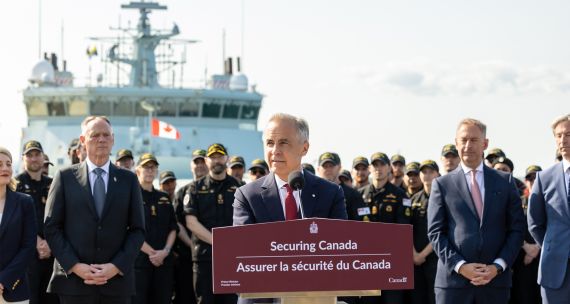
Ratification, however, has lagged. While the federal government has now committed to it, the timeline remains unclear. On March 31, 2026, Prime Minister Mark Carney launched A Force of Nature: Canada’s Strategy to Protect Nature, a C$3.8-billion conservation investment that commits C$24.4 million over five years to ratify the Treaty and advance implementation. The announcement aligns Canada’s domestic conservation ambitions with its international obligations. The strategy targets an increase in marine conservation from 15.5 per cent to 28 per cent on the way to 30 per cent by 2030 and commits Canada to joining the Ocean Panel – a coalition of serving world leaders working to advance transformative ocean governance.
While the commitment is welcome, the delay has consequences. Much of the High Seas Treaty’s foundational institutional architecture – scientific bodies, environmental assessment standards, MPA governance procedures – is being established through PrepCom processes. Canada has participated in these processes only as a signatory, without voting rights or formal capacity to shape institutional decisions. A ratified Canada will enter a governance framework whose early design choices were made largely without it.
Other middle powers, however, have moved faster. Japan has ratified the Treaty and is actively aligning its implementation with UNCLOS while expanding marine protection co-operation with Southeast Asian partners, including the Philippines. Australia, which has co-chaired meetings even prior to formal ratification, is expected to become a party by August 2026, having completed the necessary domestic implementing legislation.
However, other middle powers, such as the U.K. and Germany, have yet to ratify the Treaty. The gap in middle-power engagement is consequential. China is at the table; the U.S. is not; commercial pressure on the deep seabed is growing; and Southeast Asian states have limited capacity and legal coherence to anchor governance outcomes on their own. Without more states of comparable alignment and technical capacity actively participating, the prospects for consistent, rules-based implementation in contested maritime spaces are limited. Canada’s challenge now is to move quickly toward ratification before COP1.
• Edited by Vina Nadjibulla, Vice-President Research & Strategy, APF Canada