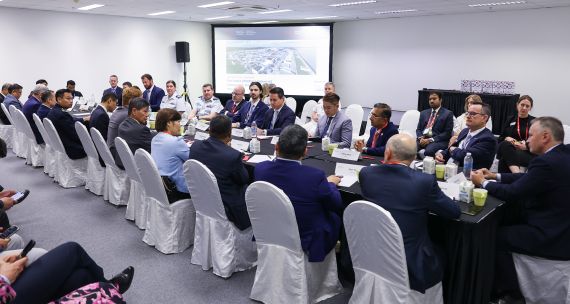
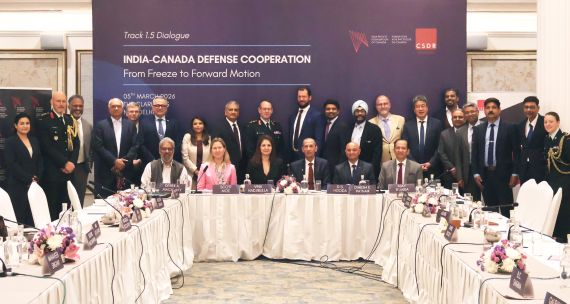
Note de synthèse préparée en appui à la participation de la FAP Canada au Dialogue semi-officiel Canada–Inde : évaluation des potentiels et priorités dans les relations de défense et de sécurité, tenu le 5 mars 2026 à New Delhi, Inde. Cet évenement est une initiative de recherche Inde-Canada de la FAP Canada en patenairat avec le Council for Strategic and Defense Research (CSDR) en Inde.
Les relations Canada-Inde se sont réorienté de la tension diplomatique à l’engagement pragmatique, et le canal sécuritatire a connu des avancées au sein de cette réinitialisation plus large. L’indicateur prinicpal a apparu début février 2026 quand Ajit Doval, cnseiller national en sécurité a visité Ottawa pendant deux jours pour des pourparlers de haut niveaux. Les deux parties ont alors convenu d’un plan de travail commun sur la sécurité nationale et l’application de la loi. Elles ont également décidé d’établir des officiers de liaison en matière de sécurité et d’application de la loi dans les capitales respectives, et se sont engagées à officialiser la coopération en cybersécurité et en échange de renseignements. Ces démarches ont permis de rouvrir les canaux institutionnels et de mettre en place des mécanismes fonctionnels favorisant une coopération sensible mais pragmatique.
Ce processus de réinitialisation avait été amorcé en 2025, à la suite d’une rencontre entre les deux premiers ministres en marge du sommet du G7 tenu au Canada. À la suite de cet entretien, Ottawa et New Delhi ont réinstauré leurs hauts commissaires en août et repris les dialogues officiels entre hauts fonctionnaires ainsi que les engagements ministériels, redonnant structure et élan à la relation bilatérale. En octobre 2025, les deux ministres des Affaires étrangères ont convenu d’une « nouvelle feuille de route » pour poursuivre la reconstruction des liens, en identifiant des secteurs propices à un engagement approfondi.
Le premier dialogue semi-officiel, organisé par la FAP Canada et le CSDR en novembre 2025, a illustré la portée et le rythme du changement. Les participants ont décrit les liens bilatéraux comme étant passés d’un état « désespéré à prometteur » depuis le début de 2024. Ce dialogue a permis de relancer la conversation sur la coopération en défense et en sécurité, un thème jusque-là secondaire face aux échanges axés sur le commerce, les minéraux critiques et les technologies climatiques. Les discussions ont abordé avec franchise les obstacles au renforcement des liens en matière de défense : divergences dans les contrôles à l’exportation, perceptions régionales des menaces dans l’Indo-Pacifique et lacunes persistantes en matière de confiance. Les participants ont également tracé un parcours pragmatique, visant les domaines d’alignement concret plutôt que des engagements rhétoriques ou ambitieux.
La présente note dresse une évaluation des opportunités à court terme en matière de coopération industrielle dans le domaine de la défense. Le moyen le plus sûr de progresser dans ce secteur passe par la mise en place de partenariats ciblés et précis dans des domaines tels que la formation et la simulation, le lancement et le maintien des systèmes, les technologies cybernétiques et numériques, les outils de renseignement, de surveillance et de reconnaissance (ISR) basés dans l’espace, ainsi que les composantes critiques liées à l’électronique et aux minéraux critiques — qu’il s’agisse de leur traitement ou de leur exploration. Ces secteurs représentent des axes de complémentarité importants entre le Canada et l’Inde.
• Préparée par Zoraver Cheema, chercheur, Asie du Sud, FAP Canada; révisé par Aditi Malhotra, gestionnaire de programme, Asie du Sud, et Vina Nadjibulla, vice-présidente, Recherche et stratégie, FAP Canada.