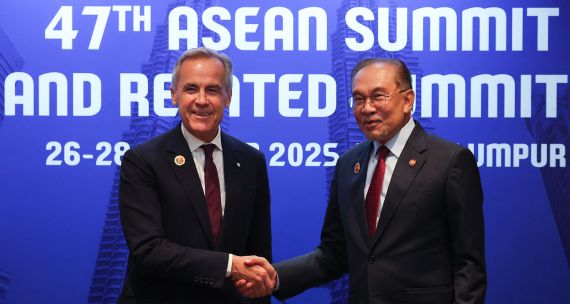
The Asia Pacific Foundation of Canada is pleased to launch the Council for Security Cooperation in the Asia Pacific (CSCAP) annual publication, Regional Security Outlook 2026. As the secretariat for CSCAP, the premier Track 2 organization in the Indo-Pacific region, APF Canada has served as the editor of the publication since January 2025.
The Indo-Pacific is changing rapidly, and with it, the opportunities and challenges facing countries across the region. Geopolitical rivalries are deepening, technology competition is accelerating, economic nationalism is on the rise, and supply chains are becoming increasingly politicized. The return of Donald Trump to the White House has created new uncertainties, and while the recent Trump-Xi summit has produced a degree of tactical stabilization, underlying U.S.-China rivalry continues to deepen across trade, technology, and military posture— reshaping a regional landscape already complicated by territorial disputes, uneven development, and climate risks. For many countries in the region, the central question is no longer simply which side to align with, but how to navigate a more competitive world while preserving their independence and agency. This shifting landscape presents real challenges, but also genuine opportunities to build new partnerships, diversify trade, and play a more active role in shaping the rules that will define the region’s future.
The U.S.–China relationship remains the central axis shaping the region’s security environment and will continue as such for years to come. While both Washington and Beijing continue to pursue selective engagement, their structural rivalry has deepened across trade, technology, military posture, and critical infrastructure (Council on Foreign Relations 2026). A full economic decoupling remains unlikely, as both countries remain significantly interconnected, but growing derisking measures and strategic competition are increasingly forcing regional countries to navigate competing political, technological, and economic ecosystems. What holds this uneasy relationship together is less mutual trust than a shared awareness of the economic devastation either side could inflict on the other (Kelly and Hirson 2026).
At the same time, emerging technologies are transforming the Indo-Pacific security landscape in ways that blur the boundaries between economic security, national security, and technological governance. AI, cyber capabilities, space infrastructure, digital platforms, and critical undersea infrastructure are creating new vulnerabilities alongside new opportunities for growth and innovation. From AI-enabled disinformation and cyber threats to concerns over submarine cables, critical minerals, and the resilience of digital infrastructure, security risks in the region are cross-domain, transnational, and deeply interconnected (Chilukuri et al. 2025).
Against this backdrop, regional actors are strengthening both traditional and non-traditional security co-operation. Japan and South Korea have deepened ties with the United States and with one another (Kanodia 2025), while India has expanded its role across the Indian Ocean and beyond (Shukla 2025). ASEAN remains central to the region’s diplomatic architecture, though growing geopolitical pressures and internal divisions continue to test its cohesion (Thit Htoo 2025).
Meanwhile, minilateral frameworks and issue-specific coalitions have proliferated, reflecting both the limitations of existing institutions and the growing influence of middle powers in shaping the regional order (Biba 2026).
These developments underscore the Indo-Pacific’s continued strategic importance in an increasingly contested and multipolar world. In this context, the 2026 edition of the Council for Security Cooperation in the Asia Pacific (CSCAP) Regional Security Outlook examines emerging security challenges reshaping the region, from intensifying technological competition and cyber-enabled threats to the increasingly apparent vulnerabilities of digital infrastructure, fraying climate governance, and evolving regional dynamics. Together, the contributions to this volume explore how countries in the Indo-Pacific can strengthen resilience, manage strategic competition, and build more effective mechanisms for regional co-operation in this period of accelerating change.
The first paper, by Umi Ariga, argues that the growing integration of AI, cyber, space, and emerging quantum technologies into military systems across Northeast Asia is compressing decision-making timelines, increasing uncertainty, and creating new cross-domain escalation risks that existing regional-governance mechanisms are ill-equipped to manage.
The second paper, by Mark Bryan Manantan, asserts that generative AI is rapidly transforming online scam operations in Southeast Asia by enabling more scalable, sophisticated, and deceptive forms of cyber fraud, while also offering governments and industry new AI-driven tools for detection and prevention. This is an emerging “AI paradox” in which the same technology both empower and combat transnational cybercrime.
Datuk Prof. Dr. Faiz Abdullah argues in the third paper that the Indo-Pacific’s economic and security orders are becoming increasingly inseparable. What was once a region built on economic interdependence is now one where trade, technology, and supply chains are increasingly weaponized as instruments of geopolitical competition. The central challenge for countries in the region is to address legitimate security concerns without allowing economic coercion to define the regional order.
In the fourth paper, Do Manh Hoang contends that submarine cables in the South China Sea have become strategically vital yet highly vulnerable infrastructure for Vietnam and other Southeast Asian states. Great power competition, legal gaps, maritime disputes, greyzone tactics, and limited domestic technical capacity increasingly threaten regional digital connectivity and security, thereby requiring stronger domestic resilience and greater international co-operation.
Akekelak Chaipumee analyzes the evolving crisis in Myanmar in the fifth paper, tracing its structural roots to unresolved questions of state formation and the military’s deeply embedded role in political life, before turning to its broader implications for regional security and ASEAN cohesion. Chaipumee then assesses how neighbouring states and regional mechanisms have responded to a crisis that has long spilled over Myanmar’s borders, fuelling displacement, transnational crime, and instability across the region.
The sixth and final paper, by Yuan Sha, argues that Asia’s fragmented climate governance and growing climate vulnerabilities create an urgent need for stronger regional co-operation. It proposes that China, through its green transition strategy, clean-tech capacity, climate financing, and multilateral engagement, has the potential to act as a major “green engine” driving Asia’s low-carbon transformation, despite significant geopolitical and governance constraints.
Note: The CSCAP Regional Security Outlook (CRSO) brings expert analysis to bear on critical security issues facing the region. The views in the CRSO 2025 do not represent those of any Member committee or the editors; they represent the perspectives and are the responsibility of the individual authors. This report was edited by APF Canada per its engagement with the Council for Security Cooperation in the Asia Pacific (CSCAP) and is therefore only available in English, the official working language of CSCAP.