Dans l'actualité
Réactions médiatiques de la FAP Canada aux derniers enjeux et événements en Asie
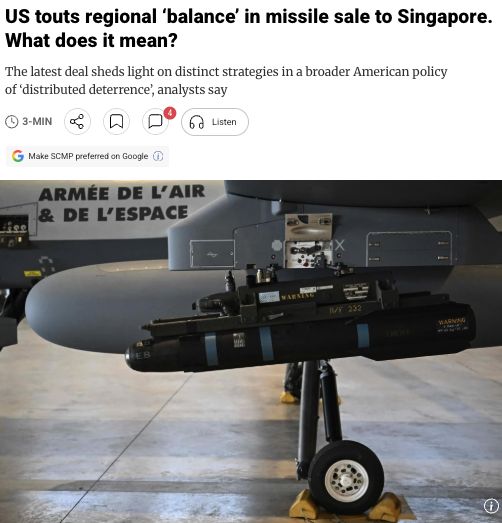
US touts regional ‘balance’ in missile sale to Singapore. What does it mean? (s’ouvre dans un nouvel onglet)
South China Morning Post, July 3, 2026
Featuring: Vice-President, Research & Strategy, Vina Nadjibulla, APF Canada
Excerpt: Washington wants capable partners that can operate alongside US forces and assume greater responsibility for regional security, according to Vina Nadjibulla, vice-president of research and strategy at the Asia Pacific Foundation of Canada.
The US arms sales to its allies were aimed at pushing them to share the security burden while expanding Washington’s influence and the American defence sector, said Nadjibulla, who described the strategy as “distributed modernisation without a single dramatic escalatory leap”.
“Singapore largely purchases advanced systems with its own resources; the Philippines combines its own modernisation spending with substantial US help; and other Southeast Asian partners receive different mixes of maritime surveillance, training, exercises and defence equipment.”

Canada-Philippine relations expected to grow with Carney meeting (s’ouvre dans un nouvel onglet)
CTV News, July 2, 2026
Featuring: Vice-President, Research & Strategy, Vina Nadjibulla, APF Canada
Excerpt: Nadjibulla says President Marcos Jr.'s visit to Canada marks a "major milestone in Canada-Philippines relations." It shows that the relationship is "growing and expanding around economic, defence, security, and people-to-people ties... it also strengthens Canada's engagement with Southeast Asia more generally," as the Philippines will host the ASEAN Summit as its 2026 Chair later this year.
She notes the visit is also part of the prime minister's "middle-power diplomacy diversification effort... It's good to see that Canadian outreach is being reciprocated."
As a stand-alone visit without additional stops in the U.S., Nadjibulla says this visit "really shows the Philippines cares about Canada and sees it as a reliable partner with which it wants to deepen relations."
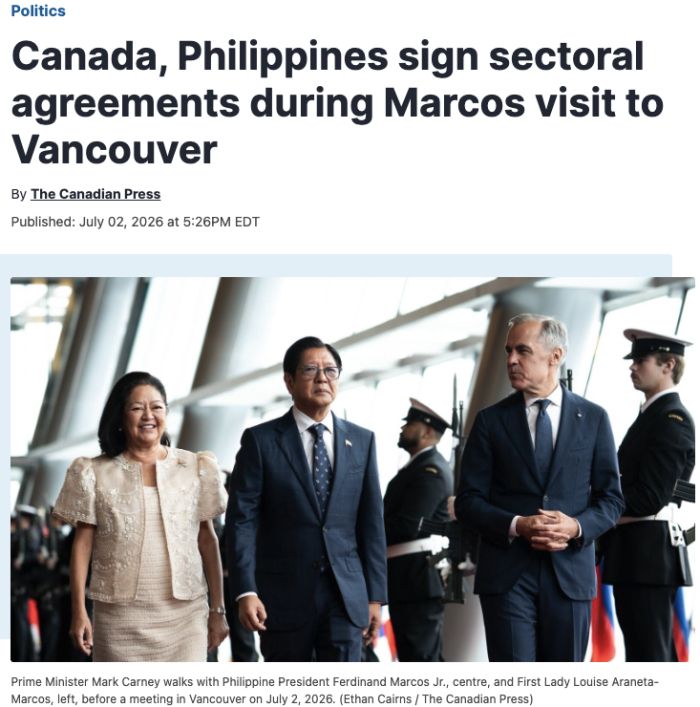
Canada, Philippines sign sectoral agreements during Marcos visit to Vancouver (s’ouvre dans un nouvel onglet)
Canadian Press (via BNN Bloomberg), July 2, 2026
Featuring: Vice-President, Research & Strategy, Vina Nadjibulla, APF Canada
Excerpt: Asia Pacific Foundation vice-president Vina Nadjibulla wrote in an analysis that the Marcos visit demonstrates Canada’s four-year-old Indo-Pacific strategy is starting to yield results.
She says Carney has visited leaders abroad, but having them come to Canada shows a real interest, particularly as the Philippines works with Ottawa on trade, maritime surveillance and energy.
Canada is currently negotiating a trade deal with both the Philippines and a broader bloc of southeast Asian nations, and Carney hopes to conclude those talks ahead of his visit to Manila in November.
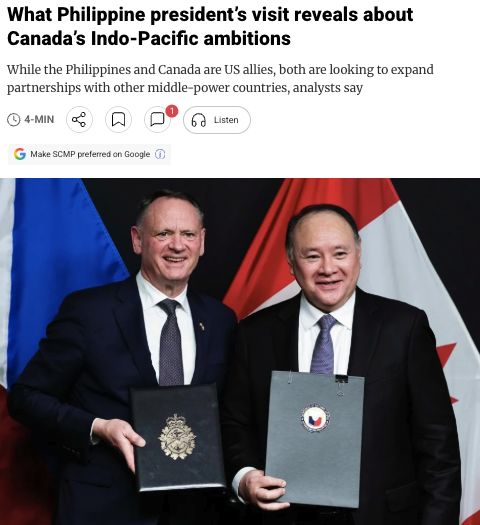
What Philippine president’s visit reveals about Canada’s Indo-Pacific ambitions (s’ouvre dans un nouvel onglet)
South China Morning post (SCMP), July 2, 2026
Featuring: Vice-President, Research & Strategy, Vina Nadjibulla, APF Canada; Rachael Gurney, Senior Project Specialist, Trade & Investment, APF Canada
Excerpt: “The Philippines is an important place to begin because it is where Canada’s Indo-Pacific Strategy has arguably had its greatest impact,” Vina Nadjibulla, vice-president for research and strategy of the Asia Pacific Foundation Canada, wrote in an article posted on the foundation’s website on Monday.
Rachael Gurney, a senior project specialist in international trade and investment at the Asia Pacific Foundation of Canada, said the Filipino diaspora’s “deep integration” gave any foreign policy goals between Canada and the Philippines “a strong foundation to build on”.
“President Marcos is visiting Vancouver, which has the third largest Filipino community in Canada,” she said. “Filipinos are the third largest immigrant group in the Metro Vancouver area, making his visit very significant for promoting Canada-Philippines ties.”
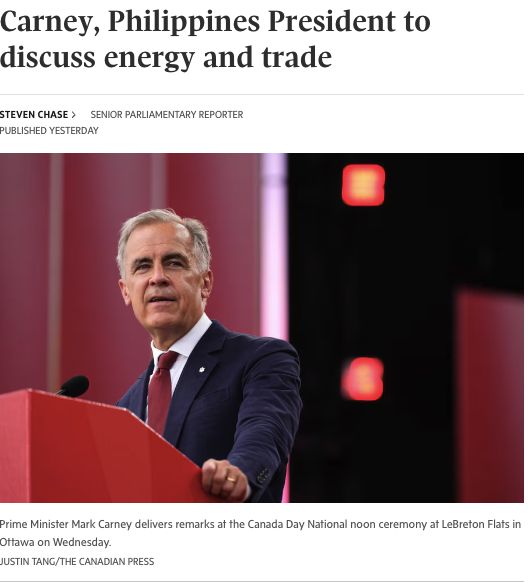
Carney, Philippines President to discuss energy and trade (s’ouvre dans un nouvel onglet)
The Globe and Mail, July 1, 2026
Featuring: Vice-President, Research & Strategy, Vina Nadjibulla, APF Canada
Excerpt: Vina Nadjibulla, vice-president of strategy and research at the Asia Pacific Foundation, noted that the Philippines was the first country to declare a state of national energy emergency in response to the war in Iran, after the conflict disrupted supply chains, drove up fuel prices and exposed the country’s acute dependence on imported petroleum.
Canada and the Philippines have grown closer in recent years, particularly on the security and defence front. In November, they signed a legal framework allowing Canadian and Philippine troops to train and operate on each other’s territory, among other agreements.
“I think there’s also conversation around uranium and a nuclear sector, because Philippines is interested in exploring that,” Ms. Nadjibulla said.
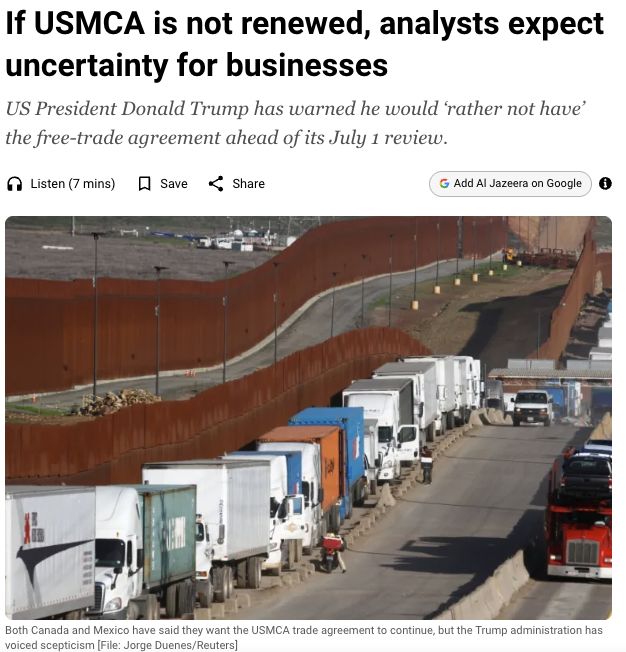
If USMCA is not renewed, analysts expect uncertainty for businesses (s’ouvre dans un nouvel onglet)
Al Jazeera, June 28, 2026
Featuring: Vice-President Research & Strategy Vina Nadjibulla, APF Canada
Excerpt: “The most likely scenario is that [the USMCA agreement] will go into an annual renewal process,” said Vina Nadjibulla, vice president and head of research at the Asia Pacific Foundation of Canada, a nonprofit think tank.
But she added that the dynamics of July’s negotiations remain unclear. She pointed to a lingering question: “Is nothing agreed till everything is agreed, or is incremental change acceptable?”
In the worst case, any party could give six months’ notice and cancel the trade agreement altogether.
Nadjibulla noted that Trump might be leaning in that direction. “He has said he wished [the USMCA] didn’t exist,” she said.
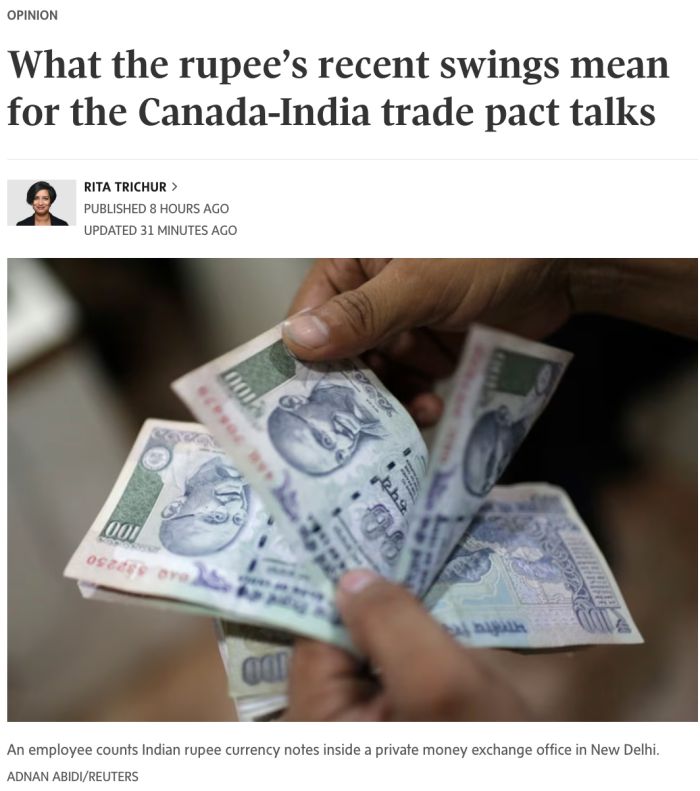
What the rupee’s recent swings mean for the Canada-India trade pact talks (s’ouvre dans un nouvel onglet)
The Globe and Mail, June 26, 2026
Featuring: Tanya Dawar, Research Scholar, South Asia, APF Canada
Excerpt: “If anything, both sides have more reasons to close the deal,” said Tanya Dawar, a research scholar with the Asia Pacific Foundation of Canada, in a recent interview.
“This highlights distinct movements between more reactive, short-term portfolio flows and more stable, long-term investment commitments,” she said.
As for Canadian exporters, a softer rupee will make goods such as Saskatchewan pulses and potash more expensive. That currency pressure comes on top of existing Indian tariffs.
Said Ms. Dawar: “Saskatchewan farmers are getting squeezed twice.”
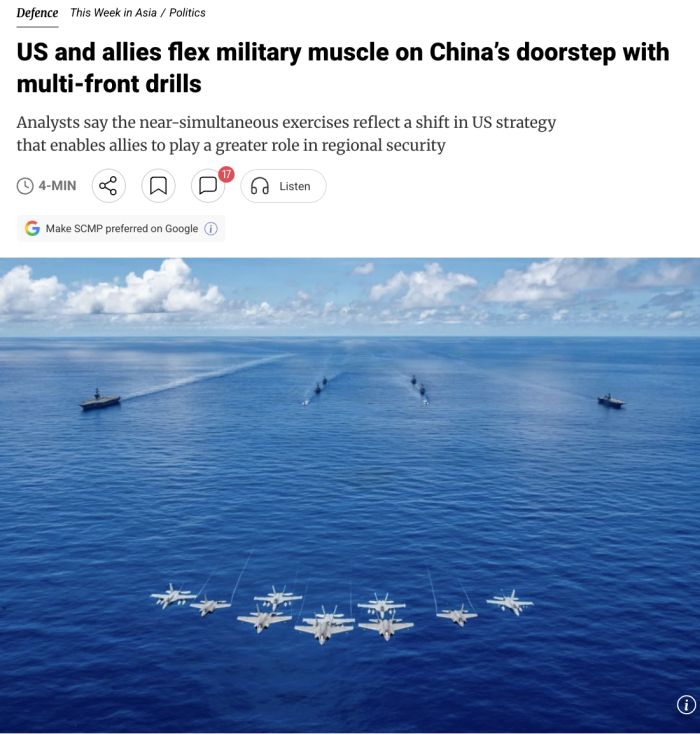
US and allies flex military muscle on China’s doorstep with multi-front drills (s’ouvre dans un nouvel onglet)
South China Morning Post (SCMP), June 26, 2026
Featuring: Vice-President Research & Strategy Vina Nadjibulla, APF Canada
Excerpt: Experts say Washington still regards its own bases and forces as essential but is increasingly looking to allies to contribute more in terms of capabilities, access, personnel and political resolve.
“The emerging model is therefore a more distributed coalition in which Japan, the Philippines, Australia and other partners bring complementary capabilities and provide access across a wider geographical area,” said Vina Nadjibulla, vice-president of research and strategy at the Asia Pacific Foundation of Canada.
For Nadjibulla, the collective message is clear: deterrence will depend less on a single large US presence and more on a dispersed, resilient and interoperable coalition designed to complicate an adversary’s planning across the region.
“They demonstrate that the US is trying to replace a primarily hub-and-spokes alliance system with a more networked security architecture,” she said.
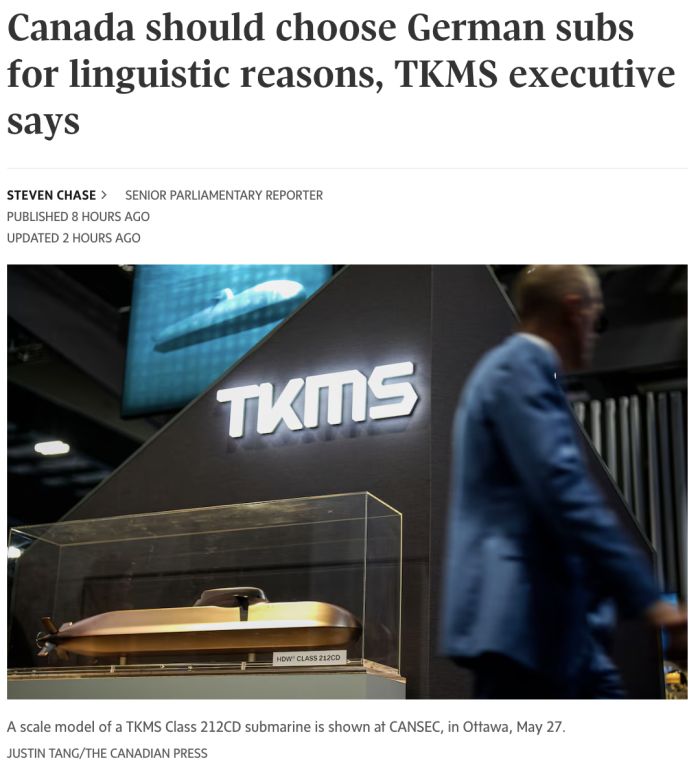
Canada should choose German subs for linguistic reasons, TKMS executive says (s’ouvre dans un nouvel onglet)
The Globe and Mail, June 25, 2026
Featuring: Vice-President Research & Strategy Vina Nadjibulla, APF Canada
Excerpt: Vina Nadjibulla, Vice-President, Research and Strategy at the Asia Pacific Foundation, said Canada, says Canada and South Korea have a deep and mature partnership spanning trade and investment, defence and security, as well as political relations, and share extensive cultural and people-to-people ties.
“Framing the submarine decision as a choice between different ‘cultural ecosystems’ is unnecessary and risks creating an artificial cultural wedge between close partners,” Nadjibulla added. “Korean firms operate globally and have demonstrated that they can work effectively across languages, regulatory systems and business environments.
“At a time when Canada is seeking to deepen its defence and industrial relationships with trusted partners in Asia, proposals should be judged on capability, industrial benefits and long-term value, not on assumptions about cultural compatibility.”

Radio West with Sarah Penton: Team Canada's Trade Mission to Japan (s’ouvre dans un nouvel onglet)
CBC Radio News (multi-station syndication engagement), June 24, 2026
Featuring: President & CEO Jeff Nankivell, APF Canada
Excerpt: [Starting at 1:07:40] Nankivell tells CBC's Sarah Penton that the ongoing Team Canada Trade Mission to Japan comes at the right time.
"It is imperative that [Canada] diversifies its trade and investment relationships around the world and Japan is going to be a really important part of that. We already have a strong and growing economic relationship with Japan... it shares Canada's values and it shares our geopolitical priorities... so it's a natural partner for Canada."
To take advantage of Canada's expanding trade partnership with Japan, including, he notes, through mechanisms like the Trans-Pacific Partnership, "businesses need to get out there and find partners in Japan, familiarize themselves with the... culturally specific and stringent requirements of the Japanese markets, and make themselves known to potential customers and distributors and investors in Japan. That's what this kind of mission can help to do."
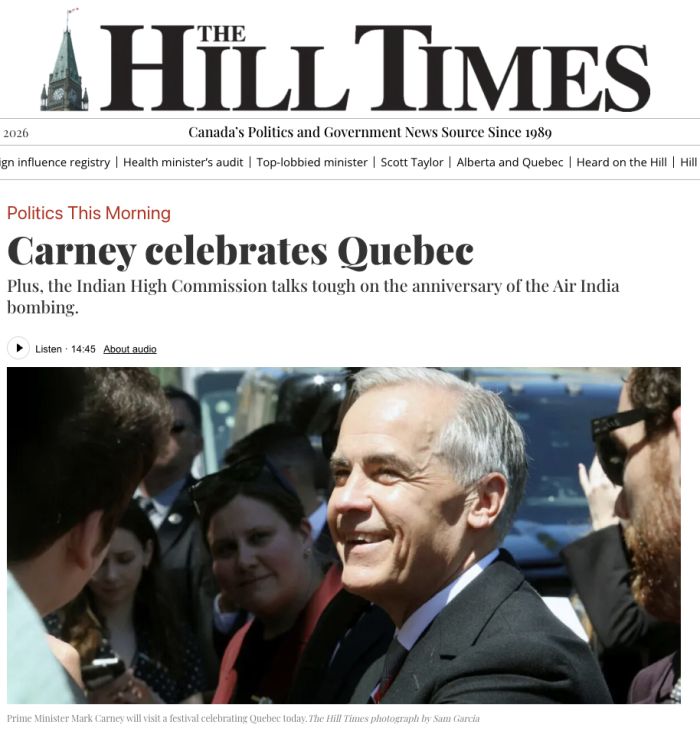
Politics This Morning: Carney celebrates Quebec (s’ouvre dans un nouvel onglet)
The Hill Times - Politics This Morning, June 23, 2026
Featuring: Vice-President Research & Strategy Vina Nadjibulla, APF Canada
Excerpt: Nadjibulla told Politics This Morning that ultimately it will be up to the Chinese Communist Party to decide if a joint venture between Chinese and Canadian firms to build cars in Canada would be possible. What would make such a deal attractive to China, if there is one at all, is the potential for access to the North American market and not just the Canadian market, she said. But so far, the signals from U.S. decision-makers suggest they are not open to allowing access to Chinese cars, Nadjibulla added.
“It will depend on whether China wants to play the long game and enter the Canadian market, and then position itself for an eventual change in the U.S., maybe in five years, maybe in three years … because it’s not commercially viable just to produce for the Canadian market. It’s too small.”
Canada-China EVs Deal (s’ouvre dans un nouvel onglet)
OMNI, June 22, 2026
Featuring: Vice-President Research & Strategy Vina Nadjibulla, APF Canada
Excerpt: Vina Nadjibulla discusses the possibility of a joint manufacturing venture for Chinese EVs in Canada, noting that "in China, it's not like private companies... can act completely independent of the government."
"So this idea that private... Canadian companies and Chinese companies will talk... will come up with some kind of deal," and that the "governments would just need to stay out of the way," she says, "I don't think that would work in the case of China"
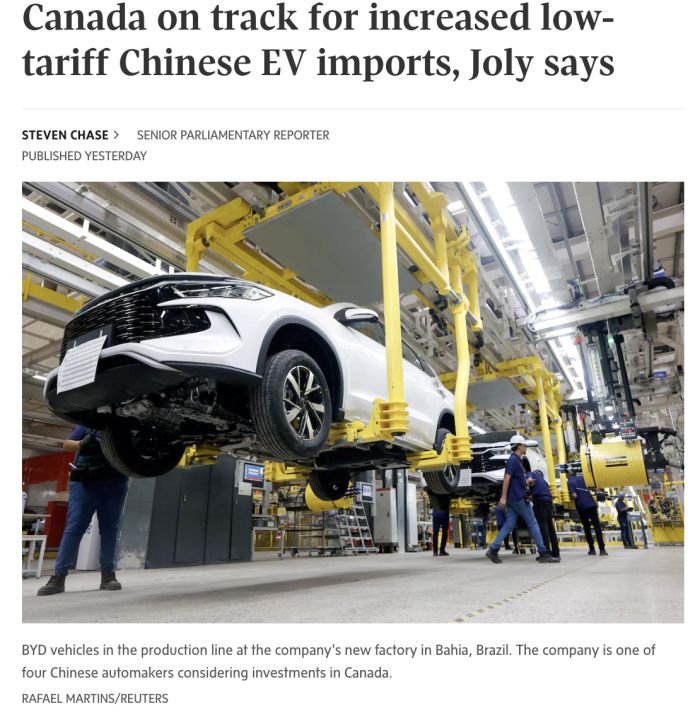
Canada on track for increased low-tariff Chinese EV imports, Joly says (s’ouvre dans un nouvel onglet)
The Globe and Mail, June 22, 2026
Featuring: Vice-President Research & Strategy Vina Nadjibulla, APF Canada
Excerpt: Vina Nadjibulla, vice-president of research and strategy at the Asia Pacific Foundation of Canada, said Canadians should not assume Chinese vehicle makers are making their own decisions, independent of Beijing’s Communist Party-controlled government, on how to enter this country’s market.
“We shouldn’t be naive,” she said. “In the case of China, the government plays a critical role, and we cannot assume that these are market-driven private sector conversations.”
“So far the U.S. has made it very clear that they don’t want to see Chinese EVs in the U.S., and they’re going to actually tighten rules of origin for the auto sector.”
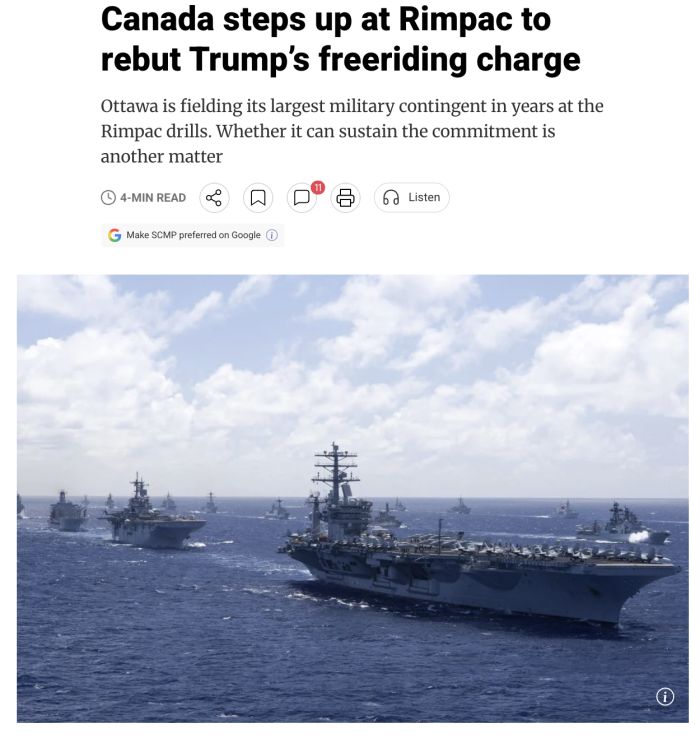
Canada steps up at Rimpac to rebut Trump’s freeriding charge (s’ouvre dans un nouvel onglet)
South China Morning Post, June 22, 2026
Featuring: Vice-President Research & Strategy Vina Nadjibulla, APF Canada
Excerpt: Vina Nadjibulla, vice-president of research and strategy at the Asia Pacific Foundation of Canada, said the Rimpac deployment “supports Canada’s interest in preserving open sea lanes and a stable, rules-based maritime order in the Indo-Pacific”, while showing it could “contribute specialized capabilities and exercise leadership within a large and complex multinational operation”.
Nadjibulla noted that Rimpac also offered an opportunity to deepen interoperability with partners such as Japan, South Korea, Australia and the Philippines – the very allies Canada would need to work alongside in any regional contingency.
But she cautioned that sustaining the operational tempo and connecting deployments to deeper defence partnerships and industrial cooperation would matter far more than any single show of force.
“Regional partners will ultimately judge Canada by the consistency of its presence over many years, not by any single exercise.”
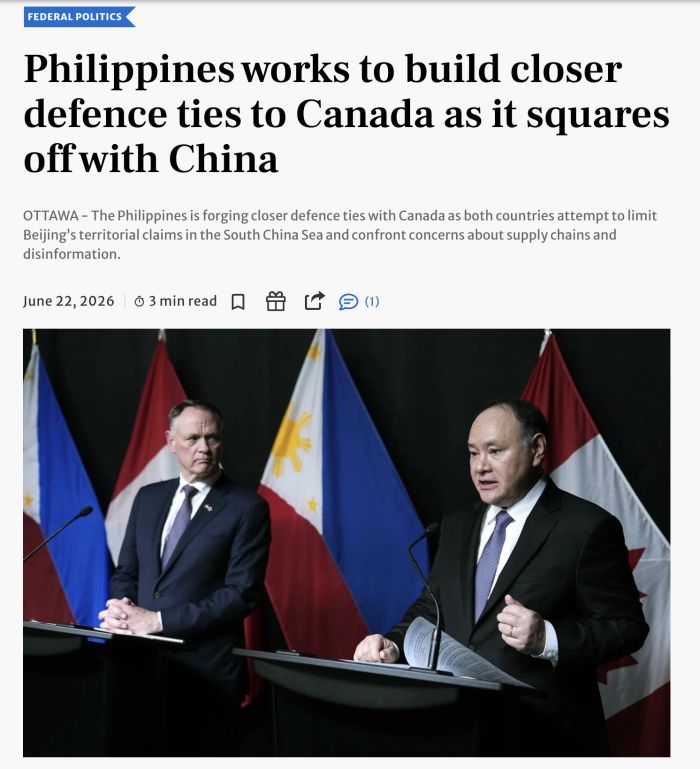
Philippines works to build closer defence ties to Canada as it squares off with China (s’ouvre dans un nouvel onglet)
The Canadian Press (via The Toronto Star), June 22, 2026
Featuring: Vice-President Research & Strategy Vina Nadjibulla, APF Canada
Excerpt: Asia Pacific Foundation of Canada Vice-President Vina Nadjibulla said the Philippines is where Canada has made the most progress on strengthening defence ties under the Indo-Pacific strategy the Liberals released in late 2022.
“Canada also has a lot of strength in cybersecurity, and as part of the Indo-Pacific strategy, there has been a concerted effort to build the capacity of the Philippines when it comes to cyber defence,” she said.
“The Philippines is positioning itself as the front line state when it comes to maritime security and the defence of maritime rules-based order in the Indo-Pacific.”
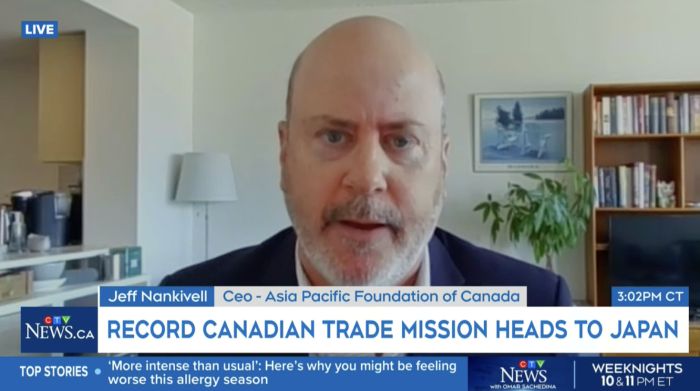
How important is it for Canada to develop additional trade deals with Asia? (s’ouvre dans un nouvel onglet)
CTV News, June 21, 2026
Featuring: Jeff Nankivell, President & CEO, APF Canada
Excerpt: Nankivell says the latest Team Canada trade mission to Japan shows that Ottawa's "priority is to really push in the areas where we see the greatest growth potential, and this Canada-Japan relationship has developed nicely."
He adds that it is critical for Canada to strengthen economic ties with Asia. "When we talk about trade, we should not only talk about trade in terms of goods, but also trade in services. Canada has growth potential in markets like Japan, in areas like financial services, clean technologies, and other forms of digital services. At the same time, Japan is the third largest foreign investor in Canada, and it's really critical that [Ottawa] attracts more foreign investment from partners that are outside of the U.S., which also tends to bring with it larger trade flows and other benefits."
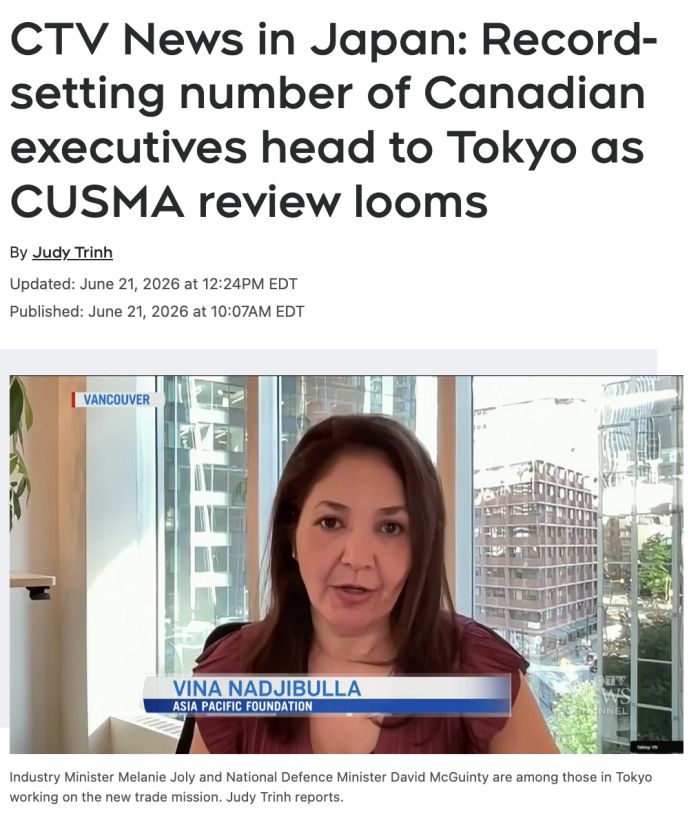
Record-setting number of Canadian executives head to Tokyo as CUSMA review looms (s’ouvre dans un nouvel onglet)
CTV News, June 21, 2026
Featuring: Vice-President Research & Strategy Vina Nadjibulla, APF Canada
Excerpt: Japan is a trusted partner. It is a G-7 member. It is a fellow democracy with whom we have an important strategic relationship. We cannot jeopardize that relationship because we’re trying to pursue diversification with China,” warns Vina Nadjibulla, vice-president of the Asia Pacific Foundation of Canada.
“So basically, this fall there need to be discussions about extending the canola and other tariff relief that Canada got. And the question is, will China ask for more concessions?” Nadjibulla said, adding that she expects Industry Minister Melanie Joly to face tough questions in Japan about whether those quotas will be increased, and under what terms she will allow Chinese car companies to build vehicles in Canada.
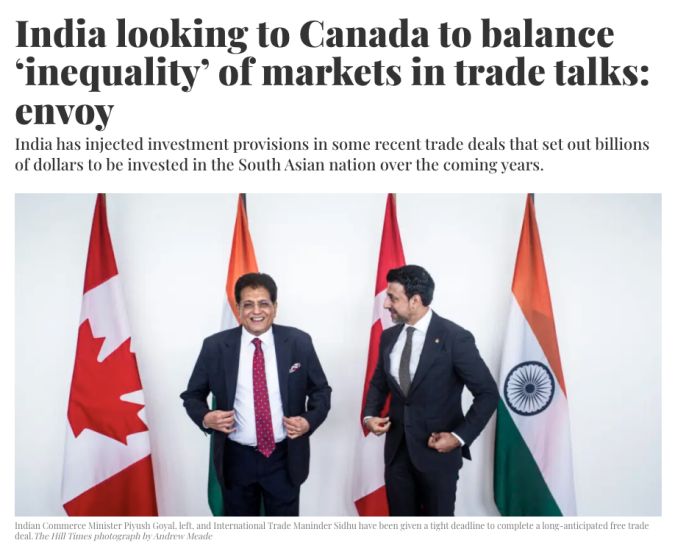
India looking to Canada to balance ‘inequality’ of markets in trade talks: envoy (s’ouvre dans un nouvel onglet)
The Hill Times, June 10, 2026
Featuring: Vice-President Research & Strategy Vina Nadjibulla, APF Canada
Excerpt: The Asia Pacific Foundation of Canada’s Vina Nadjibulla noted that India is a “tough negotiator,” and that their officials are trying to “push and get the best deal they can for their country.”
She said the investment and mobility provisions that were in previous deals India has struck are aspects at which Canada would need to look. “But we have to make sure that we’re also very much protecting Canadian interests,” Nadjibulla said, noting the size of the Canadian economy is larger than those of New Zealand or the EFTA.
“When it comes to investment, we have a strong footing already given that Canadian institutions have invested close to $100-billion in India,” Nadjibulla said. “While it can be part of the agreement, it’s also something that is in line with what Canada is already trying to do.”
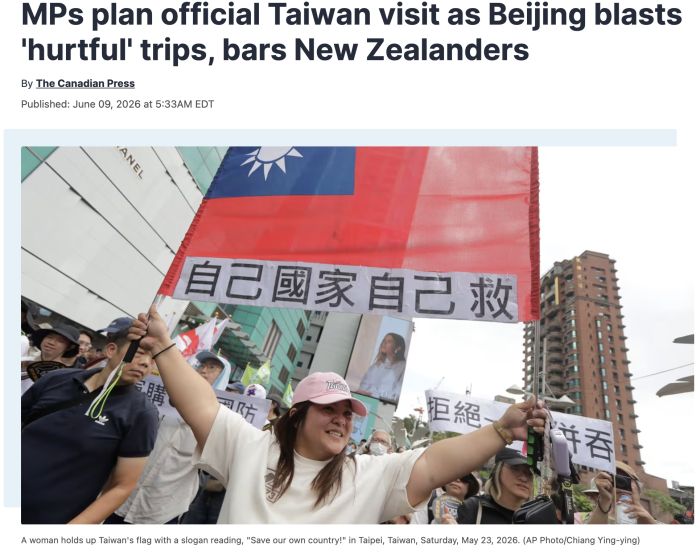
MPs plan official Taiwan visit as Beijing blasts 'hurtful' trips, bars New Zealanders (s’ouvre dans un nouvel onglet)
The Canadian Press (via BNN Bloomberg), June 9, 2026
Featuring: Vice-President Research & Strategy Vina Nadjibulla, APF Canada
Excerpt: Nadjibulla said it’s crucial for the exchanges with Taiwan to continue — particularly those involving multiple political parties — after the unclear message sent when the two MPs had ended their visit early.
“It’s important from a perspective of democratic solidarity. At a time when democracies are under assault, both internally and from external challenges, we do need to work closely together,” she said.
Taiwan and Canada can learn from each other as they grapple with disinformation, foreign interference and transnational repression, Nadjibulla said. Canada’s Indo-Pacific strategy also called for deepening economic and scientific collaboration with Taiwan, she noted.
“The other element is to do with making a point that Canadian foreign policy and Canadian policies on Taiwan and on China are being driven by Canadians here in Canada — rather than being dictated to by demands from either Beijing or any other superpower,” she said, noting China’s ban on the four New Zealand MPs.
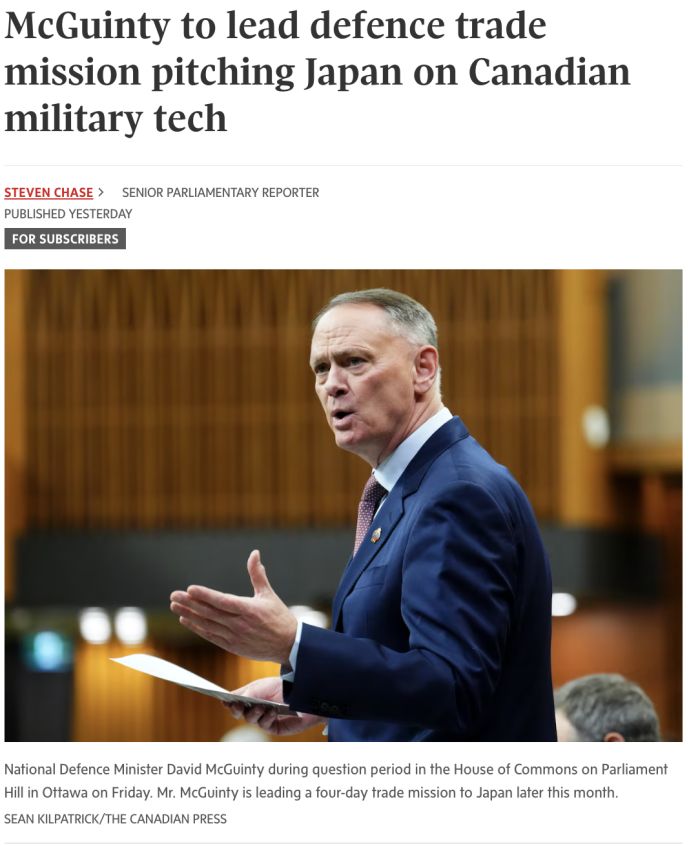
McGuinty to lead defence trade mission pitching Japan on Canadian military tech (s’ouvre dans un nouvel onglet)
The Globe and Mail, June 8, 2026
Featuring: Vice-President Research & Strategy Vina Nadjibulla, APF Canada
Excerpt: Vina Nadjibulla, vice-president of research and strategy at the Asia Pacific Foundation of Canada, said the timing of this trip is good because both countries are making “generational investments in our defence sector” as they seek to maintain peace and stability in both the Indo-Pacific and the Arctic.
Mr. Carney, saying that Canada could no longer rely on the United States for protection, used his first budget last November to deliver a defence-spending increase of more than $84-billion over five years – which is believed to be the biggest short-term cash infusion for the military since the Korean War.
Ms. Nadjibulla said increased focus by Canadian cabinet ministers on Japan is important as Ottawa seeks to build middle-power coalitions around the world.