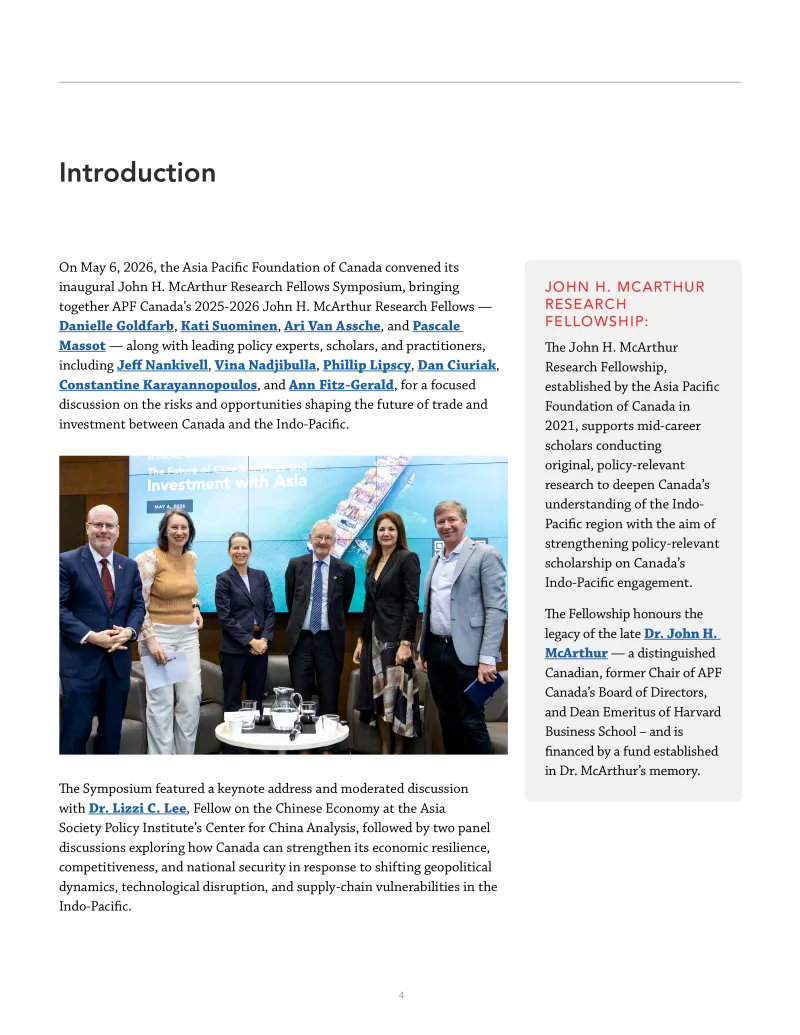
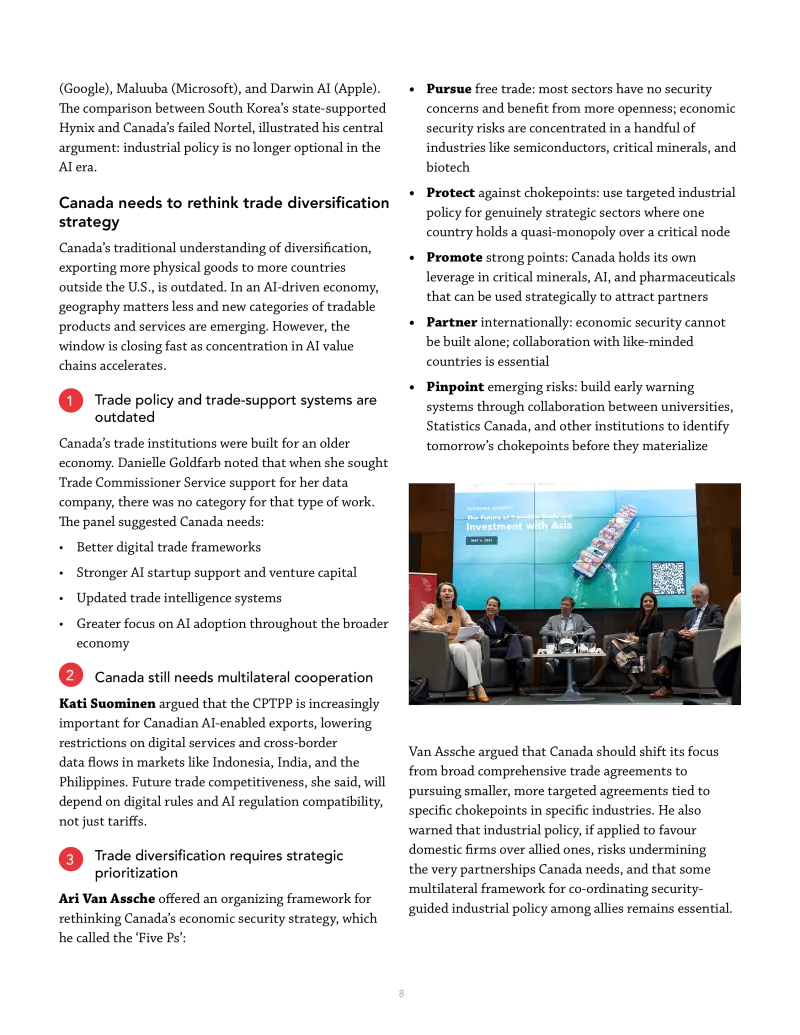
On May 6, 2026, the Asia Pacific Foundation of Canada convened its inaugural John H. McArthur Research Fellows Symposium, bringing together APF Canada’s 2025-2026 John H. McArthur Research Fellows — Danielle Goldfarb, Kati Suominen, Ari Van Assche, and Pascale Massot — along with leading policy experts, scholars, and practitioners, including Jeff Nankivell, Vina Nadjibulla, Phillip Lipscy, Dan Ciuriak, Constantine Karayannopoulos, and Ann Fitz-Gerald, for a focused discussion on the risks and opportunities shaping the future of trade and investment between Canada and the Indo-Pacific.
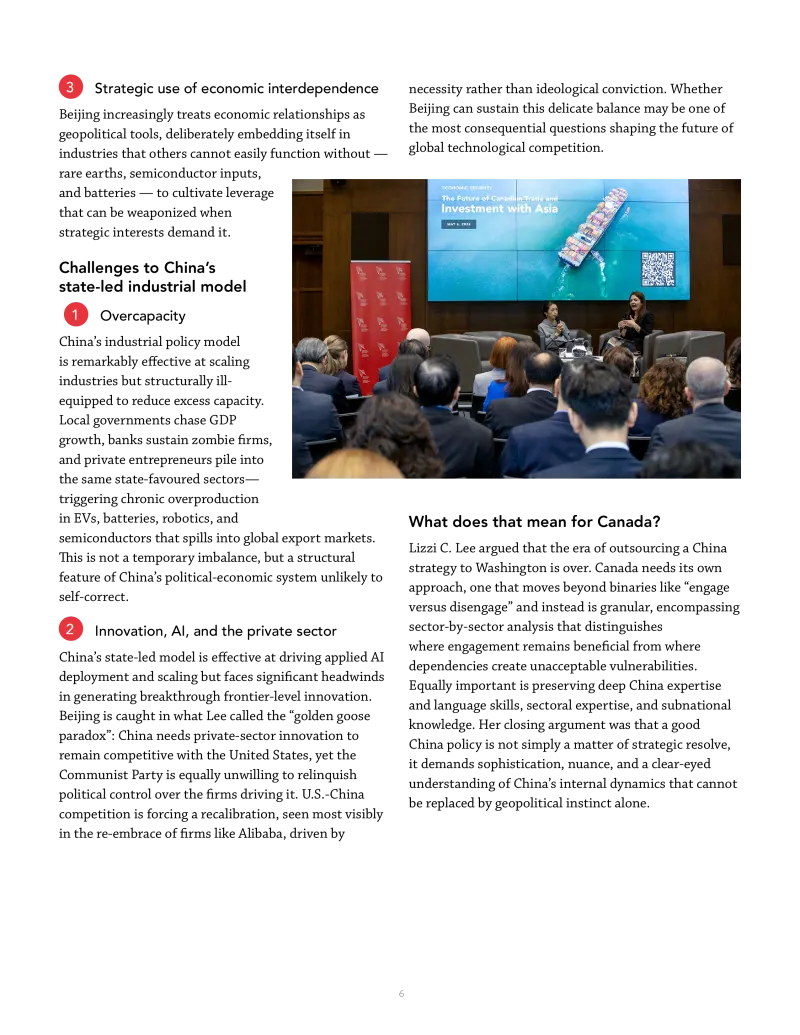
The Symposium featured a keynote address and moderated discussion with Dr. Lizzi C. Lee, Fellow on the Chinese Economy at the Asia Society Policy Institute’s Center for China Analysis, followed by two panel discussions exploring how Canada can strengthen its economic resilience, competitiveness, and national security in response to shifting geopolitical dynamics, technological disruption, and supply-chain vulnerabilities in the Indo-Pacific.
Key Takeaways
- The world has entered a fundamentally different era
The assumptions that underpinned Canada's prosperity for decades – open globalization, efficiency-driven trade, and market-led supply chains – no longer fully apply. The global economy is moving toward a more fragmented, strategically managed system in which geopolitics, industrial policy, and economic security are deeply intertwined. This is not a temporary disruption but a structural shift that demands a fundamental rethinking of Canada’s foreign and domestic policies.
- China is reshaping globalization around itself, not retreating from it
China is remaking itself into an integrated technological and industrial system designed to reduce its own dependencies while increasing others' dependence on it, embedding itself across batteries, critical minerals, semiconductors, and pharmaceuticals supply chains in ways that make de-risking or decoupling far harder than most Western governments assumed. Yet China also has real vulnerabilities, depending heavily on imported raw materials and on global export markets, that are also often overlooked by Western policymakers.
- AI is restructuring trade as profoundly as it is restructuring everything else
Trade is no longer primarily about physical goods. The fastest-growing segment of global trade is digital and AI-enabled services, and this shift is accelerating. Smaller Canadian firms can now become "micro-multinationals," exporting data, algorithms, and AI services globally at near-zero marginal cost, creating real opportunities to diversify beyond the U.S. market in ways that geography previously made impossible.
- Canada has consistently underperformed during technological transitions
Canada lost ground during the data economy by failing to retain and scale its most innovative firms, hollowing out Canada's high-growth firm base and deepening its productivity crisis. The age of machine knowledge capital presents both a renewed threat and a genuine opportunity, but only if Canada develops the industrial strategy, state capacity, and firm retention mechanisms it has previously lacked.
- Industrial policy is no longer optional, but must be undertaken strategically
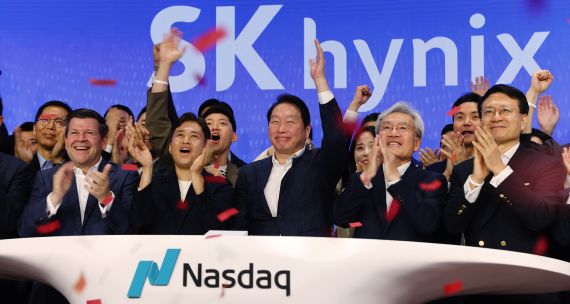
All major powers are now intervening strategically in AI, semiconductors, critical minerals, batteries, and advanced manufacturing. Canada can no longer stand apart. However, industrial policy done poorly risks undermining economic competitiveness and allied co-operation. The lesson from South Korea's Hynix versus Canada's Nortel, and from Japan's patient investment in Lynas, is that effective industrial policy requires long time horizons, disciplined focus, public-private co-ordination, and allied collaboration, not reactive subsidy competition.
- Economic security requires strategic prioritization, not blanket protection
Canada cannot protect or subsidize everything simultaneously. Economic security risks are concentrated in a handful of genuinely strategic sectors, including semiconductors, critical minerals, defence, advanced batteries, and AI infrastructure, but these sectors still benefit from more trade and investment, not less. Canada needs to identify its real vulnerabilities, its own points of leverage, and the right partners, then focus its resources accordingly.
Recommendations
- Develop a genuinely independent and sophisticated China strategy
Canada needs its own made-in-Canada approach to China built on granular, sector-by-sector analysis, distinguishing where engagement with China remains beneficial from where dependencies create unacceptable risks. This means resisting both reflexive securitization and naive engagement, investing seriously in China expertise, and moving beyond binary frameworks like "engage vs. disengage."
- Build an integrated economic security architecture
Canada currently has an AI strategy but no data strategy, a defence industrial strategy but no overarching national security strategy, and no National Security Council or equivalent co-ordinating structure. It needs a coherent, interlocking system, or a “sovereign digital spine,” integrating AI, data, and digital infrastructure strategies while supporting the growth and retention of domestic technology firms.
- Move beyond resource extraction toward high-value industrial participation
Canada's critical mineral wealth is a genuine strategic asset, but only if Canada captures more of the value chain beyond raw material exports. This requires sustained investment in domestic refining, processing, and battery manufacturing capacity and a more nuanced approach to foreign investment that regulates rather than selectively bans Chinese participation.
- Modernize trade policy and support systems for the AI era
Canada's trade institutions and trade agreements were built for a different economic era. Canada needs better digital trade frameworks, stronger AI startup support, updated trade intelligence systems, and a much more active CPTPP agenda on data flows and digital services, while pursuing smaller, more targeted trade agreements focused on specific strategic chokepoints.
- Invest in patient, allied industrial co-operation, and learn from Japan
No country can build economic security alone. Canada needs to commit to sustained, patient capital alongside allied partners, following models like Japan's 20-year investment in Lynas that combines public financing, arm's-length professional management, and deep R&D collaboration, particularly in critical minerals and AI, to build partnerships.
- Play an active role in defusing U.S.-China escalation dynamics
The mutual weaponization of economic relationships between the U.S. and China is creating a self-reinforcing security dilemma that middle powers cannot afford to watch from the sidelines. Canada has both an interest and an opportunity to build coalitions and shared frameworks that reduce escalatory dynamics, positioning itself as a rule-maker and convener among like-minded middle powers on critical minerals governance and AI regulation to digital trade rules.